
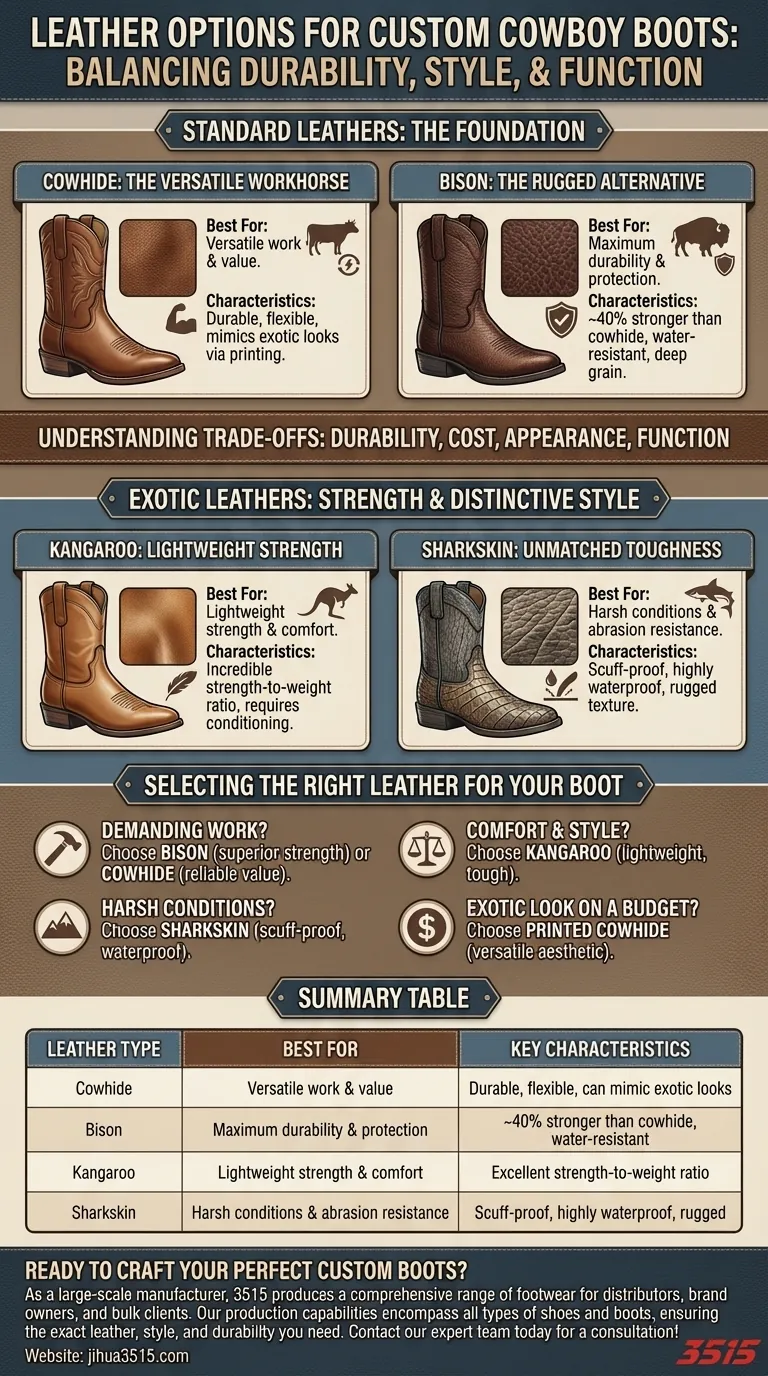
The most common leather options for custom cowboy boots range from traditional hides like cowhide and bison to more exotic choices like kangaroo and sharkskin. Each material offers a distinct combination of durability, flexibility, appearance, and maintenance requirements, allowing you to tailor the boot to its intended purpose.
The ideal leather for your custom boots is not about finding the "best" material, but about understanding the trade-offs between durability, style, and cost to match your specific needs, whether for demanding work or distinctive daily wear.
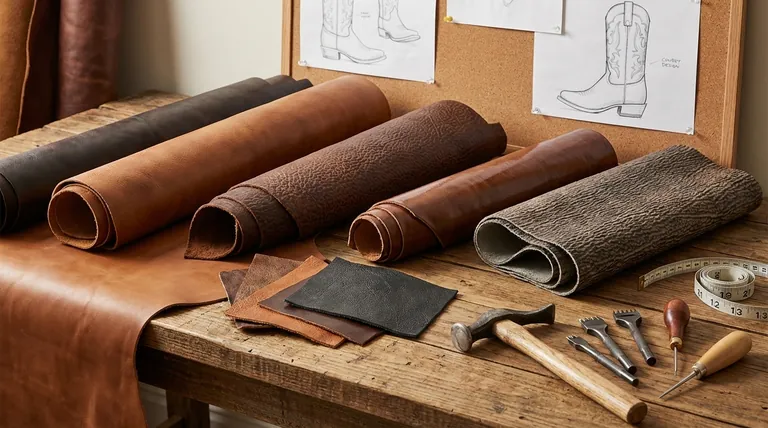
Standard Leathers: The Foundation of Durability
The most common leathers are chosen for their proven track record of strength and versatility. They form the backbone of both working and dress boots.
Cowhide: The Versatile Workhorse
Cowhide is the industry standard for a reason. It is exceptionally durable, offering strong resistance to tears and punctures, making it perfect for sturdy work boots.
This leather is also highly flexible and generally less expensive than exotic options. Furthermore, its surface can be printed and textured to convincingly mimic more expensive leathers like crocodile or lizard.
Bison: The Rugged Alternative
For a step up in raw strength, bison is an excellent choice. It is considered one of the most durable leathers available, approximately 40% stronger than traditional cowhide.
Its rigid, interlocking fiber structure provides superior protection. Bison leather is also characterized by a unique, deep grain pattern and a natural oil coating that adds a degree of water resistance.
Exotic Leathers: Strength and Distinctive Style
Exotic leathers provide unique performance characteristics and visual appeal that set them apart from standard hides.
Kangaroo: Lightweight Strength
Imported from Australia, kangaroo leather is renowned for its incredible strength-to-weight ratio. Its tightly intertwined fiber structure makes it remarkably tough despite being lightweight.
This combination of durability and low weight makes it a popular material for high-performance athletic footwear, a quality that translates well to a comfortable, long-lasting boot. It does, however, require occasional conditioning to maintain its integrity.
Sharkskin: Unmatched Toughness
Sharkskin is one of the toughest and most abrasion-resistant materials you can put on a boot. It is naturally scuff-proof and highly waterproof, making it suitable for harsh conditions.
The texture is characteristically rough, and it is less breathable than other leathers. While different shark species offer varied patterns, the material is prized for its raw, rugged appearance.
Understanding the Trade-offs
Choosing a leather involves balancing competing factors. What you gain in one area, you might sacrifice in another.
Durability vs. Maintenance
While materials like bison and sharkskin offer extreme durability, they can be stiffer initially. Leathers like kangaroo offer a unique blend of strength and light weight but require more consistent care to prevent drying.
Cost vs. Appearance
Exotic leathers like sharkskin provide a truly unique look but come at a premium price. If your primary goal is a specific aesthetic, a printed cowhide can offer a similar visual effect at a much lower cost, though without the specific performance characteristics of the genuine exotic hide.
Function vs. Comfort
A highly waterproof leather like sharkskin is excellent for wet environments but offers very little breathability, which can be a drawback in hot, dry climates. Materials like cowhide and kangaroo provide a better balance for all-around wear.
Selecting the Right Leather for Your Boot
Your final choice should be guided by how you plan to use your boots.
- If your primary focus is demanding work and maximum durability: Choose bison for its superior strength or traditional cowhide for its proven reliability and value.
- If your primary focus is a balance of comfort, strength, and unique style: Kangaroo offers a lightweight yet tough option ideal for frequent wear.
- If your primary focus is a rugged, scuff-proof boot for harsh conditions: Sharkskin is unmatched in its toughness and water resistance.
- If your primary focus is achieving a classic or exotic look on a budget: Cowhide provides the most versatility, especially with options for printing and texturing.
Ultimately, the right leather is the one that best serves your functional needs while reflecting your personal style.
Summary Table:
| Leather Type | Best For | Key Characteristics |
|---|---|---|
| Cowhide | Versatile work & value | Durable, flexible, can mimic exotic looks |
| Bison | Maximum durability & protection | ~40% stronger than cowhide, water-resistant |
| Kangaroo | Lightweight strength & comfort | Excellent strength-to-weight ratio |
| Sharkskin | Harsh conditions & abrasion resistance | Scuff-proof, highly waterproof, rugged |
Ready to craft your perfect pair of custom cowboy boots?
As a large-scale manufacturer, 3515 produces a comprehensive range of footwear for distributors, brand owners, and bulk clients. Our production capabilities encompass all types of shoes and boots, ensuring you get the exact leather, style, and durability you need.
Let's discuss your project and bring your vision to life. Contact our expert team today for a consultation!
Visual Guide
Related Products
- High-Traction Suede Tactical Boots Wholesale & Custom Manufacturing
- Wholesale High-Traction Camo Boots - Custom Manufacturer for Brands
- Wholesale Lightweight Tactical Boots Custom Manufacturer for Desert & Combat Use
- Durable Leather Tactical Boots Wholesale & Custom Manufacturing for Brands
- Wholesale Durable Mid-Cut Tactical Boots for Custom & Private Label Brands
People Also Ask
- Why is sequential analysis utilized to evaluate tactical boots? Master Dynamic Boot Development and Ergonomic Performance
- How does the material of tactical boots affect their performance? Choose the Right Material for Your Mission
- How do tactical boots differ from regular boots? Performance, Durability & Design Explained
- How do military uniforms and tactical boots impact the prediction of thermal risk? Essential Safety Insights
- What are the benefits of integrating FES and sEMG into tactical boots? Safety, Reliability & Field-Ready Performance



















