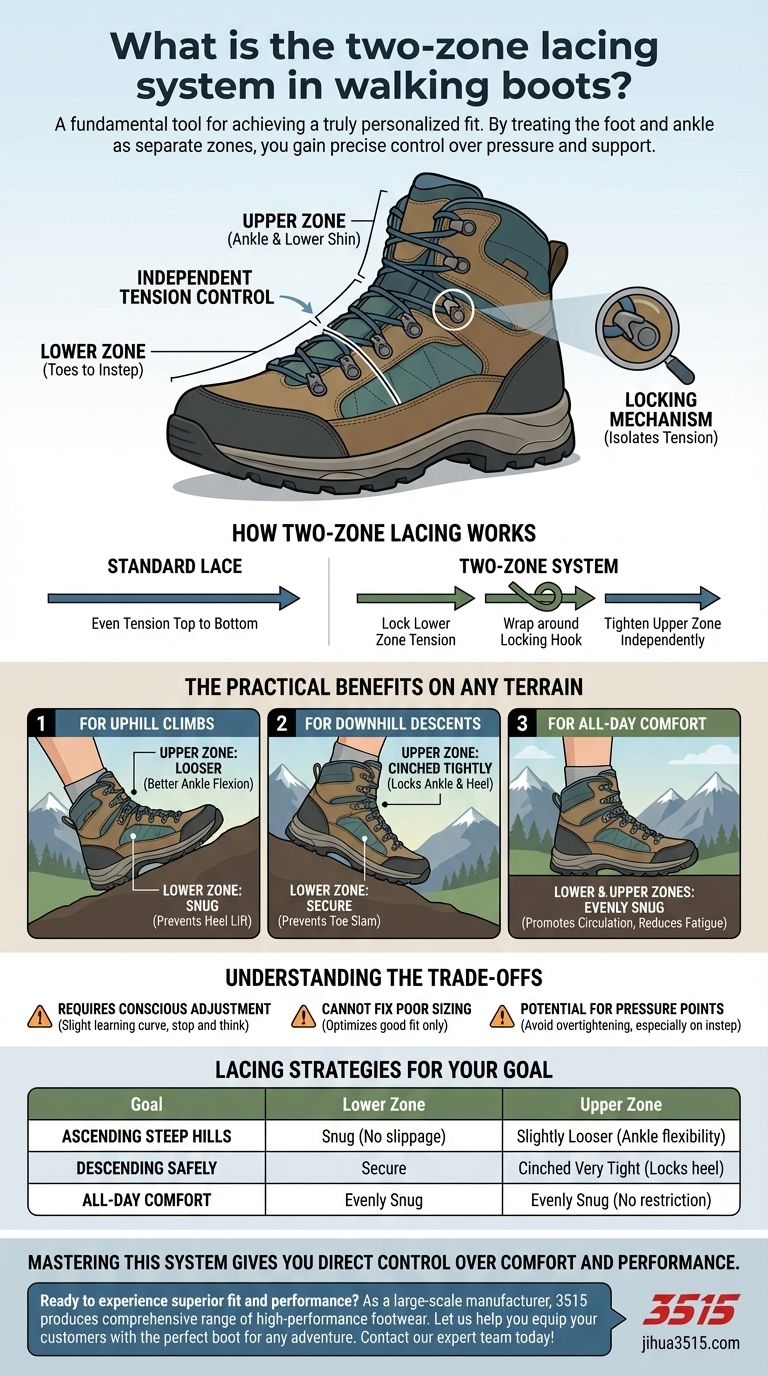
At its core, a two-zone lacing system divides a walking boot's laces into two independent sections: the lower zone over your foot and the upper zone around your ankle. This separation allows you to apply different levels of tension to each area, giving you a customized fit that a standard lacing pattern cannot achieve.
The two-zone system isn't just a feature; it's a fundamental tool for achieving a truly personalized fit. By treating the foot and ankle as separate zones, you gain precise control over pressure and support, which directly translates to better stability and comfort on the trail.
How Two-Zone Lacing Actually Works
The genius of the system lies in its ability to isolate tension. A standard lace pulls evenly from top to bottom, but a two-zone system allows you to lock in the tension of the lower section before you even start lacing the upper section.
The Two Distinct Zones
The system creates a clear division. The lower zone covers the top of your foot, from the toes to the instep. The upper zone covers the ankle and lower shin, providing crucial support.
The Locking Mechanism
The key to the system is a special locking eyelet or hook, often located where the boot begins to curve upwards at the ankle. Once you tighten the lower laces to your desired fit, you wrap the lace around this hook. This lock pinches the lace, preventing it from loosening as you begin tightening the upper zone.
The Practical Benefits on Any Terrain
This level of control isn't just for comfort; it's a technical advantage that allows you to adapt your boot's performance to the specific challenge you're facing.
For Uphill Climbs
When ascending, you need to prevent your heel from lifting inside the boot, which is a primary cause of blisters. A snug fit in the lower zone keeps your foot secure, while a slightly looser upper zone allows for better ankle flexion and movement.
For Downhill Descents
Descending puts immense pressure on your toes. By cinching the upper zone tightly, you lock your ankle and heel into the back of the boot. This prevents your foot from sliding forward and your toes from slamming into the front of the boot with every step.
For All-Day Comfort
On long, flat sections, your feet can swell. The two-zone system lets you create a generally secure fit that isn't overly constrictive, promoting better blood circulation and reducing fatigue.
Understanding the Trade-offs
While highly effective, this system is a tool that requires proper understanding to use correctly. It is not a magic bullet for all boot-related issues.
It Requires Conscious Adjustment
Unlike a simple "pull and tie" lacing method, this system requires you to stop and think about the terrain ahead. You must learn how to adjust the two zones to match your needs, which involves a slight learning curve.
It Cannot Fix a Poorly Sized Boot
Two-zone lacing optimizes a good fit; it cannot correct a fundamental mismatch between your foot and the boot. If the boot is the wrong size or shape for you, no lacing technique will make it comfortable or safe.
Potential for Pressure Points
The ability to apply targeted tension is also the ability to apply too much tension. If you overtighten one specific area, especially over the instep, you can create uncomfortable pressure points or restrict circulation.
Lacing Strategies for Your Goal
Use these starting points to adapt your boots to the trail.
- If your primary focus is ascending steep hills: Keep the lower zone snug to eliminate foot slippage, but allow the upper zone to be slightly looser for better ankle flexibility.
- If your primary focus is descending safely: Cinch the upper zone very tight to lock your heel into the back of the boot, preventing your toes from sliding forward.
- If your primary focus is all-day comfort on flat ground: Aim for an evenly snug fit in both zones that feels secure but does not restrict blood flow.
Mastering this simple system gives you direct control over your comfort and performance on any terrain.
Summary Table:
| Zone | Area Covered | Primary Function |
|---|---|---|
| Lower Zone | Top of foot (toes to instep) | Secures the foot to prevent slippage |
| Upper Zone | Ankle and lower shin | Locks the ankle for stability and support |
Ready to experience superior fit and performance?
As a large-scale manufacturer, 3515 produces a comprehensive range of high-performance footwear for distributors, brand owners, and bulk clients. Our production capabilities encompass all types of walking boots and hiking shoes, including models with advanced features like the two-zone lacing system.
Let us help you equip your customers with the perfect boot for any adventure. Contact our expert team today to discuss your footwear needs!
Visual Guide
Related Products
- Premium Wholesale Wheat Nubuck Safety Boot with Rapid Lacing System
- Wholesale Training Shoes with Dial Lacing System Custom OEM Manufacturing
- Wholesale Comfort Leather Business Shoes with Dial Lacing System
- Premium Wholesale Tactical Style Safety Shoes Boots with Quick Lacing
- Advanced KPU Athletic Safety Shoe with Steel Toe Cap Anti-Slip Rotary Lacing System
People Also Ask
- Why are oil-resistant and anti-slip properties critical for industrial safety boots? Expert Outsole Engineering Guide
- What are the primary protective functions of industrial safety boots in oil palm plantations? Master Rough Terrain Safety
- How do industrial safety boots assist maintenance personnel working on high-level palm oil factory structures?
- What are the primary protective functions of industrial safety boots in granite quarry environments? Essential Guide
- Why are industrial safety boots with high-grip outsoles required for oil leaks and B3 waste? Ensure Worker Stability