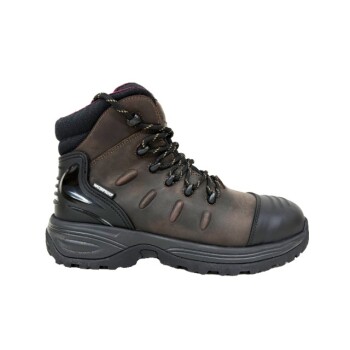
Industrial footwear functions as a critical physical barrier within a palm oil refinery's safety protocols. Its primary role is to act as the final line of defense against mechanical trauma, chemical splashes, and environmental hazards when engineering controls cannot fully isolate the worker from danger. By mitigating risks such as sharp object penetration and heavy impacts, specialized footwear ensures both worker safety and operational continuity.
In the context of a palm oil refinery, industrial footwear is not merely uniform; it is a specialized mitigation tool designed to prevent debilitating lower limb injuries from punctures, heavy impacts, and chemical exposure.
The Defense Mechanism Against Refinery Hazards
Protection Against Mechanical Trauma
In a refinery environment, the risk of heavy objects falling or machinery shifting is constant. Industrial footwear provides a hardened shield, typically through reinforced toes and metatarsal guards, to absorb and deflect these impacts.
Preventing Puncture Injuries
Refinery floors often present hazards from sharp objects, such as metal shards or debris. Specialized soles are engineered to resist penetration, preventing sharp items from piercing the shoe and injuring the foot.
Chemical and Thermal Shielding
Palm oil processing involves exposure to hot fluids and various chemical agents. Footwear within this PPE framework must serve as an impermeable barrier, protecting the skin from chemical splashes and thermal burns that standard clothing cannot withstand.
Stability on Compromised Surfaces
Refineries frequently have oily, wet, or uneven surfaces. Industrial footwear serves a preventative role against slips and falls by providing specialized traction, which is essential for maintaining stability in high-intensity zones.
Integration into the Broader PPE Framework
The Final Line of Defense
While engineering controls—such as guardrails and automated machinery—are the primary method for reducing risk, they are not infallible. Industrial footwear complements these measures by protecting the worker when environmental controls fail or during maintenance tasks where exposure is unavoidable.
Part of a Multi-Layered System
Footwear does not function in isolation. It is a core component of a multi-layered defense system that includes hard hats, protective clothing, and respiratory protection.
Enhancing Operational Efficiency
When workers are confident in their physical safety, hesitation decreases. Correctly configured PPE, including footwear, contributes to smoother operations by reducing the frequency of lost-time injuries and accidents.
Critical Considerations and Trade-offs
Specificity vs. Versatility
No single type of industrial footwear covers every refinery risk equally. A shoe designed for maximum impact resistance may lack the specific insulation required for electrical work, or the chemical resistance needed for processing areas.
Mobility vs. Protection
Higher levels of physical protection often result in heavier footwear. There is an inherent trade-off between the thickness of the protective barrier and the agility or comfort of the worker, which can lead to fatigue over long shifts.
False Sense of Security
Reliance on footwear should never replace situational awareness. It is vital to remember that PPE reduces the severity of an injury but does not remove the hazard itself.
Ensuring the Right Fit for the Risk
To maximize safety and efficiency, footwear selection must align with the specific operational risks of the refinery zone.
- If your primary focus is heavy machinery areas: Prioritize footwear with reinforced steel or composite toes and metatarsal guards to deflect crushing impacts.
- If your primary focus is chemical processing: Select footwear with high chemical resistance and impermeable materials to prevent burns and skin absorption.
- If your primary focus is maintenance on slippery floors: Ensure the footwear has high-grade slip-resistant soles designed specifically for oily environments.
- If your primary focus is electrical work: Verify that the footwear carries the appropriate insulation rating to prevent shock hazards.
Effective safety in a palm oil refinery relies on matching the specific protective capabilities of the footwear to the precise hazards of the environment.
Summary Table:
| Hazard Category | Protection Mechanism | Key Footwear Feature |
|---|---|---|
| Mechanical Impact | Absorbs energy from falling/shifting objects | Steel or Composite Safety Toes |
| Puncture Risks | Prevents sharp debris from piercing the sole | Puncture-Resistant Midsole |
| Chemical/Thermal | Acts as an impermeable barrier against hot oils | Oil & Chemical Resistant Materials |
| Slip Hazards | Provides stability on oily or wet surfaces | High-Traction Slip-Resistant Outsoles |
| Electrical Risk | Prevents shock during maintenance tasks | Electrical Hazard (EH) Rated Insulation |
Secure Your Workforce with Premium PPE Solutions from 3515
As a large-scale manufacturer serving distributors and brand owners, 3515 offers comprehensive production capabilities for all footwear types, anchored by our flagship Safety Shoes series. Our extensive portfolio covers work and tactical boots, outdoor shoes, training shoes, and sneakers, as well as Dress & Formal shoes to meet diverse bulk requirements.
Whether you are supplying a palm oil refinery or managing a large-scale industrial operation, we provide the durability and protection your brand needs. Partner with us to leverage our manufacturing expertise—contact us today to discuss your bulk production needs!
References
- Rapima Sartika Tinambunan, Feby Aulia Safrin. IMPLEMENTASI METODE JOB SAFETY ANALYSIS SEBAGAI UPAYA PENCEGAHAN KECELAKAAN KERJA PADA KARYAWAN. DOI: 10.55047/transekonomika.v3i3.414
This article is also based on technical information from 3515 Knowledge Base .
Related Products
- Durable Leather Work Boots for Wholesale & Custom Manufacturing
- Puncture-Resistant Velcro Safety Boots for Wholesale & Custom Manufacturing
- Durable Leather Work Boots for Wholesale & Custom OEM Manufacturing
- Wholesale Customizable Safety Boots Durable & Protective Footwear Manufacturing
- Wholesale Heavy-Duty Waterproof Steel Toe Work Boots OEM Manufacturer
People Also Ask
- What is the difference between full-grain and top-grain leather? Premium Material Guide for Boot Manufacturers
- What are the common workplace hazards that can be mitigated with the right work boots? Protect Your Workforce
- What are the common foot issues workers face due to uncomfortable work boots? Prevent Pain & Deformities
- What are the advantages of leather versus synthetic work boots? A Guide to Choosing the Right Material
- What are the key components of modern work boots? Engineered for Ultimate Durability and Comfort