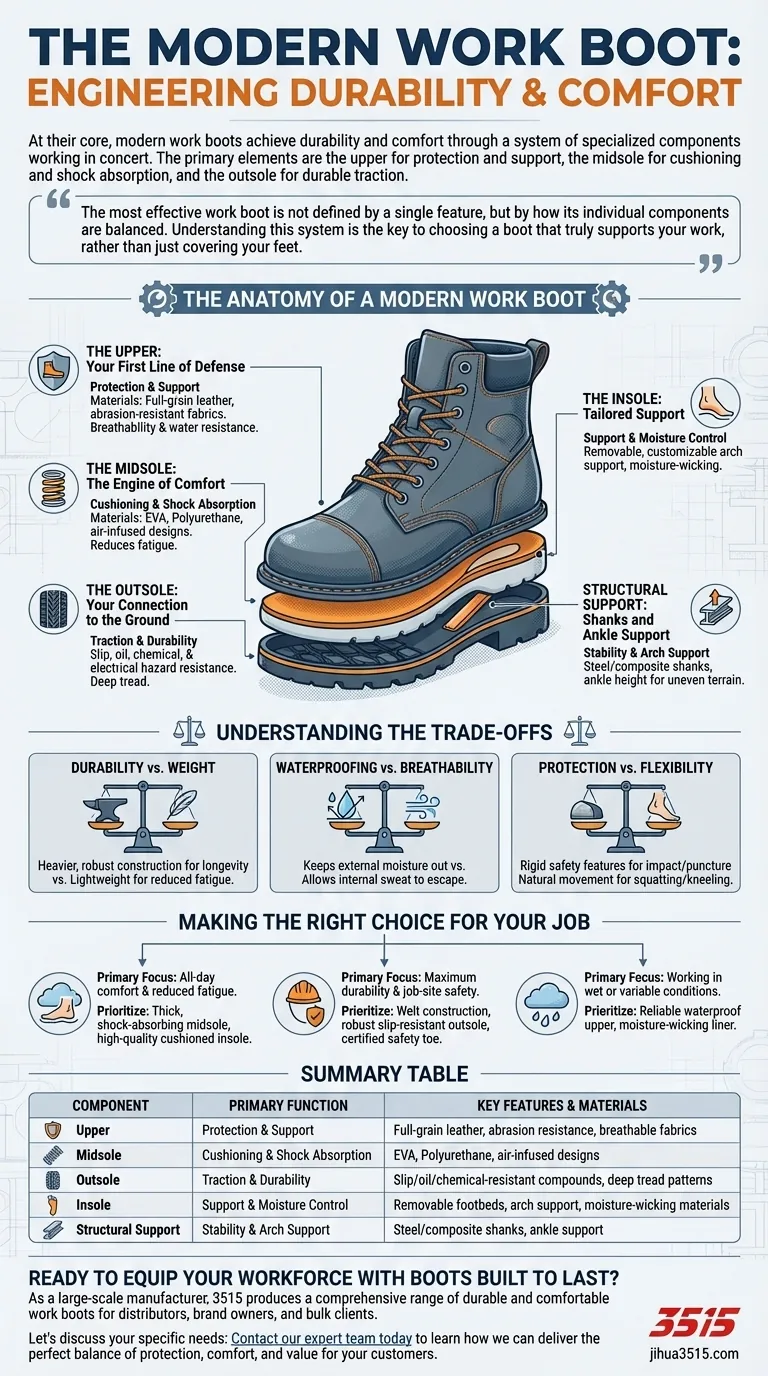
At their core, modern work boots achieve durability and comfort through a system of specialized components working in concert. The primary elements are the upper for protection and support, the midsole for cushioning and shock absorption, and the outsole for durable traction. These foundational parts are then enhanced with features like protective toe caps and internal shanks to meet specific job-site demands.
The most effective work boot is not defined by a single feature, but by how its individual components are balanced. Understanding this system is the key to choosing a boot that truly supports your work, rather than just covering your feet.
The Anatomy of a Modern Work Boot
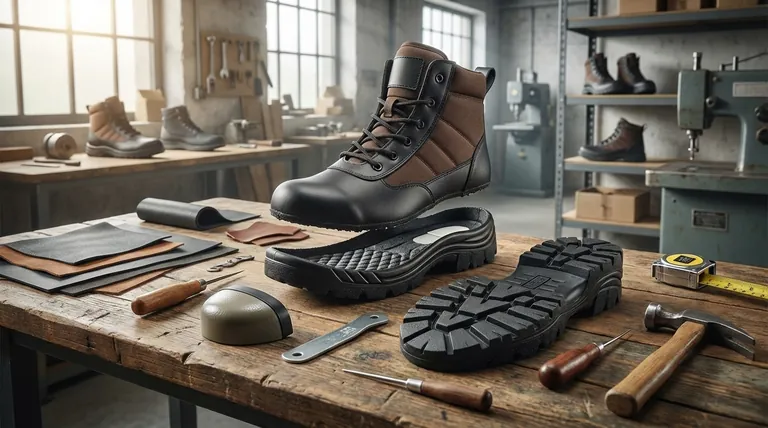
A work boot is an integrated system where each part plays a distinct role in performance. From the part that touches the ground to the material that wraps your ankle, every component is engineered with a specific purpose.
The Upper: Your First Line of Defense
The upper is the entire part of the boot that covers the foot. Its main jobs are to provide protection from impacts and abrasions while securely holding your foot in place.
Materials used for the upper directly influence the boot's breathability, water resistance, and overall durability. Common options include full-grain leather for toughness and synthetic fabrics for lightweight flexibility.
The Midsole: The Engine of Comfort
The midsole is a layer of material sandwiched between the insole and the outsole. This is the primary source of cushioning and shock absorption.
A quality midsole, often made from materials like EVA or Polyurethane, is crucial for reducing fatigue during long hours on your feet. Some advanced designs are air-infused to provide cushioning without adding significant weight.
The Outsole: Your Connection to the Ground
The outsole is the bottom-most layer of the boot that makes direct contact with the ground. It is engineered for durability and, most importantly, traction.
The material and tread pattern determine the boot's slip resistance, which is a critical safety feature. Outsoles may also be designed to resist oil, chemicals, or electrical hazards depending on the work environment.
The Insole: Tailored Support
Often called the footbed, the insole is the layer inside the boot that your foot rests on directly. Many modern work boots feature removable insoles.
This allows you to customize the fit and level of arch support. High-quality insoles also incorporate moisture-wicking materials to keep feet dry and comfortable throughout the day.
Structural Support: Shanks and Ankle Support
A shank is a rigid piece of material, often steel or composite, placed in the sole between the insole and outsole. It provides crucial support for the arch of your foot, reducing strain when climbing ladders or standing for long periods.
Proper ankle support, dictated by the boot's height and construction, is also essential for stability and free movement on uneven terrain.
Understanding the Trade-offs
Choosing the perfect work boot involves balancing competing priorities. An improvement in one area, such as durability, can sometimes come at the cost of another, like weight or flexibility.
Durability vs. Weight
Heavier boots built with thick leather and robust welted construction offer maximum longevity and protection. However, this added weight can lead to significant fatigue by the end of a long workday.
Conversely, lightweight boots reduce fatigue and are often more comfortable out of the box, but may not withstand the same level of abuse as their heavier counterparts.
Waterproofing vs. Breathability
A fully waterproof membrane is excellent for keeping feet dry from external moisture like rain or puddles. However, this same barrier can trap sweat, leading to discomfort.
Boots with moisture-wicking liners and more breathable (but less waterproof) uppers are better suited for hot and dry environments where managing sweat is the primary concern.
Protection vs. Flexibility
Features like a steel safety toe and a rigid shank provide unparalleled protection against impacts and punctures. This rigidity, however, can limit the natural flexibility of your foot.
For jobs that require frequent squatting, kneeling, or climbing, a more flexible boot with a composite toe and shank might offer a better balance of safety and ergonomic comfort.
Making the Right Choice for Your Job
Your specific work environment and daily tasks should dictate which components you prioritize.
- If your primary focus is all-day comfort and reduced fatigue: Prioritize a boot with a thick, shock-absorbing midsole and a high-quality cushioned insole.
- If your primary focus is maximum durability and job-site safety: Look for welt construction, a robust and slip-resistant outsole, and a protective toe that meets national safety standards.
- If your primary focus is working in wet or variable conditions: Select a boot with a reliable waterproof upper, but ensure it also has a moisture-wicking liner to manage internal sweat.
Understanding these components empowers you to select a work boot that is not just a piece of equipment, but a true tool for your trade.
Summary Table:
| Component | Primary Function | Key Features & Materials |
|---|---|---|
| Upper | Protection & Support | Full-grain leather, abrasion resistance, breathable fabrics |
| Midsole | Cushioning & Shock Absorption | EVA, Polyurethane, air-infused designs for lightweight comfort |
| Outsole | Traction & Durability | Slip/oil/chemical-resistant compounds, deep tread patterns |
| Insole | Support & Moisture Control | Removable footbeds, arch support, moisture-wicking materials |
| Structural Support | Stability & Arch Support | Steel/composite shanks, ankle support for uneven terrain |
Ready to equip your workforce with boots built to last?
As a large-scale manufacturer, 3515 produces a comprehensive range of durable and comfortable work boots for distributors, brand owners, and bulk clients. Our production capabilities encompass all types of safety footwear, ensuring your team has the right tool for the job.
Let's discuss your specific needs: Contact our expert team today to learn how we can deliver the perfect balance of protection, comfort, and value for your customers.
Visual Guide
Related Products
- Durable Leather Work Boots for Wholesale & Custom Manufacturing
- Durable Leather Work Boots for Wholesale & Custom OEM Manufacturing
- Durable Leather Work Boots Wholesale Manufacturer & Custom Factory
- Durable Leather Moc Toe Work Boots for Wholesale & Custom Manufacturing
- Wholesale Leather Work Boots with Customizable Wedge Sole for Brands
People Also Ask
- What is the difference between full-grain and top-grain leather? Premium Material Guide for Boot Manufacturers
- What are the common workplace hazards that can be mitigated with the right work boots? Protect Your Workforce
- What are the common foot issues workers face due to uncomfortable work boots? Prevent Pain & Deformities
- What are the advantages of leather versus synthetic work boots? A Guide to Choosing the Right Material
- Is there a definitive answer to whether pull-on or lace-up work boots are better? Choose the Right Boot for Your Job