In short, uncomfortable work boots are a direct cause of numerous debilitating foot issues. These range from inflammatory conditions like plantar fasciitis and general arch pain to long-term structural problems such as bunions and hammertoes, along with musculoskeletal strain that can affect the entire body.
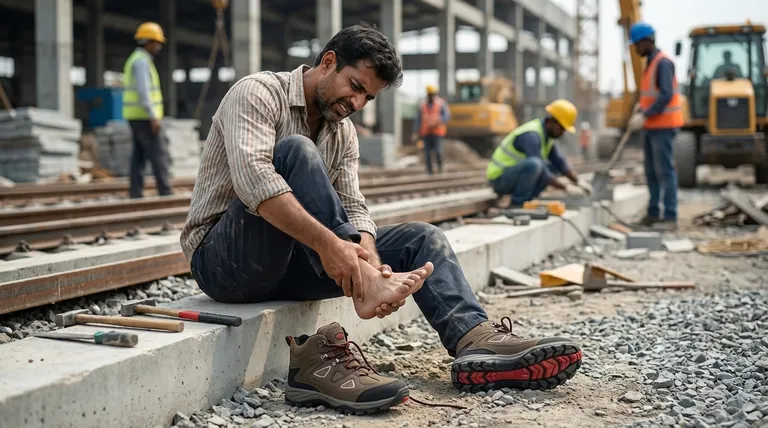
Your work boots are the foundation for your entire body during the workday. When that foundation is compromised by a poor fit or lack of support, it creates a chain reaction of pain and injury that extends far beyond simple foot soreness.
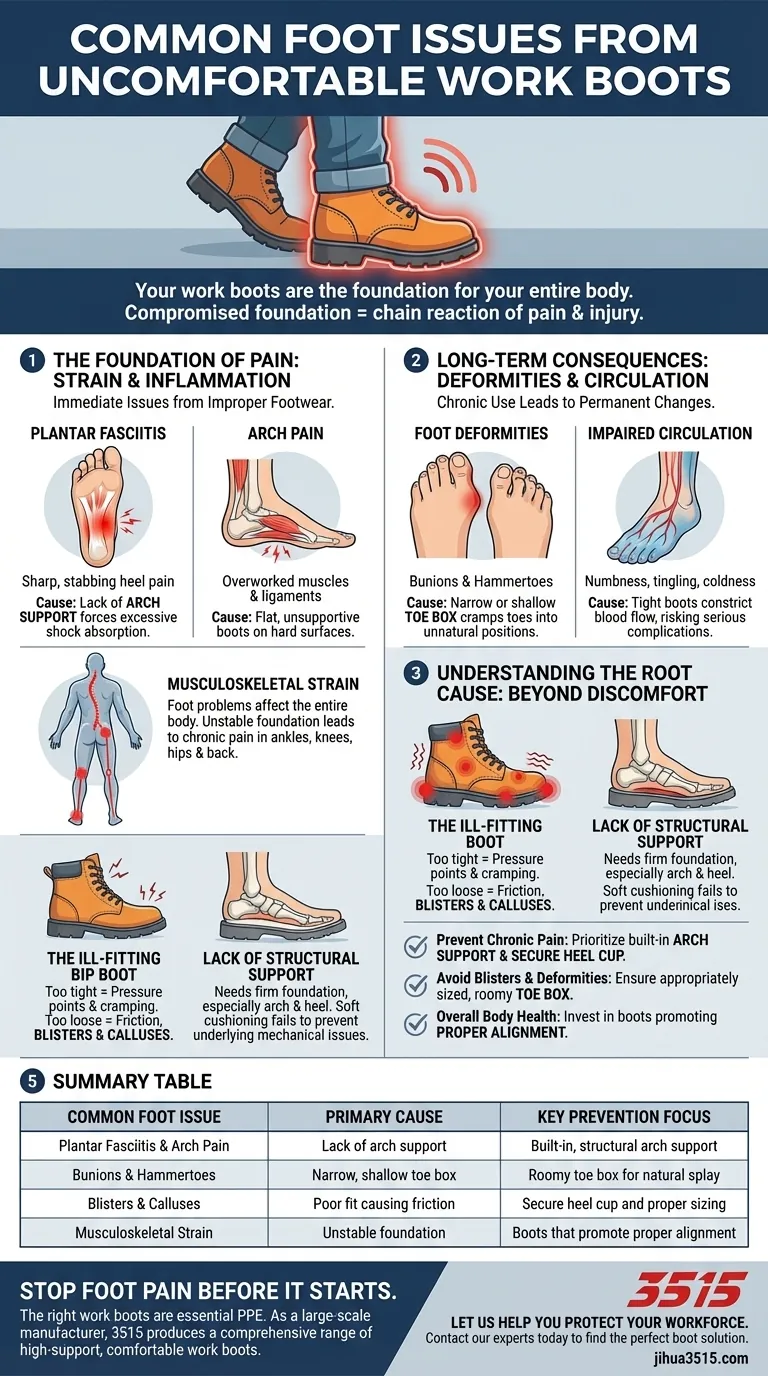
The Foundation of Pain: Strain and Inflammation
The most immediate issues from improper footwear are often related to inflammation caused by excessive strain on the foot's complex structures.
Plantar Fasciitis
Plantar fasciitis is a sharp, stabbing pain in the heel. It's caused by inflammation of the plantar fascia, the thick band of tissue that connects your heel bone to your toes.
Work boots lacking proper arch support force this tissue to absorb excessive shock and strain with every step, leading directly to this painful condition.
Arch Pain
Generalized arch pain occurs when the muscles and ligaments in the arch are overworked. This is a common result of wearing flat, unsupportive boots on hard surfaces for long hours.
Over time, this constant strain can lead to the weakening or even the collapse of the foot's natural arch.
Musculoskeletal Strain
Foot problems rarely stay in the foot. An unstable or misaligned foundation forces your ankles, knees, hips, and lower back to compensate.
This creates a kinetic chain reaction of strain, leading to chronic pain in other parts of the body that may not seem related to your footwear.
Long-Term Consequences: Deformities and Circulation
Chronic use of ill-fitting boots can lead to permanent changes in the structure of your feet and impact your circulatory health.
Foot Deformities
Bunions (a bony bump at the base of the big toe) and hammertoes (an abnormal bend in the middle joint of a toe) are often caused by a narrow or shallow toe box.
When your toes are constantly cramped, the pressure forces them into unnatural positions, eventually leading to these painful and permanent deformities.
Impaired Circulation
Boots that are too tight can constrict blood vessels in the feet. This restriction of blood flow can cause numbness, tingling, and coldness.
In severe cases or for individuals with pre-existing conditions like diabetes, poor circulation can lead to much more serious health complications.
Understanding the Root Cause: Beyond "Discomfort"
The term "uncomfortable" often masks specific, identifiable failures in a work boot's design or fit. Understanding these failures is key to prevention.
The Ill-Fitting Boot
A boot that is too tight creates pressure points and cramping, while a boot that is too loose allows the foot to slide, causing friction. This friction is the primary cause of painful blisters and hardened calluses.
Lack of Structural Support
Many boots provide cushioning but lack true structural support. Your foot needs a firm foundation, especially in the arch and heel, to maintain proper alignment and distribute weight evenly.
A soft insole can feel comfortable initially but may fail to prevent the underlying mechanical issues that cause conditions like plantar fasciitis.
Making the Right Choice for Your Goal
Selecting the right boot requires you to look beyond simple comfort and consider the specific demands of your job and your body.
- If your primary focus is preventing chronic pain (like plantar fasciitis): Prioritize boots with excellent, built-in arch support and a secure heel cup to prevent strain.
- If your primary focus is avoiding blisters and deformities: Ensure the boot has an appropriately sized toe box that allows your toes to splay naturally.
- If your primary focus is overall body health: Recognize that your boot is a critical tool that affects your knees, hips, and back, and invest in a pair that promotes proper alignment.
Ultimately, treating your footwear as essential personal protective equipment is the first step toward preventing a lifetime of pain.
Summary Table:
| Common Foot Issue | Primary Cause from Boots | Key Prevention Focus |
|---|---|---|
| Plantar Fasciitis & Arch Pain | Lack of arch support | Built-in, structural arch support |
| Bunions & Hammertoes | Narrow, shallow toe box | Roomy toe box for natural splay |
| Blisters & Calluses | Poor fit causing friction | Secure heel cup and proper sizing |
| Musculoskeletal Strain (Knees, Hips, Back) | Unstable foundation | Boots that promote proper alignment |
Stop foot pain before it starts. The right work boots are essential PPE, not just footwear. As a large-scale manufacturer, 3515 produces a comprehensive range of high-support, comfortable work boots for distributors, brand owners, and bulk clients. Our production capabilities encompass all types of safety shoes and boots designed to prevent the common issues detailed above.
Let us help you protect your workforce. Contact our experts today to discuss your specific needs and find the perfect boot solution for your team.
Visual Guide
Related Products
- Durable Leather Work Boots for Wholesale & Custom Manufacturing
- Durable Leather Work Boots for Wholesale & Custom OEM Manufacturing
- Durable Leather Work Boots Wholesale Manufacturer & Custom Factory
- Durable Leather Moc Toe Work Boots for Wholesale & Custom Manufacturing
- Wholesale Leather Work Boots with Customizable Wedge Sole for Brands
People Also Ask
- What is the difference between full-grain and top-grain leather? Premium Material Guide for Boot Manufacturers
- What are the common workplace hazards that can be mitigated with the right work boots? Protect Your Workforce
- What are the advantages of leather versus synthetic work boots? A Guide to Choosing the Right Material
- What are the key components of modern work boots? Engineered for Ultimate Durability and Comfort
- Is there a definitive answer to whether pull-on or lace-up work boots are better? Choose the Right Boot for Your Job