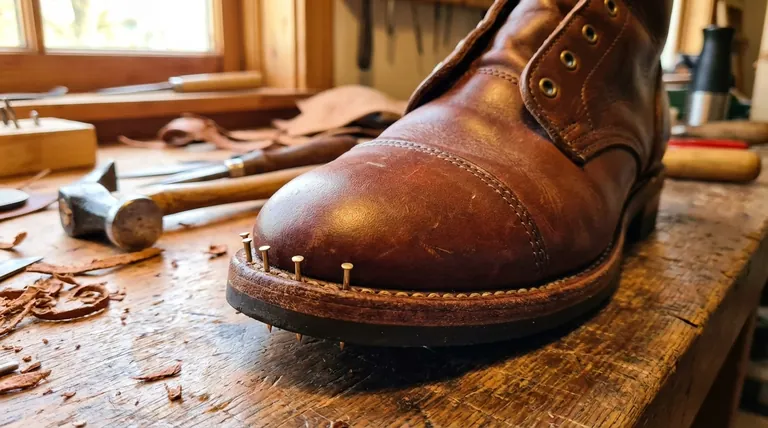
Those small nails in the tip of your Goodyear welted shoes are a critical structural reinforcement, not a decorative flourish. They are strategically placed to secure the welt and outsole at the toe, the shoe's highest-wear area. This prevents the vital seams from splitting or separating under daily stress, dramatically increasing the footwear's durability and lifespan.
The core function of these nails is to transform the shoe's most vulnerable point—the toe seam—into a bastion of strength. They are a deliberate engineering choice that signals a commitment to long-lasting, repairable construction.
The Anatomy of a High-Wear Point
To appreciate the function of the nails, you must first understand why the toe of a shoe is under constant assault. This area faces the most scuffs, impacts, and flexing in every step you take.
The Vulnerability of the Toe
The front tip of the shoe leads the way, absorbing the brunt of daily wear. This constant friction and pressure place immense strain on the stitching that holds the entire shoe together.
The Critical Welt Seam
Goodyear welting is prized because it creates a strong, water-resistant, and easily repairable shoe. A strip of leather, the welt, is stitched to the upper and the insole. The outsole is then stitched to this same welt. This seam is the structural backbone of the shoe.
The Point of Potential Failure
Without reinforcement, the repeated stress at the toe could cause the welt stitching to fray and pull apart over time. This would compromise the shoe's integrity and lead to premature failure.
How Toe Nails Provide Structural Reinforcement
The nails are a simple but highly effective solution to the problem of stress at the toe. They act as a physical lock on the shoe's construction.
Pinning the Layers Together
The nails are driven through the outsole, the welt, and into the insole material beneath. This physically pins all the critical layers together at the most crucial point.
Preventing Seam Separation
This pinning action acts like a clamp, preventing the welt seam from having any room to shift, loosen, or open up. It removes the stress from the thread and places it on the solid metal nails.
A Hallmark of Durability
By neutralizing the primary failure point, these nails directly contribute to the shoe's overall longevity. They ensure the foundation remains secure, allowing the shoe to be resoled multiple times without compromising the core structure.
Understanding the Nuances
While highly functional, it's useful to see this feature in its proper context. Not all high-quality shoes have them, but their presence tells a specific story.
A Time-Tested Method
The use of nails or pegs to reinforce shoe construction is a traditional, time-tested technique. While modern adhesives are incredibly strong, many master shoemakers still rely on this mechanical fastening for guaranteed durability.
Function Over Form
While the neatly arranged nails can be aesthetically pleasing, their purpose is purely functional. They are a visible sign that the manufacturer has intentionally over-engineered the shoe for a longer life.
Variations in Practice
The most common configuration is four or five nails. However, the exact number and placement can vary by maker. The underlying principle remains the same: to lock down the welt at the tip.
Making the Right Choice for Your Goal
Understanding this small detail empowers you to better assess the construction and intended purpose of a shoe.
- If your primary focus is maximum longevity and durability: View toe nails as a clear, positive indicator of robust construction designed to withstand years of hard wear.
- If your primary focus is understanding shoe quality: Recognize these nails not as a simple feature, but as a deliberate choice by the shoemaker to reinforce a critical stress point, signaling a deep commitment to craftsmanship.
Ultimately, these nails are a testament to a philosophy of building things to last.
Summary Table:
| Function | Key Benefit |
|---|---|
| Pins Layers Together | Secures outsole, welt, and insole at the high-stress toe area. |
| Prevents Seam Separation | Removes stress from stitching, transferring it to the solid metal nails. |
| Enhances Longevity | Transforms the toe from a vulnerability into a bastion of strength for years of wear. |
| Facilitates Repair | Maintains structural integrity, allowing the shoe to be resoled multiple times. |
Build footwear that stands the test of time.
As a large-scale manufacturer, 3515 produces a comprehensive range of durable footwear for distributors, brand owners, and bulk clients. Our production capabilities encompass all types of shoes and boots, including robust constructions like Goodyear welting designed for longevity.
Let's collaborate to create durable footwear your customers will trust.
Contact our experts today to discuss your manufacturing needs.
Visual Guide

Related Products
- Durable Goodyear Welt Leather Work Boots for Wholesale & Private Label
- Wholesale Durable & Breathable Training Shoes for Custom Brands
- Wholesale Breathable Training Shoes Custom Athletic Footwear Manufacturer
- Lightweight Breathable Training Shoes for Wholesale & Custom OEM Manufacturing
- Custom OEM Training Shoes Wholesale Manufacturer Durable & Breathable
People Also Ask
- What is the difference between full-grain and top-grain leather? Premium Material Guide for Boot Manufacturers
- What are the advantages of leather as an upper material for work boots? Unmatched Durability & Custom Comfort
- Why is it important to waterproof leather work boots? Protect Your Investment and Performance
- How should new leather work boots be broken in? A Guide to Comfort and Durability
- What are the advantages of leather uppers in work boots? Unmatched Durability & Protection