
At their core, walking supports offer two fundamental benefits: they accelerate recovery and provide critical pain management for the foot, ankle, and leg. By strictly controlling motion and stabilizing the injured area, these devices create a protected, optimal environment for your body to heal itself effectively.
A walking support is more than a simple brace; it is a therapeutic tool designed to immobilize, protect, and reduce the load on an injured limb, thereby speeding up the natural healing process while minimizing pain.
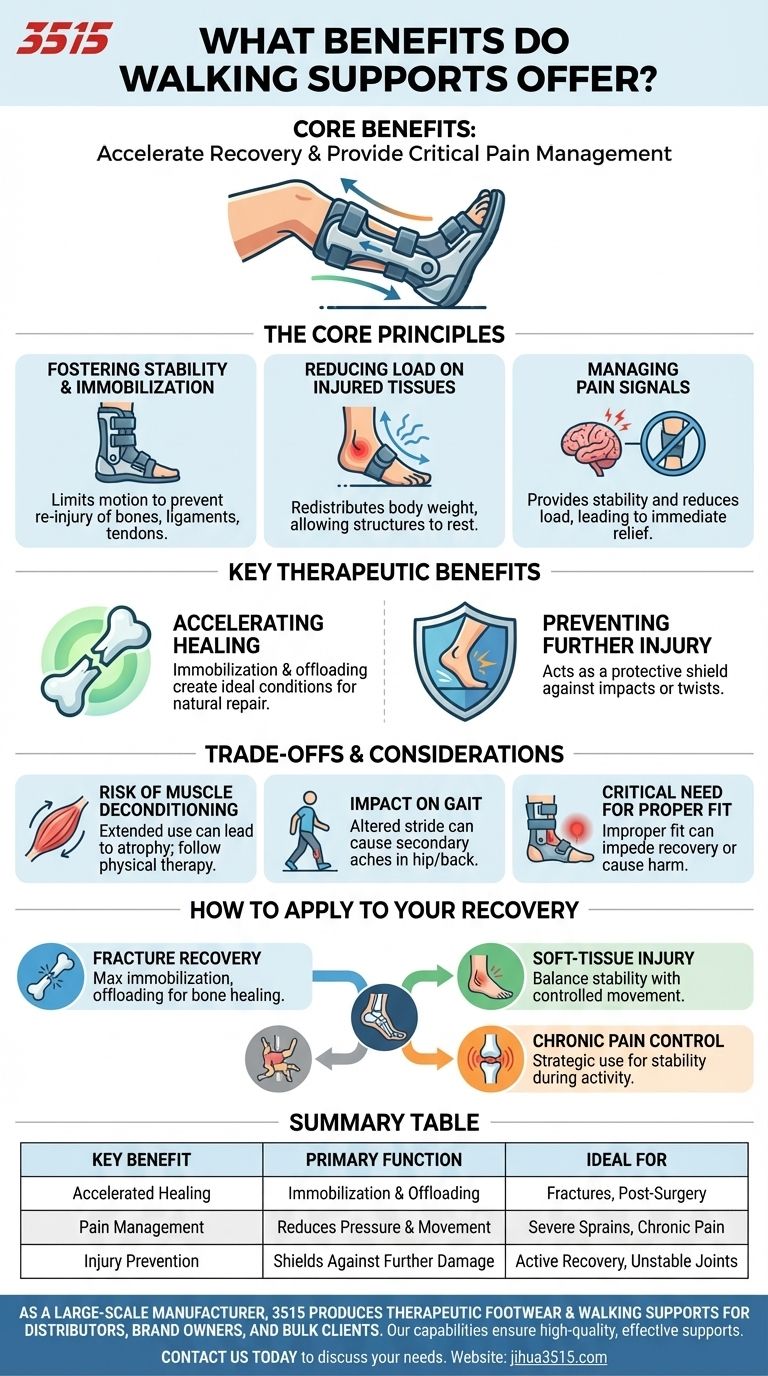
The Core Principles of a Walking Support
To understand the benefits, you must first understand the mechanical principles at play. A walking support is not passive; it actively alters the forces on your lower limb.
Fostering Stability and Immobilization
The primary function is to limit the motion of the injured foot, ankle, or leg. This rigid structure prevents accidental movements that could re-injure healing tissues like bones, ligaments, or tendons.
Reducing the Load on Injured Tissues
These supports are engineered to redistribute your body weight away from the precise point of injury. By offloading this pressure, the support allows damaged structures to rest and repair without the constant stress of weight-bearing.
Managing Pain Signals
Pain is often a direct result of movement or pressure on an injured area. By providing stability and reducing the load, a walking support addresses these two primary triggers, leading to significant and immediate pain relief.
Key Therapeutic Benefits Explained
The underlying principles of stability and load reduction translate directly into tangible benefits for your recovery journey.
Accelerating the Healing Process
Immobilization and offloading work in tandem to create the ideal conditions for your body's natural repair mechanisms. This protected state allows damaged tissues to mend without interruption or setback.
Preventing Further Injury
A walking support acts as a protective shield for your limb. It guards against unexpected impacts or twists that could worsen the initial injury or cause a new one during the vulnerable recovery period.
Understanding the Trade-offs and Considerations
While highly effective, walking supports are medical tools that come with important considerations. Objectivity requires acknowledging potential downsides.
The Risk of Muscle Deconditioning
Extended use of a highly immobilizing support can lead to muscle atrophy (weakening) in the affected leg. Following a prescribed physical therapy plan is often crucial to regain strength after the support is removed.
Potential Impact on Your Gait
Walking in a boot or brace alters your natural stride. This compensation can sometimes lead to secondary aches in your hip, back, or the opposite knee.
The Critical Need for a Proper Fit
An improperly fitted walking support can cause more harm than good. It may create pressure sores, offer inadequate support, or fail to immobilize the joint correctly, which can severely impede your recovery.
How to Apply This to Your Recovery
Using this understanding, you can better align the support's function with your specific medical needs.
- If your primary focus is recovering from a major injury (like a fracture): You need a support that offers maximum immobilization and offloads weight to allow bone and tissue to heal correctly.
- If your primary focus is managing a soft-tissue injury (like a severe sprain): The goal is to balance stability to prevent re-injury with the controlled movement necessary for proper ligament healing.
- If your primary focus is controlling chronic pain: A support can be used strategically during activities that trigger discomfort, providing stability and pain relief when you need it most.
Ultimately, a walking support is a temporary tool that empowers your body to execute its own remarkable healing process.
Summary Table:
| Key Benefit | Primary Function | Ideal For |
|---|---|---|
| Accelerated Healing | Immobilization & Offloading | Fractures, Post-Surgery |
| Pain Management | Reduces Pressure & Movement | Severe Sprains, Chronic Pain |
| Injury Prevention | Shields Against Further Damage | Active Recovery, Unstable Joints |
As a large-scale manufacturer, 3515 produces a comprehensive range of therapeutic footwear and walking supports for distributors, brand owners, and bulk clients. Our production capabilities ensure high-quality, medically-effective supports that help your customers recover faster and with less pain. Contact us today to discuss how our products can meet your specific needs and enhance your product line.
Visual Guide
Related Products
- Lightweight Breathable Sneakers with Wet-Traction Grip for Wholesale & Private Label
- Durable High-Ankle Tactical Boots Wholesale Manufacturer for Custom & Bulk Orders
- Wholesale Breathable Athletic Sneakers - Custom Lightweight Cushioned Footwear Manufacturer
- Wholesale Durable Safety Boots Manufacturer Customizable Steel Toe Work Boots
- Wholesale Lightweight Cushioned Athletic Sneakers for Custom Bulk Production
People Also Ask
- Why are breathable sneakers necessary for tropical commuting? Stay Cool and Dry in High Humidity
- What role do lightweight training shoes play in urban traffic? Boost Agility and Reaction for Safer City Navigation
- How do lightweight shoes provide support? The Science of Efficient Cushioning & Stability
- How do lightweight shoes improve breathability? Discover the Science of Cool, Dry Feet
- How do lightweight shoes contribute to healthier feet? Reduce Fatigue & Prevent Foot Problems


















