
To manage swelling effectively, the most important walking boot features are those that allow for adjustable compression. The two primary features are adjustable straps and, more importantly, inflatable air bladders found in pneumatic or "Air" CAM walkers. These components let you tighten or loosen the fit as swelling naturally fluctuates throughout the day.
The core challenge with injury recovery is that swelling is not constant. A boot that offers dynamic, adjustable compression—primarily through air bladders—is the most effective tool for managing pain and promoting healing as your body recovers.
Why Swelling Management is Critical
The Body's Natural Response
When you sustain an injury, swelling (edema) is a natural and necessary part of the healing process. However, excessive or poorly managed swelling can increase pain, limit range of motion, and slow down recovery.
The Problem with a Fixed Fit
A standard cast or a non-adjustable brace creates a problem: it can become painfully tight when swelling increases or too loose when swelling subsides. This inconsistency can compromise both comfort and the stability needed for proper healing.
The Key Features for Swelling Control
Adjustable Straps: The Baseline for Compression
Nearly every walking boot is equipped with a series of Velcro straps. These are the first line of defense against swelling.
They allow you to set the foundational level of compression and support for the boot. As swelling changes significantly, you can readjust these straps for a better overall fit.
Inflatable Air Bladders: For Precision and Comfort
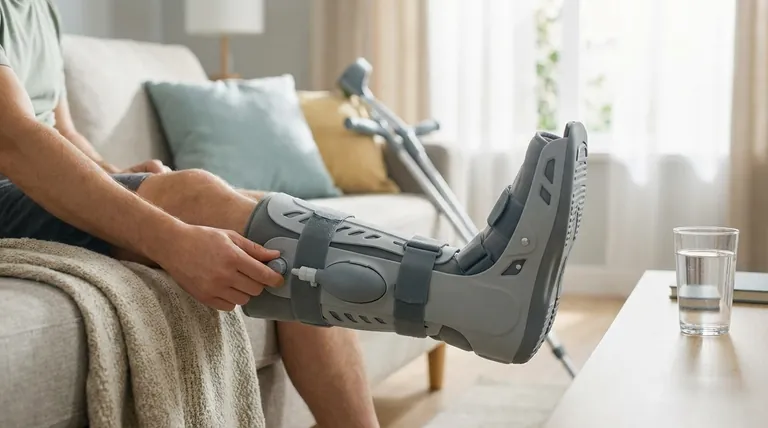
The most advanced feature for swelling is the pneumatic system, which consists of integrated air bladders. These are found in what are often called Air CAM walkers or pneumatic boots.
A small, built-in pump allows you to add or remove air from bladders surrounding your ankle and foot. This provides a uniform, comfortable pressure that can be fine-tuned in seconds without having to undo all the straps.
How These Features Work Together
The ideal process is to first secure the boot with the straps to a comfortably snug fit. Then, use the air pump to add compression for a secure, custom fit.
Throughout the day, if you feel pressure increasing, you can release a small amount of air. If the boot feels loose after a period of rest and elevation, you can add a few pumps of air to restore the supportive fit.
Understanding the Trade-offs
Standard (Non-Air) Boots
A standard boot relies solely on straps. While effective for basic immobilization, it offers less precise control over swelling.
As swelling subsides, you may find yourself constantly readjusting the straps to prevent your foot from shifting inside the boot, which can compromise stability.
Pneumatic (Air) Boots
Pneumatic boots offer superior management of swelling and a more secure, comfortable fit due to the uniform pressure of the air cells.
The primary trade-off is often a slightly higher cost and one additional component to manage. However, for most acute injuries where swelling is a major factor, the benefit is significant.
Making the Right Choice for Your Recovery
Your choice depends on the stage of your injury and your primary goal.
- If you are in the initial, acute phase of an injury: A pneumatic (air) boot is highly recommended, as swelling fluctuates most dramatically during this time.
- If your swelling is minimal or has already stabilized: A standard, non-air boot can provide sufficient support and may be a more cost-effective option.
- If your primary focus is maximizing comfort and ensuring a secure fit: The uniform, adjustable compression of an air boot is almost always the superior choice.
Ultimately, choosing a boot with adjustable compression gives you direct control over your own comfort and healing process.
Summary Table:
| Feature | Primary Function | Best For |
|---|---|---|
| Adjustable Straps | Provides foundational compression and support. | Basic immobilization and general fit adjustments. |
| Inflatable Air Bladders | Offers precise, uniform pressure control. | The acute injury phase with significant, fluctuating swelling. |
| Standard (Non-Air) Boot | Relies solely on straps for fit. | Minimal or stabilized swelling, cost-effective option. |
| Pneumatic (Air) Boot | Combines straps and air bladders for optimal control. | Maximizing comfort, security, and effective swelling management. |
Need a Walking Boot That Truly Manages Swelling? Partner with 3515.
As a large-scale manufacturer, 3515 produces a comprehensive range of medical and therapeutic footwear for distributors, brand owners, and bulk clients. Our production capabilities include advanced pneumatic walking boots with inflatable air bladders, designed to provide the precise, adjustable compression essential for effective recovery.
Let us help you provide superior comfort and healing to your customers. Contact our team today to discuss your specific needs and explore our catalog.
Visual Guide

Related Products
- Wholesale Durable Camouflage Canvas Shoes with High-Traction Cleated Rubber Sole
- Durable Rubber Sole Outdoor Shoes Wholesale & Custom Manufacturing
- Durable Goodyear Welt Leather Work Boots for Wholesale & Private Label
- Wholesale High-Traction Camo Boots - Custom Manufacturer for Brands
- Heavy-Duty Waterproof Nubuck Safety Boots Safety Shoes for Bulk Supply
People Also Ask
- Why is the selection of high-strength fabric materials necessary in the production of canvas shoes and training shoes?
- What are the properties of canvas as a shoe material? A Guide to Lightweight Comfort & Style
- Can canvas shoes be worn in rainy conditions? The Truth About Water Resistance
- What are some examples of vulcanized shoes? Discover the Flexibility and Board Feel of Classic Sneakers
- What are the characteristics of canvas as a shoe material? A Guide to Lightweight, Breathable Footwear



















