
As a general rule, you should condition your tall boots every few weeks and polish them primarily before shows or as needed for appearance. The exact frequency, however, is not based on a rigid calendar but on the leather's condition, your usage, and your environment.
The core principle of leather care is to treat it like skin. Conditioning is the moisturizer that prevents it from drying out and cracking, while polishing is the cosmetic layer that adds shine and a temporary protective barrier.
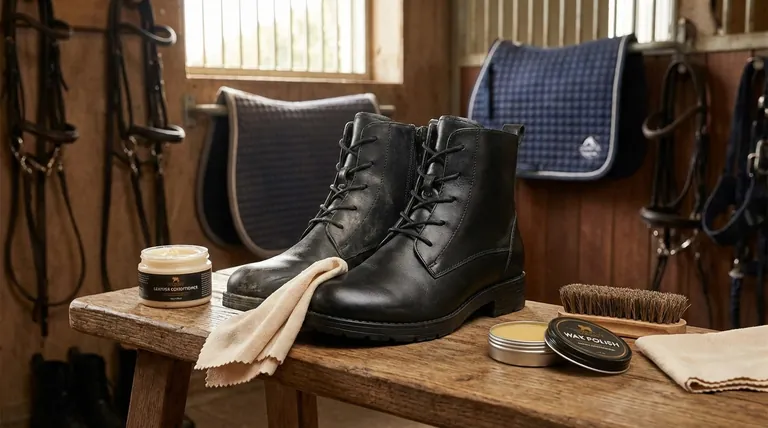
The Role of Conditioning vs. Polishing
Understanding the distinct purpose of each product is the first step to properly maintaining your boots. They are not interchangeable and serve two very different functions.
Conditioning: Feeding the Leather
A conditioner is an oil-based cream or lotion that penetrates the leather's pores. Its primary job is to restore the natural fats and oils that keep the leather supple, flexible, and hydrated.
Think of it as a deep moisturizer. Regular conditioning is what prevents the leather from becoming brittle and developing cracks over time, which is critical for the longevity of your investment.
Polishing: Creating a Surface Barrier
Polish, typically wax-based, sits on the surface of the leather. Its main purpose is to create a high-gloss shine for a professional appearance in the show ring.
While it offers a minor barrier against scuffs and moisture, its protective qualities are secondary to its aesthetic function. Applying polish to dry, under-conditioned leather can actually seal in the dryness and make cracking worse.
Establishing Your Care Routine
Instead of following a strict schedule, learn to read the signs your boots are giving you. This "as needed" approach ensures you provide care when it's most effective.
Visual and Tactile Cues for Conditioning
Your boots will tell you when they need conditioning. Look for these key indicators:
- Dryness or Stiffness: The leather feels less flexible than it used to.
- Fading or Discoloration: The color looks lighter or blotchy in high-wear areas.
- Light-Colored Scuffs: Minor scuffs appear pale, indicating the surface is dry.
- Water Absorption: If water soaks in quickly instead of beading, the leather has lost its protective oils.
How Usage and Environment Impact Frequency
The demands you place on your boots directly influence how often they need care.
Riders in dry, dusty climates may need to condition more often to combat the arid conditions. Conversely, those in wet or muddy environments should ensure boots are thoroughly cleaned and dried before conditioning to prevent trapping damaging moisture and grime.
Understanding the Trade-offs and Pitfalls
More is not always better when it comes to leather care. Both under-care and over-care can damage your boots.
The Risk of Over-Conditioning
Applying conditioner too frequently or too heavily can oversaturate the leather. This makes the surface feel sticky or greasy.
An over-conditioned boot acts like a magnet for dust and dirt. This grime can mix with the excess conditioner to create an abrasive paste that wears down the leather's finish and stitching.
Polishing on Unprepared Leather
Never polish a dirty or dry boot. Wiping away surface dirt is the absolute minimum first step.
Polishing dirty boots grinds grit into the finish, causing scratches. Polishing dry boots simply covers up the underlying problem and can accelerate cracking by creating a stiff, inflexible surface layer.
Making the Right Choice for Your Goal
Tailor your care routine to your primary objective to get the best performance and lifespan from your tall boots.
- If your primary focus is show-ring presentation: Clean your boots after every ride, condition them a day or two before a show, and apply a light polish the morning of the event for maximum shine.
- If your primary focus is daily training and durability: Clean your boots regularly and condition them whenever they show signs of dryness, which might be every few weeks depending on your climate and riding frequency.
- If your boots are in storage: Give them a thorough cleaning and a light conditioning before storing them to ensure the leather doesn't dry out over time.
Ultimately, the best boot care strategy is a responsive one that maintains the leather's health.
Summary Table:
| Activity | Primary Goal | Key Indicator | Recommended Frequency |
|---|---|---|---|
| Conditioning | Moisturize & prevent cracking | Leather feels stiff, looks faded, water soaks in | Every few weeks, or as needed (e.g., before shows) |
| Polishing | Add shine & minor scuff protection | For aesthetic appeal before events | Before shows or as needed for appearance |
Ready to ensure your tall boots receive the best care? As a large-scale manufacturer, 3515 produces a comprehensive range of durable equestrian and work footwear for distributors, brand owners, and bulk clients. Our expertise in materials ensures your boots are built to last with proper maintenance. Let's discuss how our production capabilities can meet your needs for high-quality, long-lasting boots.
Contact us today for a consultation!
Visual Guide

Related Products
- Durable Leather High-Ankle Tactical Boots for Wholesale & Custom Manufacturing
- Durable High-Ankle Tactical Boots Wholesale Manufacturer for Custom & Bulk Orders
- Durable High-Ankle Tactical Boots for Wholesale & Custom Manufacturing
- Wholesale Tactical Boots High-Traction & Reflective for Bulk & Brand Orders
- Wholesale High-Traction Camo Boots - Custom Manufacturer for Brands
People Also Ask
- How do military uniforms and tactical boots impact the prediction of thermal risk? Essential Safety Insights
- How does the material of tactical boots affect their performance? Choose the Right Material for Your Mission
- Why is sequential analysis utilized to evaluate tactical boots? Master Dynamic Boot Development and Ergonomic Performance
- How do tactical boots differ from regular boots? Performance, Durability & Design Explained
- What are the primary differences between tactical boots and combat boots? Choose the Right Boot for Your Mission

















