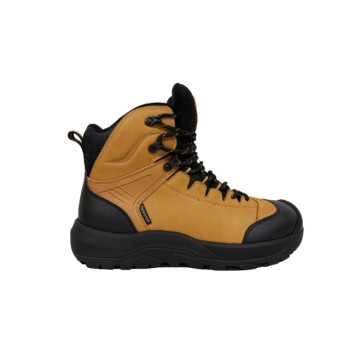
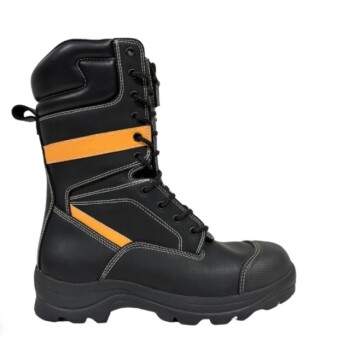
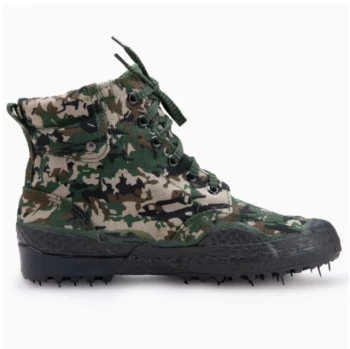
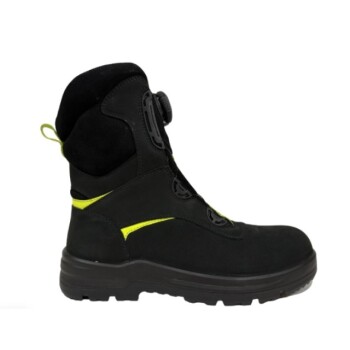
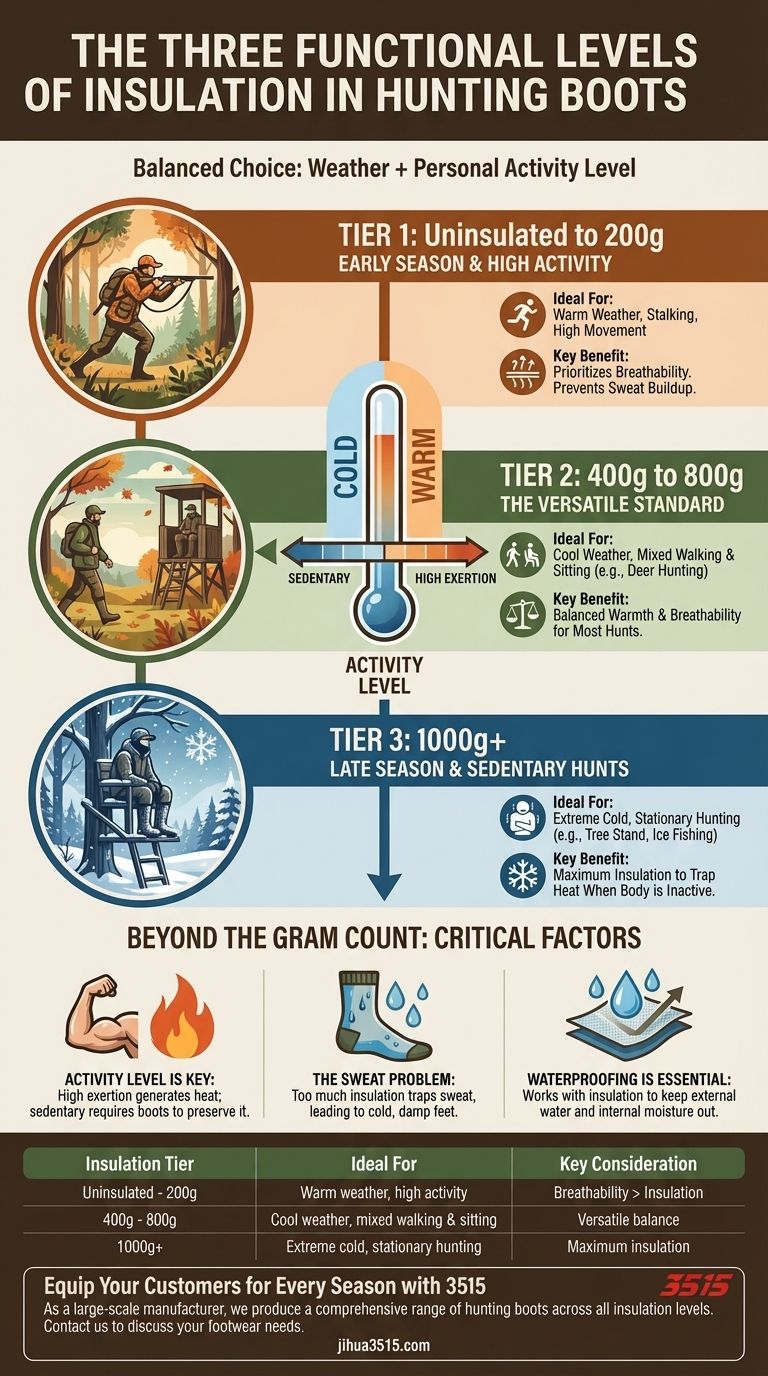
At its core, there are three functional tiers of insulation in hunting boots, measured in grams of insulating material. The first is Uninsulated to 200 grams for warm weather and high activity. The second is 400 to 800 grams, the versatile standard for most cool-weather hunts. The third is 1000 grams and above, built for extreme cold and stationary activities.
The most common mistake is choosing insulation based only on the outside temperature. The right choice is a balance between the weather and your personal activity level, because your greatest enemy in the cold is not the air, but the sweat you produce.
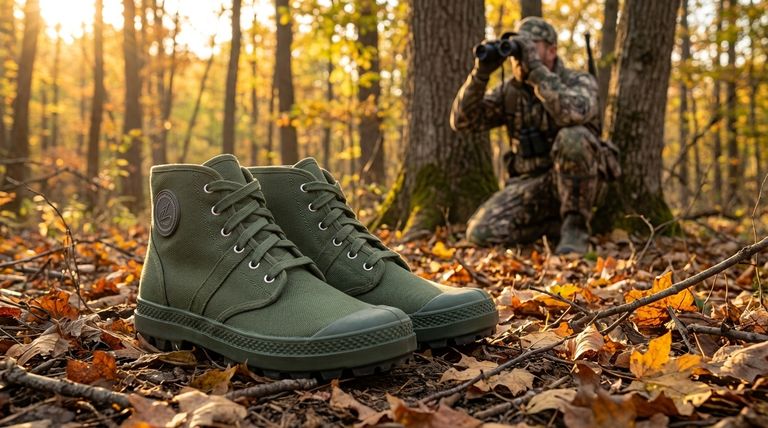
The Three Tiers of Insulation Explained
Understanding these tiers is less about memorizing numbers and more about matching the boot's capability to the demands of your hunt. Each level serves a distinct purpose.
Tier 1: Uninsulated to 200g (Early Season & High Activity)
This range is designed for mild conditions or when you are constantly moving. Stalking elk in the early season or covering significant ground generates immense body heat.
In these scenarios, breathability is more important than heavy insulation. Too much insulation will trap heat, cause your feet to sweat, and ultimately make them cold and damp once you stop moving.
Tier 2: 400g to 800g (The Versatile Standard)
This is the workhorse category for the majority of hunters. It provides a crucial balance of warmth for cool fall mornings and enough breathability to handle moderate walking.
Boots in the 400g to 800g range are ideal for deer hunting, where periods of walking are mixed with periods of sitting. This level offers enough protection for chilly weather without causing significant overheating during movement.
Tier 3: 1000g+ (Late Season & Sedentary Hunts)
When the temperature plummets and your activity level drops to zero, you need maximum insulation. This tier is built specifically for stationary hunting in frigid conditions.
Think of sitting in a tree stand, a duck blind, or ice fishing. With minimal movement, your body isn't generating heat, and circulation to your extremities decreases. Boots with 1000g, 1200g, or even 2000g of insulation are required to trap what little heat you have and protect you from the cold.
Beyond the Gram Count: Critical Factors That Matter
The gram rating is a starting point, but other factors are just as critical for maintaining warm, dry feet.
Your Activity Level is the Deciding Factor
This is the most important variable. High physical exertion generates significant heat, reducing your need for insulation. Sedentary activity generates almost none, making you entirely reliant on your boots to preserve warmth.
You must honestly assess how much you'll be walking versus sitting on any given hunt.
The Problem with Sweat
Insulation doesn't create heat; it only traps the heat your body produces. If your insulation is too heavy for your activity level, it will trap too much heat, leading to sweat.
Wet socks and damp feet lose heat exponentially faster than dry ones. This is why a hunter in 2000g boots can get colder feet while walking than a hunter in 400g boots—the first is soaked in sweat, and the second is dry.
The Importance of Waterproofing
Insulation is useless if your feet get wet from an external source. A quality waterproof membrane is a non-negotiable feature that works in tandem with insulation. It keeps snow, slush, and water out while allowing some moisture vapor from sweat to escape.
Understanding the Trade-offs
There is no single boot that can do it all. Choosing one level of insulation always involves a compromise.
The Risk of Over-Insulating
This is the most common and counter-intuitive mistake. Choosing a boot that is too warm for your activity level guarantees sweaty, clammy, and eventually cold feet. It also leads to discomfort and blisters.
The Danger of Under-Insulating
The more obvious risk is choosing too little insulation for cold, sedentary conditions. This leads to discomfort, loss of focus, and in extreme cases, puts you at risk for frostbite or other cold-related injuries.
The Reality of Owning Multiple Pairs
Because of these trade-offs, serious all-season hunters often own at least two pairs of boots. One for active, early-season hunts and another for cold, late-season sits. Trying to make one boot cover all scenarios inevitably leads to being uncomfortable at some point.
Making the Right Choice for Your Hunt
Use your primary hunting style as your guide to select the right level of insulation.
- If your primary focus is active, early-season stalking: Choose an uninsulated or 200g boot to prioritize breathability and prevent sweat.
- If your primary focus is all-around fall hunting with mixed walking and sitting: The 400g to 800g range offers the best versatility for most conditions.
- If your primary focus is stationary, late-season hunting in the cold: Select 1000g or more to ensure your feet stay warm when you aren't moving.
Ultimately, matching your boot's insulation to your activity level, not just the thermometer, is the key to comfort and success in the field.
Summary Table:
| Insulation Tier | Ideal For | Key Considerations |
|---|---|---|
| Uninsulated - 200g | Warm weather, high activity (e.g., stalking) | Prioritizes breathability to prevent sweat. |
| 400g - 800g | Cool weather, mixed walking & sitting (e.g., deer hunting) | The versatile standard for balanced warmth and breathability. |
| 1000g+ | Extreme cold, stationary hunting (e.g., tree stands) | Maximum insulation for when your body generates little heat. |
Ensure Your Hunters Have the Right Boot for Every Season
As a distributor, brand owner, or bulk client, providing the correct footwear is key to your customers' success and satisfaction. 3515, a large-scale manufacturer, produces a comprehensive range of hunting boots across all insulation levels—from breathable 200g models for early season to heavy-duty 1000g+ boots for the deep freeze. Our production capabilities ensure you get the right boots, in the right quantities, to meet every demand.
Let's equip your customers for ultimate comfort in the field. Contact our team today to discuss your hunting footwear needs.
Visual Guide
Related Products
- Premium Insulated Safety Boots and Shoes for Wholesale & Bulk Orders
- High-Traction Suede Tactical Boots Wholesale & Custom Manufacturing
- Durable Military Combat Boots with Water Drainage for Wholesale & OEM
- Wholesale Waterproof Tactical Boots Custom Suede & High-Traction Soles
- Wholesale Lightweight Tactical Boots Custom Manufacturer for Desert & Combat Use
People Also Ask
- What are the recommended insulation ratings for mild winter conditions? A Guide for Active & Stationary Workers
- How does insulation thickness correlate with temperature ranges? A Guide to Choosing the Right Warmth
- What insulation level is needed for severe cold and stationary work? 1200g or Higher is Essential
- What safety advantages do insulated boots offer beyond warmth? Dielectric Protection & Superior Grip
- How does fleece lining contribute to the warmth of insulated boots? Trapping Air for Superior Cold Protection