
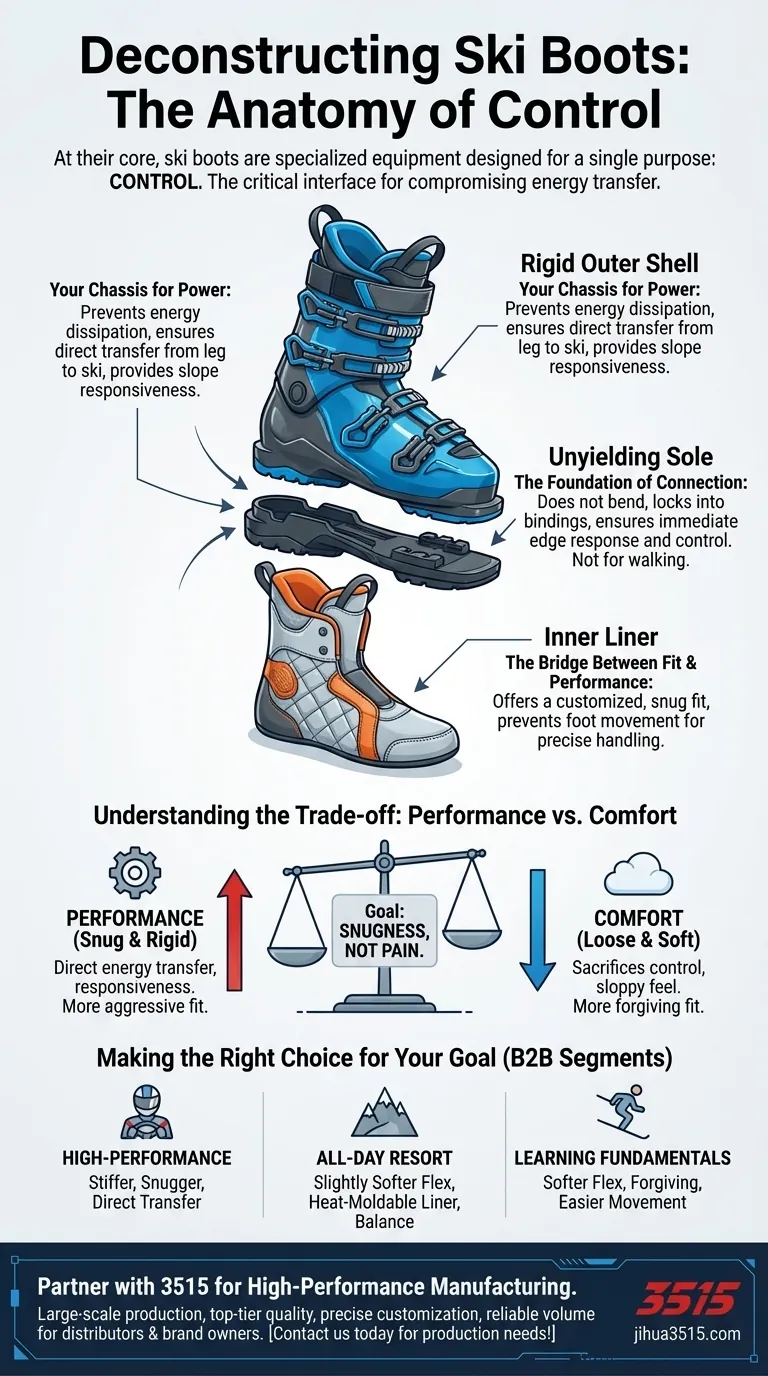
At their core, ski boots are highly specialized equipment designed for a single purpose: control. Their primary characteristics are a hard, rigid outer shell, an unyielding sole, and a soft, removable inner liner. This combination is engineered not for walking or comfort, but for translating the subtle movements of your legs and feet directly into the edges of your skis with maximum efficiency.
A ski boot's defining traits—its rigidity and snug fit—are not about comfort, but about uncompromising energy transfer. They function as the critical interface between your body and your skis, turning physical intention into precise action on the snow.

The Anatomy of Control: Deconstructing the Ski Boot
To understand why ski boots feel the way they do, it's essential to analyze how each component contributes to performance on the slopes. They are less like footwear and more like a piece of high-performance machinery.
The Rigid Outer Shell: Your Chassis for Power
The most obvious feature is the hard plastic outer shell. This component is intentionally rigid to provide a strong framework around your foot and lower leg.
This rigidity prevents your ankle and foot from flexing in ways that would dissipate energy, ensuring every ounce of force you generate is directed into the ski. This is the source of a boot's "slope responsiveness."
The Unyielding Sole: The Foundation of Connection
The sole of a ski boot does not bend. This is a critical design feature.
The boot's sole locks directly into the ski binding. Any flex in this area would create a delay or a loss of information between you and the ski, reducing control and edge-hold on the snow. This is also why ski boots are notoriously difficult and awkward to walk in.
The Inner Liner: The Bridge Between Fit and Performance
Inside the hard shell sits a removable, cushioned liner. This is the component that makes performance possible.
Its primary job is to provide a snug, customized fit that holds your foot securely in place, preventing movement within the shell. Many modern liners are heat-moldable, allowing a boot-fitter to shape them precisely to the contours of your feet for a near-perfect fit.
Understanding the Trade-offs: Performance vs. Comfort
The unique design of a ski boot creates an inherent conflict between an aggressive, performance-oriented fit and all-day comfort. Understanding this balance is key.
The Myth of All-Day Comfort
A ski boot will never feel like a sneaker or a hiking boot. Its purpose is fundamentally different.
The "comfort limitations" noted in their design are a direct consequence of the need for a snug, responsive fit. A boot that feels loose and comfortable in the shop will often feel sloppy and uncontrollable on the mountain.
The Critical Nature of Fit
The goal is snugness, not pain. A properly fitted boot should hold your foot securely from all sides without creating specific pressure points that cause pain or cut off circulation.
A boot that is too loose sacrifices control. A boot that is too tight is not only painful but can hinder performance by restricting the small, precise movements your foot needs to make.
Specialized Use Only
Ski boots are a single-purpose tool. Their rigid construction and angled stance are optimized for the skiing position.
They are not designed for extended walking and should only be worn for the act of skiing and moving between the lift and the slope.
Making the Right Choice for Your Goal
Selecting a boot means aligning its characteristics with your personal skiing objectives.
- If your primary focus is high-performance, aggressive skiing: Prioritize a stiffer, snugger-fitting boot that offers the most direct energy transfer and responsiveness.
- If your primary focus is all-day resort skiing and comfort: Opt for a boot with a slightly softer flex and a high-quality, heat-moldable liner to achieve a balance between control and comfort.
- If your primary focus is learning the fundamentals as a beginner: Choose a more forgiving boot with a softer flex that allows for easier ankle movement and makes it easier to maintain balance.
Ultimately, understanding these characteristics allows you to select a boot that functions as a natural extension of your body, translating intention directly onto the snow.
Summary Table:
| Key Characteristic | Primary Function | Impact on Performance |
|---|---|---|
| Rigid Outer Shell | Acts as a chassis for power | Ensures direct energy transfer from leg to ski |
| Unyielding Sole | Locks into bindings for stability | Provides immediate edge response and control |
| Removable Inner Liner | Offers a customized, snug fit | Prevents foot movement for precise ski handling |
Ready to equip your customers with high-performance ski boots? As a large-scale manufacturer, 3515 produces a comprehensive range of specialized footwear for distributors, brand owners, and bulk clients. Our production capabilities ensure top-tier quality, precise customization, and reliable volume for all types of ski boots. Partner with us to deliver the control and performance your market demands. Contact us today to discuss your production needs!
Visual Guide
Related Products
- Wholesale Waterproof Tactical Boots Custom Suede & High-Traction Soles
- Durable Goodyear Welt Leather Work Boots for Wholesale & Private Label
- Wholesale High-Traction Camo Boots - Custom Manufacturer for Brands
- Durable High-Ankle Tactical Boots Wholesale Manufacturer for Custom & Bulk Orders
- Durable Leather High-Ankle Tactical Boots for Wholesale & Custom Manufacturing
People Also Ask
- What waterproof technology is used in tactical boots? Unlock All-Weather Performance & Protection
- What are the advantages and disadvantages of waterproof tactical boots? A Guide to the Key Trade-Offs
- What is the significance of waterproof functionality in tactical boots? Essential for Health & Performance
- What is the role of professional 3D medical imaging software in optimizing tactical boot design and performance?
- What features enhance breathability and comfort in tactical boots? A Guide to Superior Footwear Performance



















