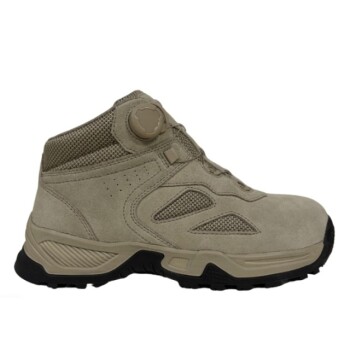
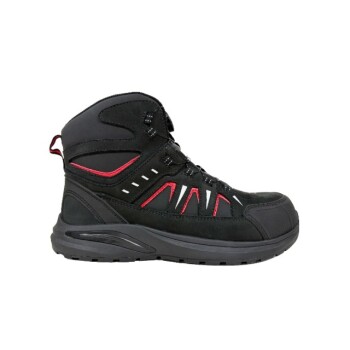
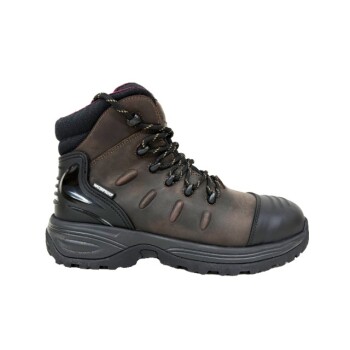
Industrial safety boots in oil palm plantations primarily function as a critical shield against puncture injuries and environmental instability. Specifically, they defend workers against sharp oil palm thorns and fallen fruit scattered across the ground. Beyond puncture resistance, their tough construction provides the necessary ankle support and traction to navigate the complex, often slippery terrain found in plantation environments.
The core protective value of these boots lies in their ability to prevent debilitating puncture wounds from thorns while simultaneously stabilizing the worker on treacherous, uneven ground to prevent slips and falls.
Defending Against Puncture Hazards
The Threat of Thorns and Debris
In a plantation setting, the ground is frequently littered with sharp organic matter. Puncture resistance is the single most critical function of the boot's sole and upper construction.
Preventing Deep Tissue Injury
Sharp oil palm thorns can easily penetrate standard footwear. Industrial boots utilize tough, reinforced soles to stop these sharp objects from reaching the foot.
Mitigating Infection Risks
By maintaining a sealed barrier against punctures, these boots play a vital role in health maintenance. They prevent initial injuries that often lead to severe, difficult-to-treat secondary infections common in tropical environments.
Ensuring Stability on Complex Terrain
Navigating Slippery Surfaces
Plantation floors are rarely flat or dry. They are often covered in loose soil, mud, or the slick residue of fallen fruit. Slip-resistant outsoles are essential for maintaining traction and preventing falls during harvesting activities.
Support for Uneven Ground
Field maintenance requires walking over roots, ditches, and slopes. The structural rigidity of industrial safety boots offers critical ankle support, reducing the likelihood of twists or sprains on unstable surfaces.
Secondary Protections for Maintenance Roles
Impact Resistance for Heavy Tasks
While the primary reference emphasizes thorns, maintenance roles often involve heavy tools or machinery. In these specific contexts, protective toe caps (anti-smash features) absorb impact energy, protecting toes from crushing injuries caused by dropped equipment or heavy fruit bunches.
Protection from Mechanical Hazards
For workers involved in the maintenance of field machinery, the sturdy construction of the boot acts as a shield. It provides a physical barrier against incidental contact with moving mechanical parts or rough metallic surfaces.
Understanding the Trade-offs
Weight vs. Fatigue
The reinforced materials required for puncture and impact resistance inevitably add weight. Heavier boots can increase worker fatigue over long shifts, which may inadvertently lead to stumbling or slower reaction times.
Breathability vs. Protection
To effectively resist punctures and moisture, these boots often use dense, impermeable materials. In hot plantation climates, this can lead to reduced breathability, potentially causing discomfort or fungal issues if foot hygiene is not managed.
Making the Right Choice for Your Goal
Select your safety footwear based on the specific risks associated with the worker's daily tasks.
- If your primary focus is Field Harvesting: Prioritize puncture resistance and high-traction soles to handle thorns and slippery mud.
- If your primary focus is Machinery Maintenance: Prioritize impact-resistant toe caps and sturdy uppers to protect against falling tools and heavy equipment.
Effective safety gear is not just about armor; it is about matching the protection to the specific environment.
Summary Table:
| Feature | Protective Function | Primary Benefit |
|---|---|---|
| Reinforced Soles | Puncture Resistance | Blocks sharp oil palm thorns and ground debris |
| Traction Outsoles | Slip Resistance | Ensures stability on mud and slick fruit residue |
| Rigid Structure | Ankle Support | Prevents sprains and twists on uneven plantation ground |
| Steel/Composite Toes | Impact Protection | Shields feet from heavy tools and falling fruit bunches |
| Sealed Barriers | Infection Prevention | Reduces risk of secondary infections from tropical wounds |
Partner with 3515 for High-Performance Safety Footwear
As a large-scale manufacturer serving distributors and brand owners, 3515 offers comprehensive production capabilities for all footwear types, anchored by our flagship Safety Shoes series. We understand the unique challenges of oil palm plantations, providing specialized puncture-resistant and slip-resistant solutions that ensure worker safety and durability.
Our extensive portfolio covers:
- Work & Tactical Boots for rugged field environments
- Outdoor & Training Shoes for versatile terrain
- Sneakers, Dress & Formal Shoes for diverse bulk requirements
Elevate your product line with our proven manufacturing expertise. Contact us today to discuss your bulk requirements and custom specifications!
References
- Willia Novita Eka Rini, Budi Aswin. Palm Oil Farmers' Perceptions on the Use of Personal Protective Equipment (PPE) in Rantau Rasau District, Tanjung Jabung District, Jambi Province. DOI: 10.55927/eajmr.v2i1.2623
This article is also based on technical information from 3515 Knowledge Base .
Related Products
- Premium Waterproof High-Cut Industrial Safety Boots for Wholesale and Bulk Orders
- Puncture-Resistant Velcro Safety Boots for Wholesale & Custom Manufacturing
- Premium Wholesale Waterproof Safety Boots High Performance Protection for Industrial Markets
- Customizable Anti-Smash Safety Boots for Wholesale & Private Label Manufacturing
- Premium Wholesale Wheat Nubuck Safety Boot with Rapid Lacing System
People Also Ask
- Why are oil-resistant and anti-slip properties critical for industrial safety boots? Expert Outsole Engineering Guide
- What dual characteristics do industrial safety boots exhibit? Balance Worker Protection with Health Recovery Efficiency
- Why is professional industrial-grade safety footwear a suitable carrier for diabetic rehabilitation insoles?
- What protective functions do industrial-grade safety boots provide in construction and mining? Maximize Worker Safety
- What functions do industrial safety boots serve? Essential Protection for Footwear Sole & Stockfit Processing