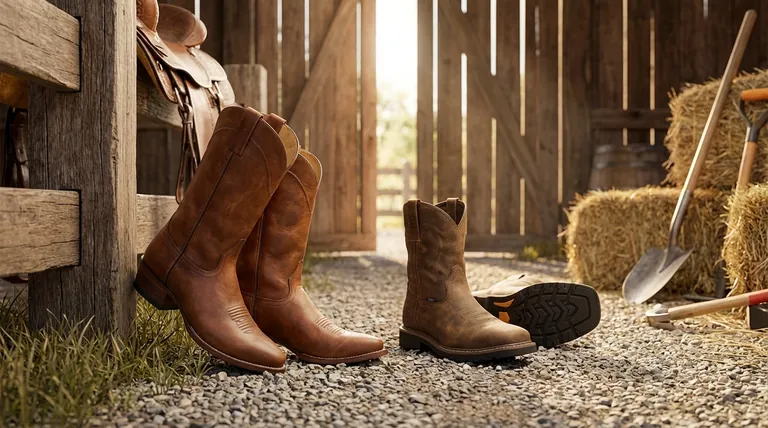
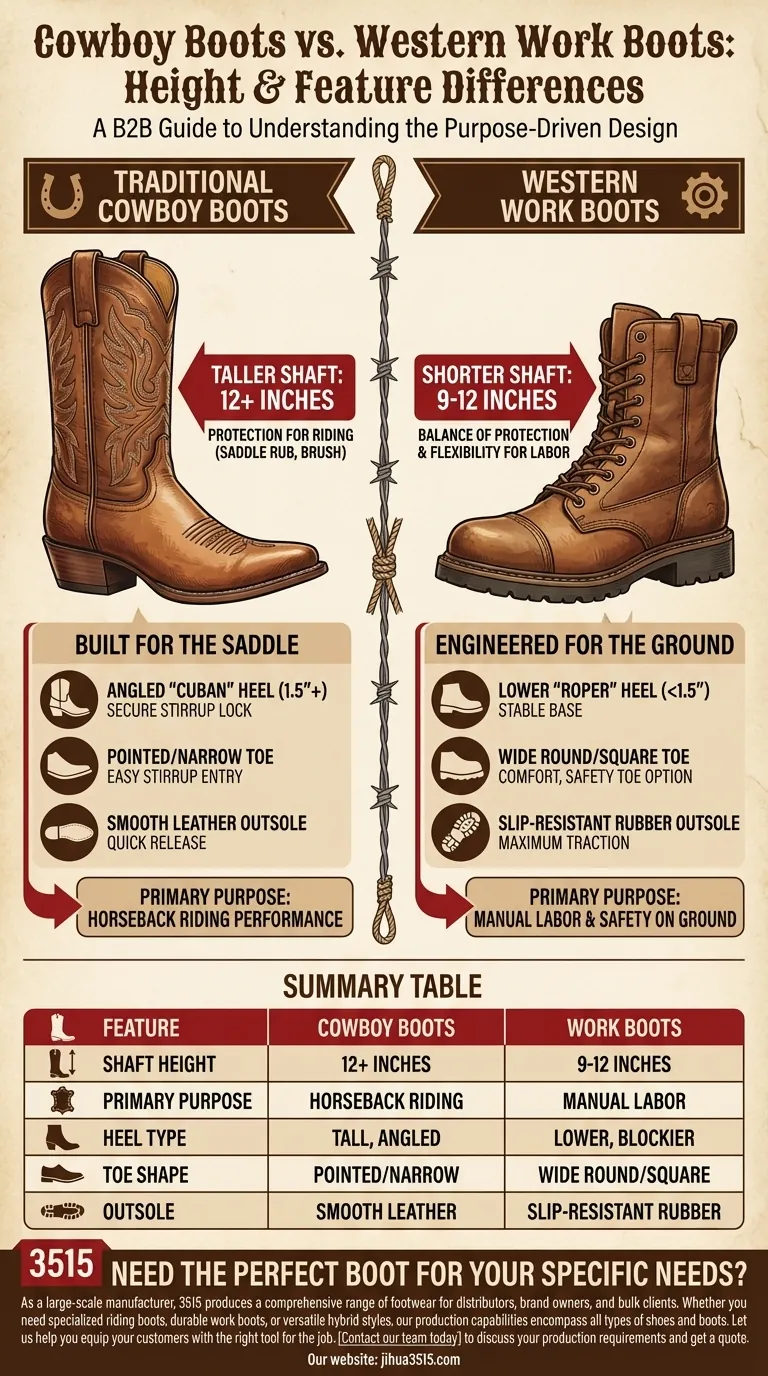
At a glance, traditional cowboy boots are typically taller, with shafts reaching at least mid-calf at around 12 inches. Western work boots are generally shorter, with shafts ranging from 9 to 12 inches, providing a more functional height for labor.
The height difference between these boots is a direct reflection of their core purpose. Cowboy boots use a taller shaft for riding protection, while Western work boots prioritize on-the-ground mobility and safety with a shorter shaft.
The Purpose Behind the Design
The shaft height isn't an arbitrary style choice; it's a critical design element directly tied to the boot's intended function. Understanding this purpose is key to selecting the right footwear.
Traditional Cowboy Boots: Built for the Saddle
The classic cowboy boot features a taller shaft, typically 12 inches or more.
This height serves to protect the rider's legs from saddle rub, brush, thorns, and snake bites while on horseback. The entire design is optimized for being in a stirrup.
Western Work Boots: Engineered for the Ground
Western work boots have a shorter shaft, usually in the 9 to 12-inch range.
This lower height offers a crucial balance between ankle protection and the flexibility needed for walking, bending, and squatting during a long workday. The focus is on stability and safety on varied terrain, not riding performance.
Key Differences Beyond Just Height
While shaft height is a clear differentiator, it's part of a complete system of features that separates these two boot categories.
The Heel
A traditional cowboy boot has a taller, angled "Cuban" heel (often 1.5 inches or more) designed to lock securely into a stirrup and prevent the foot from slipping through.
A Western work boot has a lower, blockier "roper" style heel that is often 1.5 inches or shorter. This provides a wider, more stable base for walking and standing on hard surfaces.
The Toe Box
Cowboy boots traditionally feature a pointed or narrow rounded toe. This sleek profile makes it easier for a rider to slide their foot into the stirrup quickly.
Work boots have a much wider round or square toe box. This offers more room for the toes to spread out, increasing comfort for all-day wear and often accommodating a reinforced safety toe (steel or composite).
The Outsole
The classic cowboy boot uses a smooth leather outsole. This is intentional, as it allows the foot to slide easily in and out of the stirrup without catching.
In contrast, Western work boots are built with thick, slip-resistant rubber outsoles. These soles feature heavy treading to provide maximum traction and safety on slick, uneven, or hazardous surfaces.
Understanding the Trade-offs
Choosing between these boots means prioritizing one set of benefits over another. Neither is inherently better; they are simply tools for different jobs.
Cowboy Boots: Riding Performance vs. Ground Instability
The features that make a cowboy boot perfect for riding—the tall shaft, angled heel, and smooth sole—become liabilities for extensive groundwork. They offer poor traction and can feel unstable for walking long distances.
Western Work Boots: Safety and Comfort vs. Riding Awkwardness
The work boot's design prioritizes safety and stability above all. Its grippy rubber sole and wide heel, while excellent for labor, can make it difficult and even unsafe to use in a stirrup, as it may not release easily in an emergency.
Making the Right Choice for Your Needs
Your decision should be guided entirely by your primary activity.
- If your primary focus is horseback riding: Choose a traditional cowboy boot for its specialized heel, toe, and sole designed for optimal stirrup use and leg protection.
- If your primary focus is manual labor, construction, or all-day wear on your feet: Select a Western work boot for its superior stability, safety features, and all-terrain traction.
- If you need a versatile hybrid for ranch work and occasional riding: Look for a "roper" or "rancher" style boot, which often blends the lower, stable heel of a work boot with a sole suitable for both walking and stirrups.
Ultimately, you are choosing a specialized tool, so match the boot's design to the task you perform most.
Summary Table:
| Feature | Traditional Cowboy Boots | Western Work Boots |
|---|---|---|
| Shaft Height | 12 inches or more | 9 to 12 inches |
| Primary Purpose | Horseback Riding | Manual Labor / All-Day Work |
| Heel Type | Tall, angled "Cuban" heel | Lower, blockier "roper" heel |
| Toe Shape | Pointed or narrow rounded | Wide round or square (often safety-toe) |
| Outsole | Smooth leather | Slip-resistant rubber |
Need the Perfect Boot for Your Specific Needs?
As a large-scale manufacturer, 3515 produces a comprehensive range of footwear for distributors, brand owners, and bulk clients. Whether you need specialized riding boots, durable work boots, or versatile hybrid styles, our production capabilities encompass all types of shoes and boots.
Let us help you equip your customers with the right tool for the job.
Contact our team today to discuss your production requirements and get a quote.
Visual Guide
Related Products
- Durable Goodyear Welt Leather Work Boots for Wholesale & Private Label
- Durable Leather Work Boots for Wholesale & Custom Manufacturing
- Durable Leather Work Boots for Wholesale & Custom OEM Manufacturing
- Durable Moc-Toe Wedge Work Boots | Wholesale Manufacturing for Brands
- Wholesale Leather Work Boots with Customizable Wedge Sole for Brands
People Also Ask
- What is the difference between full-grain and top-grain leather? Premium Material Guide for Boot Manufacturers
- What are the advantages of leather as an upper material for work boots? Unmatched Durability & Custom Comfort
- Why is it important to waterproof leather work boots? Protect Your Investment and Performance
- How should new leather work boots be broken in? A Guide to Comfort and Durability
- What are the advantages of leather uppers in work boots? Unmatched Durability & Protection