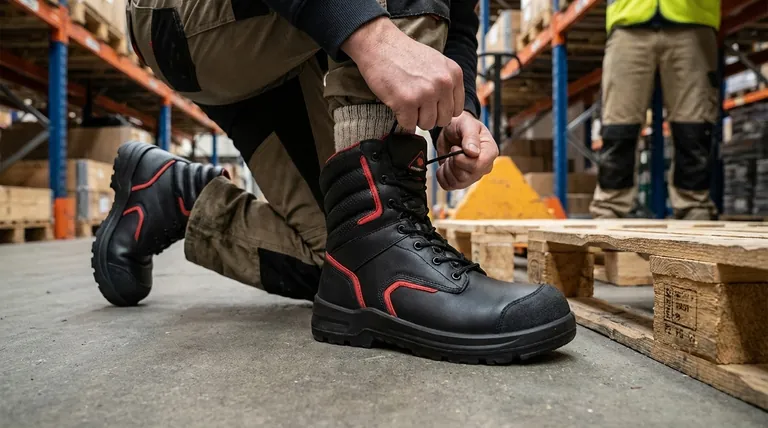
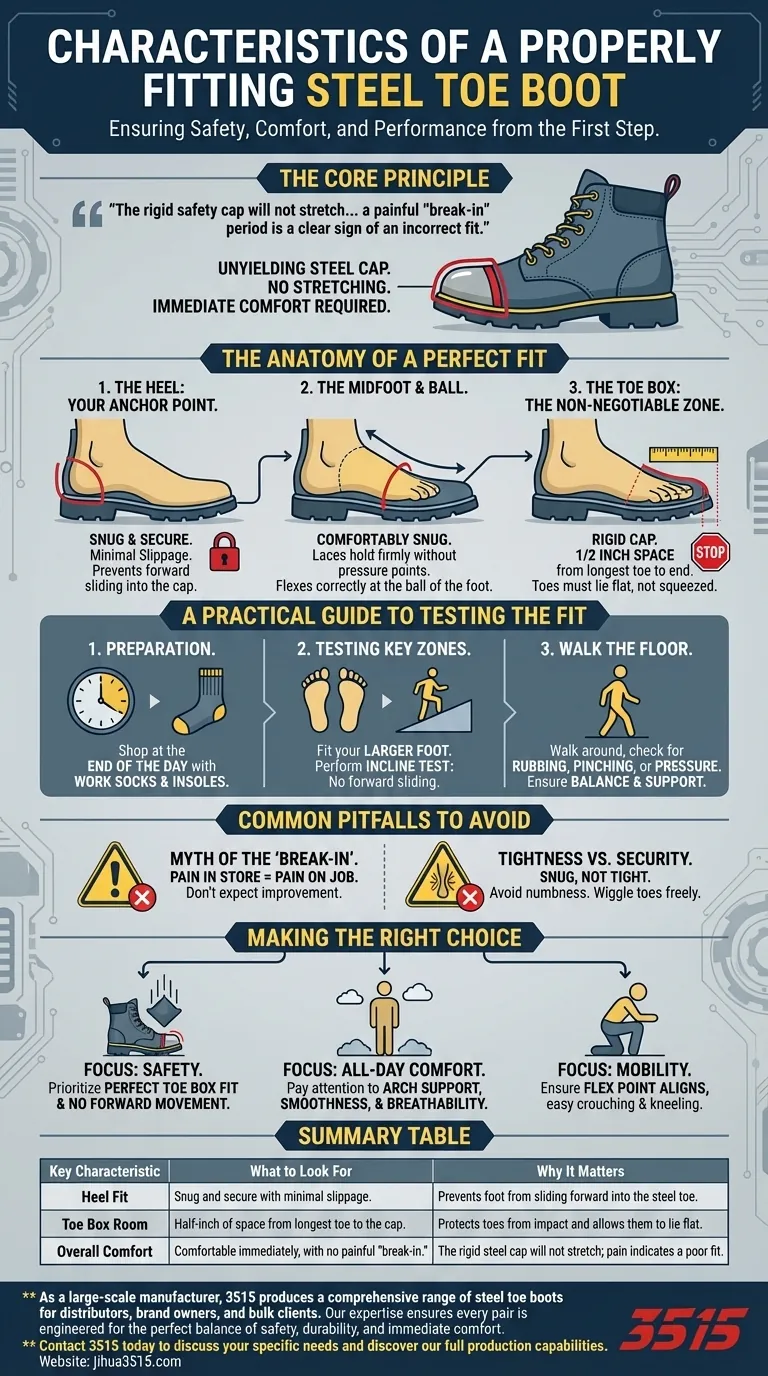
A properly fitting steel toe boot is defined by three critical factors: a snug, locked-in heel that prevents slipping; sufficient room in the protective toe box for your toes to lie flat and not touch the end; and immediate comfort from the moment you put it on. Unlike other footwear, the rigid safety cap will not stretch, meaning a painful "break-in" period is a clear sign of an incorrect fit.
The core principle of fitting a steel toe boot is to accommodate its unforgiving, rigid safety toe. The rest of the boot must fit perfectly around your foot to hold it securely in place, preventing painful friction against the unyielding steel cap.
The Anatomy of a Perfect Fit
Understanding how a boot should feel in key areas is the first step to ensuring both safety and all-day comfort. The goal is a secure fit that doesn't restrict natural movement or circulation.
The Heel: Your Anchor Point
Your heel should feel snug and secure in the boot's heel counter. When you walk, there should be minimal to no slippage.
This locked-in fit is crucial. It prevents your foot from sliding forward and jamming your toes into the steel cap, which is the most common source of pain.
The Midfoot and Ball of the Foot
The boot should feel comfortably snug across the widest part of your foot (the ball). The lacing system should hold your foot firmly without creating pressure points.
When you bend your foot, the boot should flex at the ball of your foot. If the flex point is too far forward or back, it will cause discomfort and premature wear.
The Toe Box: The Non-Negotiable Zone
This is the most critical area. The protective toe cap is rigid and will not change shape.
You must have enough length for your longest toe to be about a half-inch away from the end of the cap when standing. Your toes should also be able to lie flat without being squeezed from the sides or pushed down from the top.
A Practical Guide to Testing the Fit
Trying on boots is a physical test. You need to simulate workday conditions to expose any potential fit issues before you make a purchase.
Come Prepared for the Fitting
Always shop for boots at the end of the day, when your feet are naturally at their largest.
Wear the same type of thick work socks you use on the job, as they significantly impact the boot's internal volume. If you use custom insoles or orthotics, bring them with you.
Test the Key Fit Zones
First, ensure you are fitting to your larger foot, as most people have one foot that is slightly bigger than the other.
Perform a simple incline test. Find a ramp or stairs and stand facing downhill. Your toes should not slide forward and jam into the front of the toe cap.
Walk the Floor
Walk around for several minutes. Pay close attention to any rubbing, pinching, or pressure points, especially around the heel and the edges of the steel toe cap.
Check that the boots feel balanced and provide adequate support through your arch.
Common Pitfalls to Avoid
Trusting brand reputation over personal fit is a frequent mistake. Every foot is different, and the right boot is the one that fits you perfectly, regardless of the name on the side.
The Myth of the "Break-In" Period
A quality work boot should feel comfortable immediately. While the leather upper may soften over time, the fundamental fit around the steel toe and heel will not change.
If a boot is painful in the store, it will be painful on the job. Do not buy a boot expecting it to "get better."
Confusing Tightness with Security
A boot should be snug, not tight. A boot that is too tight restricts blood flow, causing numbness and pain over a long shift.
Ensure you can still wiggle your toes freely inside the toe box even when the boot is laced up securely.
Making the Right Choice for Your Workday
Your specific job requirements should guide your final decision. By focusing on the right characteristics, you can find a boot that serves as a tool, not a hindrance.
- If your primary focus is safety around heavy objects: Prioritize a perfect fit in the toe box, ensuring absolutely no forward foot movement during the incline test.
- If your primary focus is all-day comfort while standing or walking: Pay extra attention to arch support, interior smoothness, and overall breathability.
- If your primary focus is mobility and flexibility: Ensure the boot's flex point aligns perfectly with the ball of your foot and allows for easy crouching or kneeling.
Ultimately, investing the time to find a perfectly fitting steel toe boot is an investment in your own daily health and safety.
Summary Table:
| Key Characteristic | What to Look For | Why It Matters |
|---|---|---|
| Heel Fit | Snug and secure with minimal slippage. | Prevents foot from sliding forward into the steel toe. |
| Toe Box Room | Half-inch of space from longest toe to the cap. | Protects toes from impact and allows them to lie flat. |
| Overall Comfort | Comfortable immediately, with no painful "break-in." | The rigid steel cap will not stretch; pain indicates a poor fit. |
As a large-scale manufacturer, 3515 produces a comprehensive range of steel toe boots for distributors, brand owners, and bulk clients. Our expertise ensures every pair is engineered for the perfect balance of safety, durability, and immediate comfort. Let us help you equip your workforce with boots that fit right from the first step.
Contact 3515 today to discuss your specific needs and discover our full production capabilities.
Visual Guide
Related Products
- Wholesale Durable Breathable Safety Boots Custom OEM Manufacturer
- Durable Steel Toe Safety Boots Wholesale & Custom Manufacturing
- Wholesale Durable 6-Inch Work Boots | Custom & Private Label Manufacturer
- Puncture-Resistant Velcro Safety Boots for Wholesale & Custom Manufacturing
- Premium Sport Style Safety Boots for Bulk Orders
People Also Ask
- Why are industrial safety boots with steel toes necessary for machine operators? Essential Foot Protection for Safety
- Is it true that steel toes can cause toes to get cut off? Debunking the Dangerous Myth
- What are the characteristics of steel toe safety boots? Maximum Protection, Key Trade-offs
- Is there any truth to the myth about steel toe boots causing toe injuries upon impact? Debunking Common Safety Concerns
- Are steel toe boots comfortable for casual wear? Find Your Perfect Balance of Style & Safety