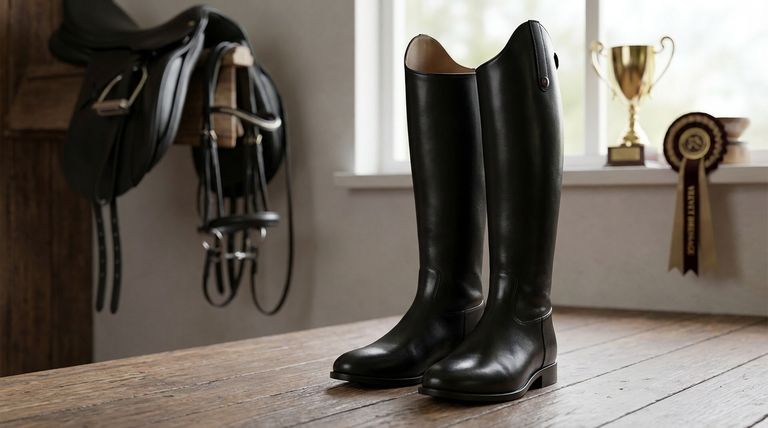
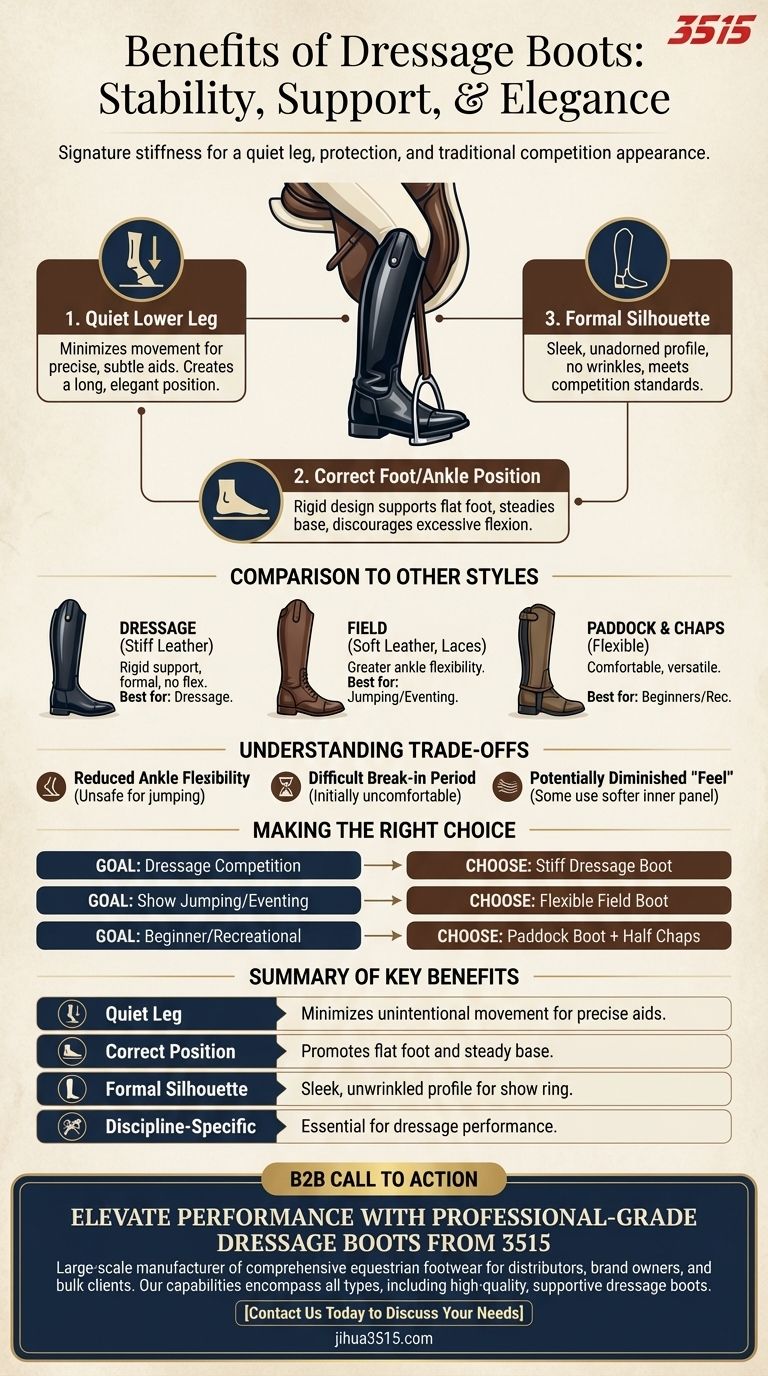
The core benefits of dressage boots stem directly from their signature stiffness and elegant design. This construction provides exceptional support to help the rider maintain a long, still, and quiet lower leg, which is fundamental to the discipline. They also offer the protection of a tall boot while creating the polished, traditional appearance required for competition.
Dressage boots are a specialized tool, not just footwear. Their defining stiffness is a functional feature designed to immobilize the rider's ankle and lower leg, creating the stability and elongated profile essential for effective dressage riding.
The Functional Purpose of Stiffness
The most defining characteristic of a dressage boot is its rigid construction. This isn't for fashion; it's a feature that directly impacts the rider's position and ability to communicate with the horse.
Encouraging a Quiet Lower Leg
The very stiff leather, often reinforced with a stiffener up the back of the boot, minimizes unintentional movement in the rider's lower leg.
This stability allows for the precise, subtle leg aids that are the hallmark of dressage. It helps create the long, elegant leg position that is both aesthetically pleasing and functionally correct for the discipline.
Promoting Correct Foot and Ankle Position
Unlike more flexible boots, dressage boots are designed with very little ankle creasing.
This structure supports a flat foot position in the stirrup and discourages excessive ankle flexion, helping the rider maintain a steady base of support.
Creating a Formal Silhouette
The sleek, unadorned profile of a dressage boot provides the smart and traditional appearance expected in the show ring.
Because they are so stiff, they do not wrinkle or slouch around the ankle, maintaining a clean line from the knee to the heel.
How Dressage Boots Compare to Other Styles
To fully appreciate the benefits of a dressage boot, it's helpful to understand how they differ from other common types of riding boots.
Dressage vs. Field Boots
Field boots, popular with show jumpers, are the most common alternative. They are made of softer leather and feature a distinctive lace-up closure at the ankle.
This design allows for greater ankle flexibility, which is necessary for the shorter stirrup length and two-point position used when jumping. Dressage boots lack this flexibility.
Dressage vs. Paddock Boots & Half Chaps
Short riding boots, also called paddock boots, are often paired with half-chaps to mimic the function of a long boot.
This combination is generally more comfortable, easier to break in, and cooler in hot weather. However, it lacks the rigid support and formal appearance of a true dressage boot.
Leather vs. Synthetic Boots
While high-level dressage boots are made of stiff leather, many beginner boots are made of rubber or plastic.
These synthetic options are more affordable, waterproof, and extremely easy to clean. They are an excellent choice for children or riders working in stables, but they do not offer the same performance or refined fit as a quality leather boot.
Understanding the Trade-offs
The specialized nature of dressage boots means their benefits come with clear limitations.
Reduced Ankle Flexibility
The primary benefit—stiffness—is also the primary drawback for other disciplines. The lack of ankle flexion makes these boots unsuitable and even unsafe for jumping.
A Difficult Break-in Period
The rigid leather requires a significant break-in period. The boots can be quite uncomfortable at first, particularly behind the knee and at the ankle, until the leather softens to the rider's leg.
Potentially Diminished "Feel"
For some riders, the thick, stiff leather can reduce the direct feel of the horse's sides. To counteract this, some modern dressage boots feature a panel of softer leather on the inner calf to enhance communication.
Making the Right Choice for Your Discipline
Choosing the right boot depends entirely on your riding goals and priorities.
- If your primary focus is dressage competition: A stiff, traditional dressage boot is essential for achieving the required leg position and formal appearance.
- If your primary focus is show jumping or eventing: The ankle flexibility of a field boot is non-negotiable for safety and performance over fences.
- If you are a beginner or ride recreationally: A more comfortable and versatile paddock boot with half-chaps offers a practical and cost-effective starting point.
Ultimately, your riding boots are a key piece of equipment that should support your function in the saddle, not hinder it.
Summary Table:
| Key Benefit | Description |
|---|---|
| Quiet Lower Leg | Stiff construction minimizes unintentional movement for precise aids. |
| Correct Ankle Position | Rigid design promotes a flat foot and steady base in the stirrup. |
| Formal Silhouette | Sleek, unwrinkled profile meets traditional competition standards. |
| Discipline-Specific Support | Essential for dressage; unsuitable for jumping due to lack of flexibility. |
Ready to elevate your performance with professional-grade dressage boots?
As a large-scale manufacturer, 3515 produces a comprehensive range of equestrian footwear for distributors, brand owners, and bulk clients. Our production capabilities encompass all types of riding boots, including high-quality, supportive dressage boots designed for optimal performance and durability.
Contact us today to discuss your needs and discover how we can be your trusted manufacturing partner.
Visual Guide
Related Products
- Wholesale Comfort Dress Shoes with Dial Closure for Custom Manufacturing
- Classic Leather Derby Dress Shoes Wholesale & Custom Manufacturing
- Wholesale Perforated Comfort Dress Shoes | Custom Derby Shoe Manufacturer
- Wholesale Patent Oxford Dress Shoes | Custom & Bulk Manufacturing
- Wholesale Breathable Perforated Leather Derby Dress Shoes for Custom Brands
People Also Ask
- How do comfort dress shoes differ from traditional dress shoes? Discover the Ergonomic Advantage
- Which dress shoe styles are suitable for wearing with jeans? A Guide to Smart-Casual Style
- What features make dress shoes suitable for standing all day? Achieve All-Day Comfort with Anatomical Design
- What are the benefits of resoling dress shoes? Extend Life & Boost Comfort
- What recent trends have influenced traditional dress shoe designs? The Shift to Modern Comfort