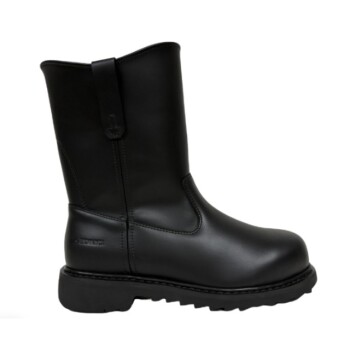
Embedding motion sensors directly into the structure of a boot creates a distinct advantage by capturing direct kinematic constraints from the interaction between the footwear and the ground. Unlike sensors placed on the torso or legs, this location allows the system to monitor the exact contact state of the foot. This results in significantly higher accuracy for calculating walking distance and stride length, which is critical for precise autonomous navigation.
By integrating sensors into the footwear itself, you solve two distinct problems: you gain high-fidelity ground interaction data for navigation, and you improve user compliance by removing the stigma of visible "medical" devices.
Achieving Technical Precision
The primary technical argument for embedded boot sensors is the quality of the data regarding movement and location.
Leveraging Direct Kinematic Constraints
When a sensor is embedded in the boot, it moves exactly as the foot does. This allows the system to capture direct kinematic constraints generated when the boot impacts the ground.
Precise Gait Cycle Triggering
Because the sensor monitors the direct contact state (the moment the boot hits or leaves the ground), it can generate precise trigger signals. This eliminates the estimation errors common with sensors placed on the upper body, which must infer foot placement.
Enhanced Navigation Accuracy
For applications requiring autonomous navigation, such as dead reckoning, this placement is superior. It provides the most accurate measurements for walking distance and stride length, minimizing drift over time.
Optimizing Signal Stability
Beyond navigation data, the physical integration of the sensor affects the raw signal quality.
Reducing Motion Artifacts
External sensors often shift or bounce independently of the body, creating noise. Embedding the sensor creates a large-area contact within the structure, ensuring the sensor stays fixed relative to the foot.
Stable Signal Collection
This structural integration minimizes "motion artifacts"—false data caused by the sensor jiggling. The result is a cleaner, more stable signal that requires less filtering and processing.
Improving Human Factors and Compliance
The effectiveness of a wearable system depends on whether the user is willing to wear it long-term.
Removing Social Pressure
External sensors can look like medical devices, drawing unwanted attention and creating social pressure. Integrating sensing elements into intelligent textiles hides the technology completely.
Increasing Long-Term Compliance
By reducing the "medical appearance," users are less self-conscious and more likely to accept the technology. This leads to better long-term compliance, ensuring data is collected consistently over weeks or months.
Non-Intrusive Design
Embedded sensors do not interfere with natural daily activities. Users can move normally without snagging wires or adjusting straps, making the technology invisible to the wearer.
Understanding the Trade-offs
While embedding sensors offers superior performance and usability, it introduces specific limitations that must be managed.
Hardware Dependency
Embedding the sensor ties the technology to a specific pair of boots. Unlike a strap-on sensor, the user cannot easily transfer the tracking capability to different footwear without owning multiple distinct units.
Lifecycle Management
The lifespan of the sensor becomes coupled with the lifespan of the boot. If the boot structure degrades or the sole wears out, the sensing capability may be compromised or lost entirely, necessitating a complete replacement.
Making the Right Choice for Your Goal
Deciding between embedded boot sensors and other wearable locations depends on your specific data requirements and user environment.
- If your primary focus is high-precision navigation: Prioritize embedded boot sensors to leverage direct ground contact for the most accurate stride length and distance calculations.
- If your primary focus is long-term user adoption: Choose embedded integration to minimize social stigma and ensure the user does not feel burdened by a visible medical device.
Ultimately, embedding sensors moves the technology from being an external accessory to an intrinsic capability of the user's gear.
Summary Table:
| Feature | Embedded Boot Sensors | Torso/Leg Wearables |
|---|---|---|
| Data Precision | Direct ground interaction/kinematic constraints | Inferred foot placement (higher error) |
| Signal Quality | High stability; minimal motion artifacts | Susceptible to noise/bouncing |
| Aesthetics | Invisible & non-stigmatizing (discreet) | Visible; often resembles medical devices |
| Compliance | High (integrated into daily footwear) | Moderate (requires active attachment) |
| Main Advantage | Superior navigation & stride accuracy | Device versatility across clothing |
As a leading large-scale manufacturer serving global distributors and brand owners, 3515 leverages decades of expertise to integrate advanced technology into rugged footwear. Whether you are looking for high-performance Safety Shoes, tactical boots, or smart sneakers, our comprehensive production capabilities ensure precision and reliability. Partner with us to bring cutting-edge, intelligent footwear solutions to your market—contact our expert team today to discuss your bulk requirements!
References
- Yang Chong, Qingyuan Zhang. Adaptive Decentralized Cooperative Localization for Firefighters Based on UWB and Autonomous Navigation. DOI: 10.3390/app13085177
This article is also based on technical information from 3515 Knowledge Base .
Related Products
- Premium Wholesale Tactical Style Safety Shoes Boots with Quick Lacing
- Heavy-Duty Goodyear Welted Pull-On Safety Rigger Boot
- Puncture-Resistant Velcro Safety Boots for Wholesale & Custom Manufacturing
- High-Traction Suede Tactical Boots Wholesale & Custom Manufacturing
- Wholesale Tactical Boots High-Traction & Reflective for Bulk & Brand Orders
People Also Ask
- How are gait analysis research findings applied to the functional design of safety shoes and tactical boots?
- How can specialized footwear mitigate safety risks? High-Volume OEM/ODM Solutions since 1951
- How do quality certification standards for safety shoes reduce perceived risk? Buy Online with Technical Certainty
- Why is the synchronization of craftsmanship and UX development emphasized for bulk customization of safety shoes?
- How does anthropomorphic design influence material selection? Enhance Footwear Performance through Biological Alignment