The most common mistakes when buying hunting boots are prioritizing marketing hype over function and selecting a boot based on a single feature instead of your specific hunting environment. The two most critical errors are choosing an incorrect fit—too tight, too loose, or wrong for your foot shape—and falling for the myth that one expensive boot can do everything.
The core principle to remember is that a hunting boot is a specialized tool, not a fashion statement. The most common and costly mistake is failing to match the tool to the job, which leads to discomfort, failed hunts, and wasted money.
The Foundational Error: A Mismatch Between Boot and Purpose
The most frequent mistake begins before you even try on a pair of boots. It's the failure to define the specific job the boot needs to do.
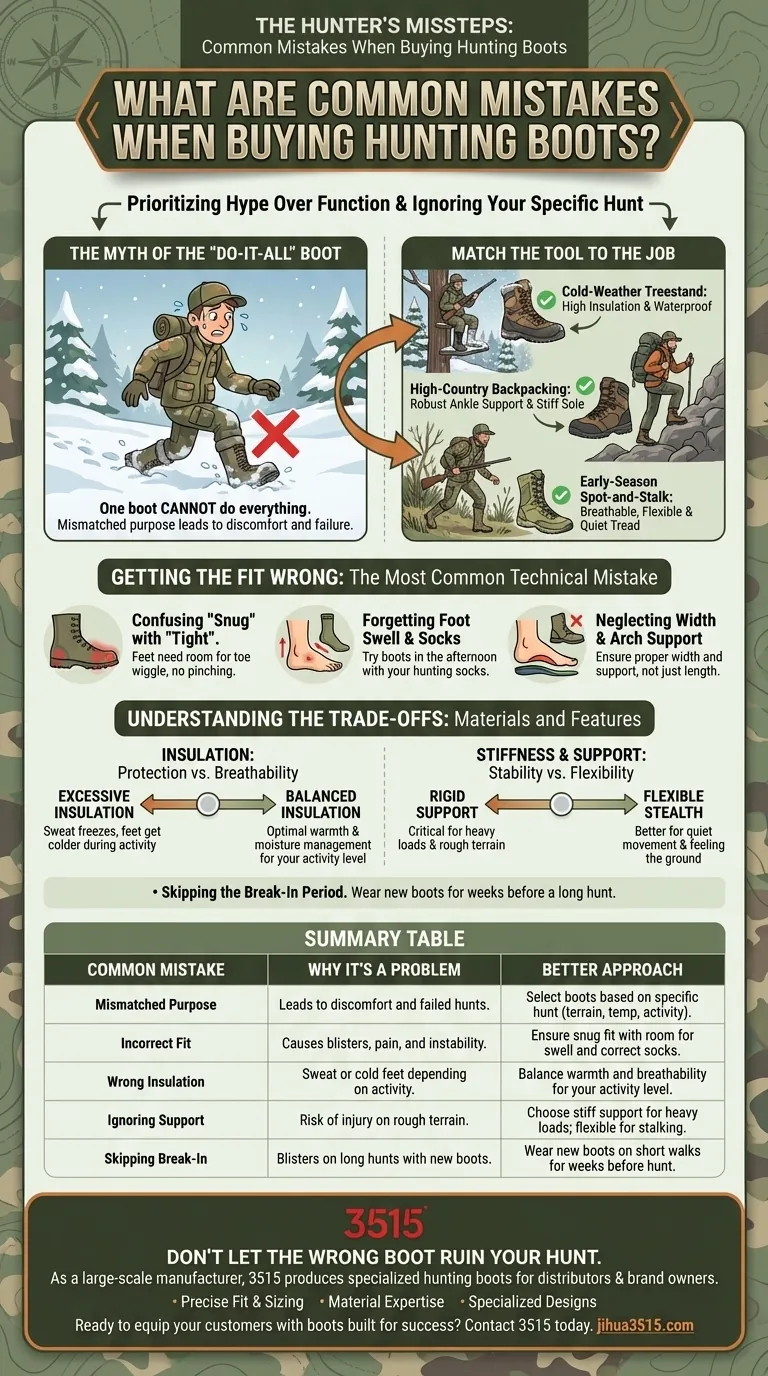
The Myth of the "Do-It-All" Boot
Many hunters search for a single, perfect boot for every possible scenario. This is an unrealistic and expensive goal.
The boot required for a frigid, late-season hunt in deep snow is fundamentally different from the one needed for a warm, early-season archery hunt over rocky terrain.
Ignoring Your Specific Hunting Environment
You must analyze the conditions you will actually face. Consider the typical temperature, precipitation, and terrain of your hunting grounds.
A lightweight, breathable boot will fail you in a cold, wet treestand, while a heavily insulated boot will cause debilitating sweat and blisters on an active mountain hunt.
Overlooking the Type of Hunt
The physical demands of your hunt dictate the boot's design. A backpack hunter carrying a heavy load requires significant ankle support and a stiff sole to prevent injury and fatigue.
Conversely, a hunter taking short walks from a base camp may benefit more from a lighter, more flexible boot that prioritizes stealth and comfort.
Getting the Fit Wrong: The Most Common Technical Mistake
Even the perfect boot for the environment is useless if it doesn't fit correctly. This is where most buyers make a critical error.
Confusing "Snug" with "Tight"
A proper fit should be snug, holding your heel in place to prevent sliding and rubbing. However, it must not be tight.
You should have enough room to wiggle your toes freely. Pinching or excessive pressure points are immediate red flags.
Forgetting Foot Swell and Sock Thickness
Your feet swell during the day and especially during strenuous hikes. Always try on boots in the afternoon or after being on your feet for a while.
Crucially, wear the exact high-quality socks you plan to hunt with. The thickness of your sock dramatically impacts the boot's fit.
Neglecting Width and Arch Support
Feet are not just different lengths; they have different widths and arch heights. A boot that is the correct length can still cause pain if it's too narrow or lacks proper arch support.
If a boot feels tight on the sides or your arch feels unsupported, it is the wrong boot for your foot, regardless of its quality or features.
Understanding the Trade-offs: Materials and Features
Every feature on a hunting boot represents a trade-off. Believing marketing that promises zero compromises is a mistake.
Insulation: Protection vs. Breathability
More insulation is not always better. While essential for stationary, cold-weather hunts, excessive insulation during active hunts leads to sweat, which can freeze and make your feet colder.
The right level of insulation balances warmth with the boot's ability to breathe and manage moisture.
Stiffness and Support: Stability vs. Flexibility
A stiff, supportive boot is critical for navigating steep, uneven terrain with a heavy pack. It provides stability and protects your ankles.
However, that same stiffness can be a liability when you need to move quietly or feel the ground beneath your feet. There is a necessary trade-off between rigid support and flexible stealth.
Skipping the Break-In Period
A common post-purchase mistake is taking brand-new boots directly on a long hunt. Stiff, new boots, especially leather ones, need time to mold to your feet.
Wear your new boots around the house and on short walks for several weeks before a hunt. This prevents painful blisters and ensures the boots are truly comfortable.
Making the Right Choice for Your Hunt
To avoid these common mistakes, your selection process must be driven by your specific needs, not by brand loyalty or a single advertised feature.
- If your primary focus is high-country backpack hunting: Prioritize robust ankle support, a stiff sole for stability under load, and durable, abrasion-resistant materials.
- If your primary focus is cold-weather treestand hunting: Choose a boot with a high level of insulation (800g or more) and guaranteed waterproofness, as you will be stationary for long periods.
- If your primary focus is early-season archery or spot-and-stalk hunting: Look for a lighter, more flexible boot with less insulation that prioritizes breathability and a quiet tread.
Ultimately, investing the time to match the boot to your hunt is the single most important factor for comfort, safety, and success in the field.
Summary Table:
| Common Mistake | Why It's a Problem | Better Approach |
|---|---|---|
| Mismatched Purpose | Using one boot for all conditions leads to failure. | Select boots based on your specific hunt (terrain, temperature, activity). |
| Incorrect Fit | Causes blisters, pain, and instability. | Ensure a snug (not tight) fit with room for toe wiggle and foot swell. |
| Wrong Insulation Level | Excessive insulation causes sweat; too little leads to cold. | Balance warmth with breathability based on your activity level. |
| Ignoring Ankle Support | Lack of support risks injury on rough terrain. | Choose stiff, supportive boots for backpacking; flexible for stalking. |
| Skipping the Break-In | New, stiff boots cause blisters on long hunts. | Wear new boots for short walks weeks before your hunt. |
Don't Let the Wrong Boot Ruin Your Hunt
As a large-scale manufacturer, 3515 produces a comprehensive range of specialized hunting boots for distributors, brand owners, and bulk clients. Our production capabilities ensure you get the right tool for the job—whether you need insulated boots for cold-weather treestand hunting or lightweight, supportive boots for high-country backpacking.
We help you avoid common mistakes by providing:
- Precise Fit and Sizing: Boots designed for real-world conditions and foot swell.
- Material Expertise: Optimal balance of waterproofing, breathability, and durability.
- Specialized Designs: Boots tailored for specific hunting styles and terrains.
Ready to equip your customers with boots built for success? Contact 3515 today to discuss your hunting footwear needs and leverage our manufacturing excellence for your brand.
Visual Guide
Related Products
- Wholesale Lightweight Tactical Boots Custom Manufacturer for Desert & Combat Use
- Durable Leather Tactical Boots Wholesale & Custom Manufacturing for Brands
- High-Traction Suede Tactical Boots Wholesale & Custom Manufacturing
- Durable Military Combat Boots with Water Drainage for Wholesale & OEM
- Wholesale Waterproof Tactical Boots Custom Suede & High-Traction Soles
People Also Ask
- What are the common types of combat boots? Find the Right Boot for Your Mission
- What specialized protections do tactical boots offer? Maximize Endurance with High-Performance Footwear
- What is the role of high-frequency acquisition hardware in technical skill analysis for outdoor and tactical boots?
- What are the different types of tactical boots available? Find the Right Boot for Your Mission
- What are the main construction similarities between tactical boots and tactical sneakers? Built for Performance & Durability