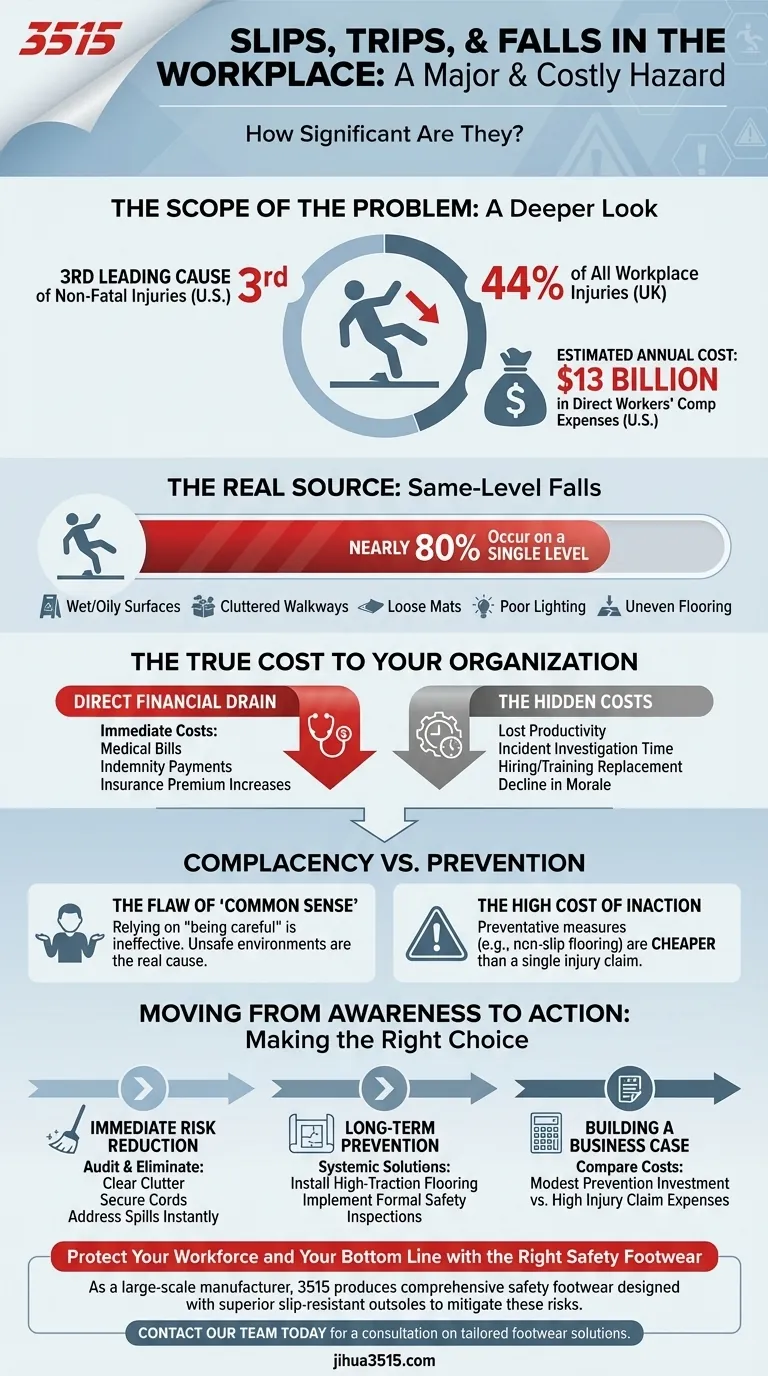
Slips, trips, and falls represent one of the most significant and costly categories of workplace injuries. These incidents are the third-leading cause of non-fatal injuries across all U.S. industries, carrying an estimated annual cost of $13 billion in direct workers' compensation expenses alone. According to the UK's Health and Safety Executive (HSE), this same category accounts for a staggering 44% of all workplace injuries reported.
The true significance of slips, trips, and falls lies not in dramatic, high-profile accidents, but in their immense frequency and severe financial impact, with the vast majority stemming from preventable, everyday hazards on a single walking level.
The Scope of the Problem: A Deeper Look
Many organizations underestimate the severity of slips, trips, and falls (STFs) because they seem like minor, isolated events. The data reveals a systemic issue that demands serious attention.
A Deceptively Common Hazard
STFs are not a fringe issue; they are a primary driver of injuries. Being the third-leading cause of non-fatal injuries in the U.S. places them among the most persistent threats to employee well-being, regardless of the industry.
The high percentage cited by the HSE (44%) underscores how these incidents dominate injury reports in many environments, often surpassing injuries caused by machinery or other more obvious hazards.
The Real Source of Danger: Same-Level Falls
A critical and often misunderstood fact is that nearly 80% of these incidents occur on the same level. This is not primarily an issue of falling from ladders, scaffolding, or other heights.
The true culprits are mundane and easily overlooked environmental factors. These include wet or oily surfaces, cluttered walkways, loose mats, poor lighting, and uneven flooring—hazards present in offices, warehouses, and retail spaces alike.
The True Cost to Your Organization
The impact of a single slip, trip, or fall extends far beyond the initial incident. The financial and operational consequences can be disruptive and long-lasting.
The Direct Financial Drain
The $13 billion annual figure for direct workers' compensation costs is a conservative estimate. This number represents the immediate, tangible expenses related to medical bills and indemnity payments.
For any single business, one serious STF injury can lead to a dramatic increase in insurance premiums, affecting profitability for years to come.
The Hidden Costs of Disruption
Direct costs are only the beginning. Every incident carries a host of indirect costs that are often much larger.
These include lost productivity from the injured employee, time spent by management on incident investigation and reporting, the cost of hiring and training a replacement worker, and a potential decline in team morale.
Understanding the Trade-offs: Complacency vs. Prevention
The pervasive nature of STF hazards often leads to a dangerous complacency. Organizations must recognize the trade-offs between assuming the risk and investing in proactive safety.
The Flaw of 'Common Sense'
A common mistake is assuming that "being careful" is a sufficient preventative measure. While individual awareness is important, most STFs are caused by unsafe environmental conditions, not simple carelessness.
Relying on employees to navigate an unsafe environment is an ineffective and unreliable safety strategy. The responsibility lies in engineering a safe workspace.
The High Cost of Inaction
Failing to address known hazards is a significant financial gamble. The cost of implementing preventative measures—such as proper cleaning protocols, non-slip mats, or improved lighting—is consistently lower than the cost of a single serious injury claim.
Proactive safety is an investment in operational stability and financial health, not just an expense.
Making the Right Choice for Your Goal
Moving from awareness to action involves focusing your safety efforts where they will have the most immediate and lasting impact.
- If your primary focus is immediate risk reduction: Prioritize a thorough audit of all walking surfaces, focusing on eliminating clutter, securing cords, and ensuring spills are addressed instantly.
- If your primary focus is long-term prevention: Invest in systemic solutions like installing high-traction flooring in high-risk areas and implementing a formal, recurring safety inspection program.
- If your primary focus is building a business case: Compare the potential direct and indirect costs of a single injury claim at your facility to the modest investment required for preventative safety measures.
By treating these everyday environmental hazards with the seriousness they command, you can fundamentally improve the safety and stability of your workplace.
Summary Table:
| Key Statistic | Impact |
|---|---|
| Rank in U.S. Non-Fatal Injuries | 3rd Leading Cause |
| Annual Direct Workers' Comp Cost (U.S.) | $13 Billion |
| Percentage of UK Workplace Injuries (HSE) | 44% |
| Where Most Incidents Occur | ~80% on a Single Level |
Protect your workforce and your bottom line with the right safety footwear.
As a large-scale manufacturer, 3515 produces a comprehensive range of industrial and safety footwear for distributors, brand owners, and bulk clients. Our production capabilities encompass all types of safety shoes and boots designed with superior slip-resistant outsoles and protective features to mitigate the risks highlighted in this article.
Don't let a preventable incident disrupt your operations. Contact our team today for a consultation on safety footwear solutions tailored to your specific workplace hazards.
Visual Guide