
The right horse boot is chosen by matching its specific protective features to the physical demands and common risks of your riding discipline. For high-impact activities like jumping, you need robust protection against forceful strikes, whereas for flatwork, the focus shifts to preventing lower-intensity interference.
The core principle is not about finding one "best" boot, but about conducting a risk assessment for your specific activity. The ideal boot provides the necessary impact protection for that discipline while minimizing heat retention and restriction of movement.

The Core Principle: Matching Protection to Risk
Before selecting a boot, you must understand what you are trying to prevent. A horse's legs are powerful yet surprisingly delicate, and different movements introduce different dangers.
What Are We Protecting Against?
The primary goal of most horse boots is to shield against impact injuries. These injuries typically occur when a horse's hoof or leg strikes another part of its body.
The most common issues are interference, where one leg strikes the opposite leg, and overreaching, where a hind hoof strikes the heel or pastern area of a front foot.
Protection vs. Support: A Critical Distinction
It is a common misconception that boots provide significant "support" to a horse's tendons and ligaments in the way a human ankle brace does.
While some specialized boots may offer minimal support, the vast majority function as armor. Their job is to absorb and dissipate the force of an impact, protecting vulnerable structures like tendons, ligaments, and bones from direct trauma.
A Practical Guide to Boots by Discipline
Different equestrian activities create different patterns of leg movement and, therefore, different risks. This is why boot design is highly specialized.
For High-Impact Activities (Jumping & Cross-Country)
These disciplines require the most robust protection due to the high speeds and forceful impacts involved.
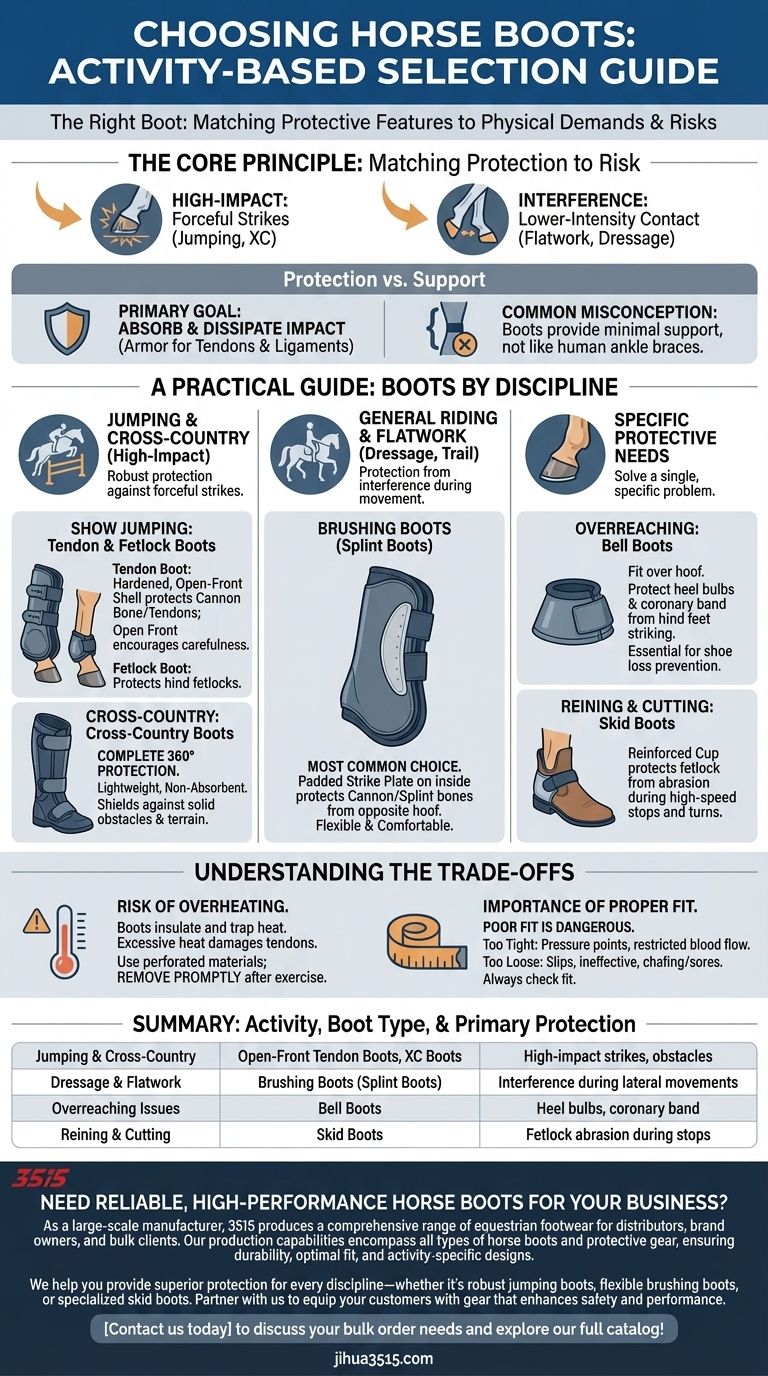
Tendon boots and fetlock boots are the standard for show jumping. The tendon boot features a hardened, open-front shell to protect the cannon bone and tendons from strikes by the hind hooves as the horse tucks its legs over a fence. The open front allows the horse to feel a pole if it gets lazy, encouraging cleaner jumping.
Cross-country boots offer complete, 360-degree protection. They are lightweight, do not absorb water, and are designed to shield the leg from solid obstacles, rocks, and unpredictable terrain from all angles.
For General Riding & Flatwork (Dressage, Trail)
These activities involve less high-impact risk but still require protection from interference, especially during complex lateral movements.
Brushing boots, also known as splint boots, are the most common choice. They feature a padded strike plate on the inside of the leg to protect the cannon bone and splint bones from being struck by the opposite hoof. They are typically flexible and comfortable for longer periods of wear.
For Specific Protective Needs
Some boots are designed to solve a single, specific problem and can be used across multiple disciplines.
Bell boots fit over the hoof and protect the soft, sensitive heel bulbs and coronary band from overreaching by the hind feet. They are essential for horses prone to pulling off their front shoes.
Skid boots are used in sports like reining and cutting. They feature a reinforced cup around the back of the fetlock to protect it from abrasion during high-speed stops and turns.
Understanding the Trade-offs
Choosing a boot is not just about maximizing protection; it's also about minimizing potential harm. No piece of equipment is without its downsides.
The Risk of Overheating
Every boot insulates the leg and traps heat. Excessive heat can be detrimental to tendon health over the long term.
Modern boots often use perforated materials and breathable liners to mitigate this risk, but it's crucial to remove boots promptly after exercise to allow the legs to cool.
The Importance of Proper Fit
A poorly fitting boot is worse than no boot at all. A boot that is too tight can create dangerous pressure points and restrict blood flow.
If a boot is too loose, it can slip down the leg, becoming ineffective and creating a hazard. It can also chafe and rub the skin, causing sores. Always follow the manufacturer's sizing guide and check the fit regularly.
Making the Right Choice for Your Horse
Your decision should be a direct response to your horse's way of going and your primary riding activity.
- If your primary focus is jumping: Use open-front tendon boots and corresponding fetlock boots to protect against high-impact strikes while encouraging carefulness.
- If your primary focus is cross-country: Select full-coverage, non-absorbent boots designed to deflect impact from any angle.
- If your primary focus is dressage or flatwork: Choose flexible brushing boots that prevent interference without restricting the horse's natural movement.
- If your horse frequently overreaches: Add correctly sized bell boots to your setup, regardless of the primary discipline.
By understanding the specific risks of your discipline, you can select the precise protection your horse needs to perform safely and confidently.
Summary Table:
| Activity | Recommended Boot Type | Primary Protection |
|---|---|---|
| Jumping & Cross-Country | Open-Front Tendon Boots, Cross-Country Boots | High-impact strikes, obstacles |
| Dressage & Flatwork | Brushing Boots (Splint Boots) | Interference during lateral movements |
| Overreaching Issues | Bell Boots | Heel bulbs, coronary band |
| Reining & Cutting | Skid Boots | Fetlock abrasion during stops |
Need Reliable, High-Performance Horse Boots for Your Business?
As a large-scale manufacturer, 3515 produces a comprehensive range of equestrian footwear for distributors, brand owners, and bulk clients. Our production capabilities encompass all types of horse boots and protective gear, ensuring durability, optimal fit, and activity-specific designs.
We help you provide superior protection for every discipline—whether it's robust jumping boots, flexible brushing boots, or specialized skid boots. Partner with us to equip your customers with gear that enhances safety and performance.
Contact us today to discuss your bulk order needs and explore our full catalog!
Visual Guide
Related Products
- Wholesale Tactical Boots High-Traction & Reflective for Bulk & Brand Orders
- Wholesale Lightweight Tactical Boots Custom Manufacturer for Desert & Combat Use
- Durable Goodyear Welt Leather Work Boots for Wholesale & Private Label
- Wholesale High-Traction Camo Boots - Custom Manufacturer for Brands
- Durable Leather Tactical Boots Wholesale & Custom Manufacturing for Brands
People Also Ask
- How do tactical boots protect against injuries? Discover the Integrated Safety System
- How do social media interactivity features enhance procurement engagement for tactical and work boots?
- What materials are used in tactical boot uppers? A Guide to Durability & Performance
- How should one choose the right tactical boots? Match Your Mission for Optimal Performance & Safety
- Importance of Professional Tactical Boots in Loess Gully Regions: Ensure Safety and Precision for Field Monitoring

















