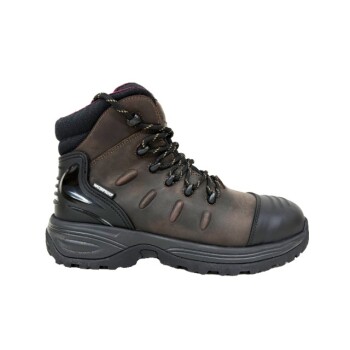
The shock absorption feature in industrial-grade footwear primarily protects the knee by mechanically dampening ground reaction forces before they travel up the leg. By utilizing specialized cushioning materials, these boots absorb the shock generated during movement, significantly reducing the stress placed on the knee's articular cartilage. This reduction in force directly addresses the mechanical wear that leads to long-term joint issues.
The core mechanism of protection is the reduction of impact intensity. By absorbing shock at the point of contact, footwear minimizes the mechanical load transferred to the knee, preventing the cartilage degradation that causes joint space narrowing and bone spur formation.
The Mechanics of Impact Reduction
To understand how footwear protects the knee, one must first understand the journey of mechanical force through the body.
Dampening Ground Reaction Forces
Every step taken in an industrial environment generates a "ground reaction force." This is the shockwave that travels from the floor, through the foot, and up into the skeletal structure.
Industrial footwear acts as a primary barrier against this energy. By intercepting the force at the point of contact, the footwear reduces the intensity of the shock before it can reach the knee joint.
The Role of Cushioning Materials
The effectiveness of this barrier relies on specialized cushioning materials engineered into the sole.
These materials are designed to compress and disperse energy. Instead of a sharp, direct impact traveling up the shin, the cushioning "dampens" the blow, smoothing out the force curve during movement.
Preserving Joint Anatomy
The ultimate goal of shock absorption is to preserve the physical structure of the knee joint.
Safeguarding Articular Cartilage
The knee relies on articular cartilage—a smooth, protective tissue—to allow bones to glide over one another.
Excessive mechanical stress wears this tissue down. By reducing the load that reaches the knee, shock-absorbing footwear safeguards this cartilage from the excessive stress that causes premature breakdown.
Preventing Structural Degeneration
When the natural shock absorbers of the body are overwhelmed, structural changes occur.
The primary reference indicates that unchecked mechanical force is a leading factor in joint space narrowing. Furthermore, reducing this impact is critical in preventing the development of bone spurs (osteophytes), which are bony projections that form along joint edges due to stress.
Understanding the Scope of Protection
While shock absorption is vital, it is important to understand exactly what it addresses to rely on it effectively.
Mitigation, Not Elimination
Shock absorption functions by reducing the intensity of forces, not eliminating them entirely.
The goal is to bring the mechanical force down to a level that the body's natural defenses can handle without injury. It essentially converts "excessive stress" into manageable motion.
Focus on Mechanical Factors
The protection provided is specifically targeted at mechanical factors of injury.
By addressing the direct physical impact, the footwear helps prevent specific pathologies like bone spurs and cartilage loss. It is a tool for managing vertical load and impact stress.
Making the Right Choice for Your Long-Term Health
Selecting the right footwear is a strategic decision for preserving joint mobility and preventing chronic conditions.
- If your primary focus is Injury Prevention: Prioritize footwear with advanced dampening materials to keep ground reaction forces below the threshold that damages articular cartilage.
- If your primary focus is Managing Joint Health: Look for shock absorption features specifically designed to minimize the mechanical stress that contributes to joint space narrowing and bone spur development.
Invest in footwear that actively manages impact, as preserving your cartilage today is the key to maintaining mobility tomorrow.
Summary Table:
| Feature | Protection Mechanism | Physical Benefit |
|---|---|---|
| Dampening Materials | Absorbs ground reaction forces | Reduces skeletal shock intensity |
| Energy Dispersion | Compresses and spreads impact | Minimizes load on shin and knee |
| Cartilage Safeguard | Limits mechanical stress | Prevents premature tissue breakdown |
| Structural Support | Manages vertical force curve | Inhibits bone spurs and joint narrowing |
Secure Your Workforce with 3515 High-Performance Footwear
Protecting your team's long-term mobility starts with the right equipment. As a large-scale manufacturer serving distributors and brand owners, 3515 offers comprehensive production capabilities for all footwear types, anchored by our flagship Safety Shoes series.
Our extensive portfolio covers work and tactical boots, outdoor shoes, training shoes, and sneakers, as well as Dress & Formal shoes designed to meet diverse bulk requirements. By partnering with us, you gain access to industry-leading shock absorption technology that safeguards articular cartilage and prevents joint degeneration.
Ready to elevate your product line with superior protective footwear? Contact us today to discuss your bulk manufacturing needs!
References
- Dai Zheng-xu, Jun Liu. Contralateral knee osteoarthritis is a risk factor for ipsilateral knee osteoarthritis progressing: a case control study. DOI: 10.1186/s12891-024-07292-6
This article is also based on technical information from 3515 Knowledge Base .
Related Products
- Wholesale Anti-Smash & Puncture-Proof Safety Shoes Custom Manufacturing for Brands
- Wholesale Customizable Safety Boots Durable & Protective Footwear Manufacturing
- Wholesale Durable Safety Boots | Custom Steel Toe & Puncture-Resistant Manufacturing
- Premium Wheat Nubuck Safety Shoes for Bulk Distribution
- Durable Steel Toe Safety Boots Wholesale & Custom Manufacturing
People Also Ask
- Why do operations involving heavy fruit bunches and 'gancu' require anti-smash and anti-puncture safety boots?
- What makes a safety shoe a safety shoe? Essential Protection for Hazardous Work
- What are the advantages of water-based polyurethane spray coatings for safety shoe slip resistance? Enhanced Traction
- What additional features can a good safety shoe offer? Maximize Protection and Comfort
- How do safety shoes and tactical boots support physiological maintenance? Protect Your Health in Toxic Environments