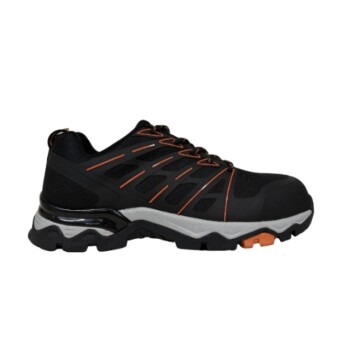
Standardized safety markings function as a universal visual language for personal protective equipment. They enhance legibility by translating complex technical specifications into consistent symbols, allowing users to instantly assess a shoe's protective capabilities. This clarity simplifies the process of navigating safety protocols as users move between distinct industrial or urban environments.
By establishing a consistent symbolic system, safety markings reduce the cognitive load required to identify appropriate footwear, ensuring users can maintain compliance and safety without analyzing complex technical data.
Decoding the Symbolic Language
Enhancing Functional Legibility
In this context, legibility refers to the ability to "read" the functional capabilities of the footwear instantly.
Standardized markings remove ambiguity regarding what a shoe can actually do.
Instead of guessing if a boot offers toe protection or electrical resistance, the user can verify these features through established symbols.
Reducing Cognitive Fatigue
Complex environments require constant decision-making, which can lead to cognitive fatigue.
When footwear markings are standardized, the brain spends less energy processing safety requirements.
This reduction in mental load allows the user to focus on their immediate surroundings and tasks rather than questioning their equipment's suitability.
Navigating Safety Protocols
Movement Across Zones
The "navigation" provided by these markings is not about wayfinding, but about navigating regulatory environments.
Workers and pedestrians often move between zones with varying risk profiles, such as transitioning from an office to a warehouse floor.
Standardized identifiers serve as a checkpoint, confirming whether the user is equipped to enter a specific zone safely.
Consistency in Urban and Industrial Settings
By utilizing consistent symbolic language, these systems bridge the gap between different environments.
Whether in a heavy industrial site or a mixed-use urban zone, the safety language remains the same.
This consistency ensures that safety protocols are maintained regardless of the specific location or the user's familiarity with that specific facility.
Understanding the Trade-offs
The Risk of Symbol Reliance
While symbols simplify decision-making, over-reliance on them can lead to complacency.
Users may trust a symbol without checking the physical condition of the footwear to ensure the feature is still functional.
The Learning Curve
Standardization only works if the user base understands the symbolic language.
If the educational component is missing, the "legibility" of the system fails, as the symbols become meaningless decoration to the untrained eye.
Making the Right Choice for Your Goal
To effectively utilize standardized safety markings, assess your specific environmental needs.
- If your primary focus is Regulatory Compliance: Ensure all footwear carries certifications that match the specific hazard codes of your operational zones.
- If your primary focus is Operational Efficiency: Select footwear with high-contrast, easily visible markings to speed up safety checks at zone transition points.
Standardized markings are the key to transforming safety from a complex guessing game into a streamlined, reliable process.
Summary Table:
| Key Feature | Functional Benefit | Impact on User Navigation |
|---|---|---|
| Symbolic Language | Translates technical specs into universal icons | Instant assessment of protective capabilities |
| Standardized Identifiers | Consistency across different work zones | Seamless transition between varying risk profiles |
| Visual Legibility | Removes ambiguity of shoe functions | Faster safety checks and reduced cognitive fatigue |
| Zone Checkpoints | Acts as a visual safety verification | Ensures compliance when moving from office to floor |
Partner with 3515 for High-Standard Footwear Solutions
As a large-scale manufacturer serving distributors and brand owners worldwide, 3515 offers comprehensive production capabilities for all footwear types. Our flagship Safety Shoes series is designed with clearly defined, standardized markings to ensure maximum legibility and regulatory compliance across any pedestrian or industrial network.
Our extensive portfolio includes:
- Work & Tactical Boots: Built for durability and extreme environments.
- Outdoor & Training Shoes: Combining performance with specialized safety features.
- Sneakers, Dress & Formal Shoes: Meeting diverse bulk requirements without compromising on protection.
Whether you are looking to restock a proprietary brand or distribute high-performance safety gear, we provide the scale and expertise to meet your needs. Contact us today to explore our bulk manufacturing options and see how our standardized safety solutions can add value to your business.
References
- Malika Ouzir. Assessment of walkability in the city centre of M’sila using a qualitative barometer. DOI: 10.2298/gsgd2202173o
This article is also based on technical information from 3515 Knowledge Base .
Related Products
- Premium Suede Sport Safety Shoes for Wholesale & Bulk Orders
- Premium Lightweight Safety Shoes for Wholesale & Bulk Orders
- Wholesale Anti-Smash & Puncture-Proof Safety Shoes Custom Manufacturing for Brands
- Premium KPU Injection Athletic Style Safety Shoes
- Premium Safety Shoes with Rotating Buckle Safety Sneakers
People Also Ask
- What are the primary functions of professional safety shoes? Maximize Safety in Water Supply Confined Spaces
- What industries have specific OSHA footwear requirements? Ensure Compliance & Protect Your Workforce
- What role do specialized safety shoes play in preventing falls? Engineering Stability in Industrial Environments
- What are the technical advantages of integrating sensors into safety shoes? Achieve Superior Motion Capture Precision
- How do the 3R principles influence green footwear design? Master Sustainable Safety Shoe Manufacturing