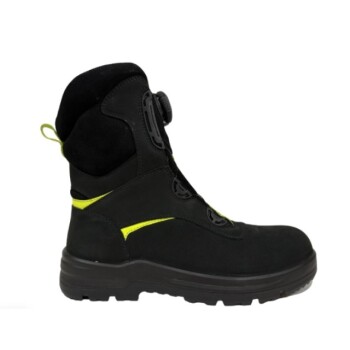
Professional protective footwear mitigates knee injuries by stabilizing the lower kinetic chain against the unpredictable terrain typical of shipyards. By combining professional-grade slip-resistant outsoles with robust ankle support systems, these boots prevent sudden lateral slips and ankle rolls. This stabilization significantly reduces the transmission of damaging shear forces to the knee joint, thereby decreasing the frequency of chronic injuries.
The knee is often the collateral victim of foot instability. By securing grip on wet, inclined surfaces and locking the ankle in place, protective footwear stops the sudden, jarring movements that create dangerous shear forces within the knee.
The Shipyard Environment and Biomechanical Stress
Navigating Uneven and Inclined Terrain
Shipyards present a complex physical challenge, requiring workers to navigate uneven terrain and inclined surfaces.
These irregularities force the body to constantly adjust its center of gravity.
Without proper support, these micro-adjustments place excessive strain on the lower joints, particularly the knees.
The Hazard of Wet Outdoor Areas
Outdoor shipyard environments are frequently wet, creating a high risk for loss of traction.
When a foot slips on a wet surface, the body instinctively attempts to correct the motion to prevent a fall.
This reflex often results in a violent twisting or jarring motion at the knee.
How Footwear Features Protect the Knee
The Role of Slip-Resistant Outsoles
Protective footwear equipped with professional-grade slip-resistant outsoles provides superior grip.
This friction ensures the foot remains planted firmly, even on slick or inclined surfaces.
By eliminating the initial slip, the footwear prevents the chain reaction of instability that travels up the leg to the knee.
Ankle Support Systems and Lateral Stability
Robust ankle support systems are designed to prevent the ankle from rolling outward or inward.
Ankle rolls are not isolated events; they transmit rotational energy upward.
By mechanically blocking this roll, the boot prevents that rotational force from becoming a dangerous torque on the knee joint.
Reducing Shear Forces
The primary mechanism of injury prevention is the reduction of shear forces.
Shear forces occur when the bones of the knee joint slide horizontally against one another, stressing ligaments and cartilage.
By preventing lateral slips and ankle instability, professional footwear minimizes these forces, directly reducing the occurrence of chronic knee issues.
Understanding the Limitations
Equipment vs. Environment
While professional footwear provides superior grip, it cannot entirely eliminate the risks inherent to a shipyard.
Extremely oily surfaces or debris may still compromise the effectiveness of slip-resistant outsoles.
Workers must remain aware of their surroundings regardless of their equipment specifications.
The Trade-off of Rigidity
High-level ankle support inherently restricts some range of motion to provide stability.
While this protects against rolls, it can alter gait mechanics slightly.
It is essential to ensure the level of support matches the intensity of the terrain to avoid causing fatigue elsewhere in the leg.
Making the Right Choice for Your Goal
Selecting the correct footwear requires analyzing the specific hazards of your shipyard zone.
- If your primary focus is preventing acute falls: Prioritize boots with the highest grade of slip-resistant outsoles to manage wet and inclined surfaces.
- If your primary focus is long-term joint health: Prioritize boots with a rigid ankle support system to minimize the cumulative shear forces that cause chronic knee injuries.
Proper footwear does not just protect the foot; it preserves the structural integrity of the knee for the long term.
Summary Table:
| Feature | Mechanism of Action | Impact on Knee Health |
|---|---|---|
| Slip-Resistant Outsoles | Enhances friction on wet/inclined surfaces | Prevents violent jarring and reflexive twisting |
| Ankle Support Systems | Restricts lateral roll and rotation | Minimizes rotational torque transmission to the knee |
| Kinetic Chain Alignment | Stabilizes the lower leg foundation | Reduces horizontal shear forces on ligaments |
| Shock Absorption | Attenuates impact from uneven terrain | Decreases cumulative stress on knee cartilage |
Secure Your Workforce with Industrial-Grade Protection
As a large-scale manufacturer serving distributors and brand owners, 3515 offers comprehensive production capabilities for all footwear types, anchored by our flagship Safety Shoes series. Our extensive portfolio covers work and tactical boots, outdoor shoes, training shoes, and sneakers, as well as Dress & Formal shoes to meet diverse bulk requirements.
Partner with 3515 to provide your clients with footwear engineered to reduce biomechanical stress and enhance shipyard safety. Contact us today to discuss your custom manufacturing needs and volume orders.
References
- Woo-Jin Kim, Byung Yong Jeong. A Cross-Sectional Descriptive Study of Musculoskeletal Disorders (MSDs) of Male Shipbuilding Workers and Factors Associated the Neck, Shoulder, Elbow, Low Back, or Knee MSDs. DOI: 10.3390/app12073346
This article is also based on technical information from 3515 Knowledge Base .
Related Products
- Premium Suede Sport Safety Shoes for Wholesale & Bulk Orders
- Heavy-Duty Waterproof Nubuck Safety Boots Safety Shoes for Bulk Supply
- Advanced KPU Athletic Safety Shoe with Steel Toe Cap Anti-Slip Rotary Lacing System
- Wholesale Suede Chelsea Safety Boots for Custom & Private Label Manufacturing
- Wholesale Durable 6-Inch Work Boots | Custom & Private Label Manufacturer
People Also Ask
- What are the primary functions of professional safety shoes? Maximize Safety in Water Supply Confined Spaces
- What industries have specific OSHA footwear requirements? Ensure Compliance & Protect Your Workforce
- What role do specialized safety shoes play in preventing falls? Engineering Stability in Industrial Environments
- What are the main components of safety shoes? A Guide to Protective Footwear Design
- How do the 3R principles influence green footwear design? Master Sustainable Safety Shoe Manufacturing