
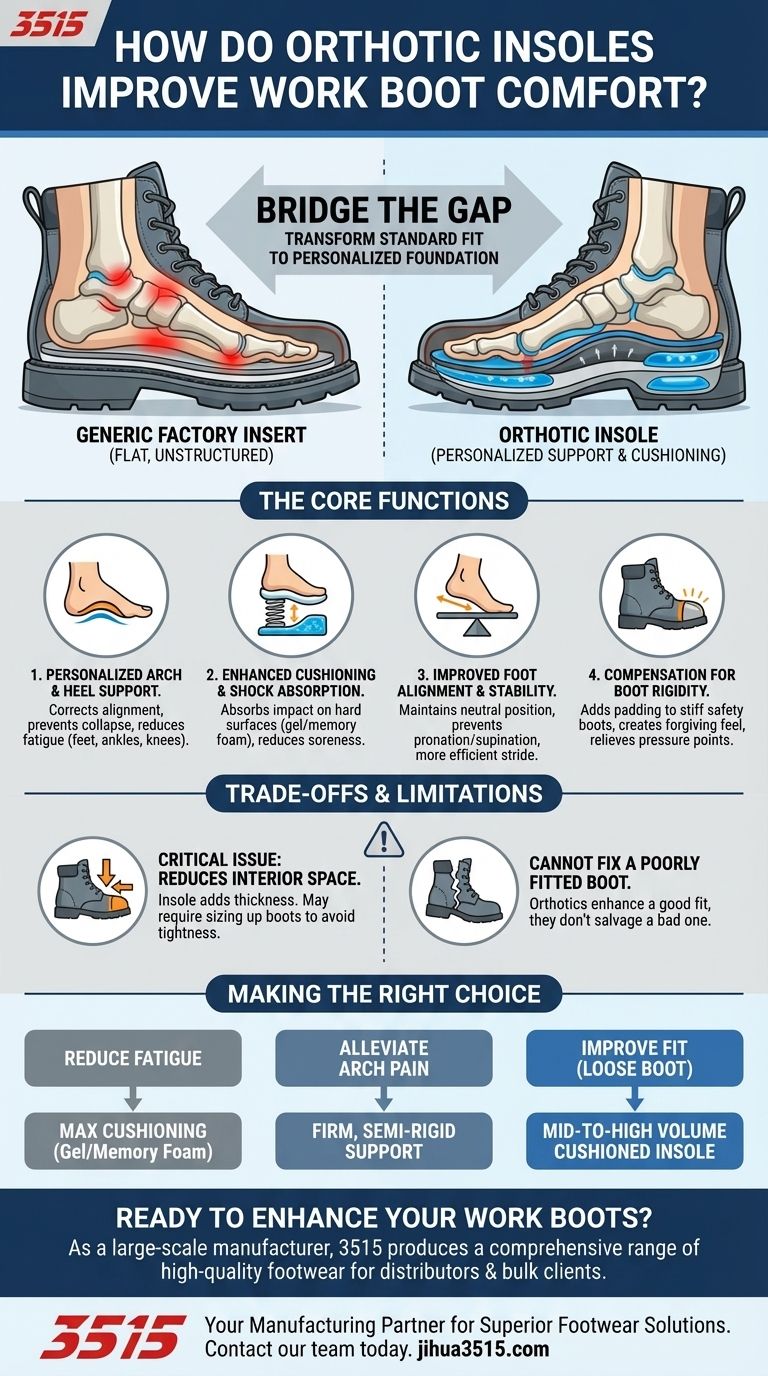
At their core, orthotic insoles improve work boot comfort by replacing the generic, mass-produced factory insert with a structure designed for support and cushioning. They add personalized arch and heel support that aligns your foot correctly, while specialized materials like gel or foam absorb the impact of walking on hard surfaces, drastically reducing fatigue over a long shift.
The fundamental role of an orthotic insole is to bridge the gap between your unique foot shape and the generic interior of your work boot, transforming a standard fit into a personalized foundation for comfort and stability.
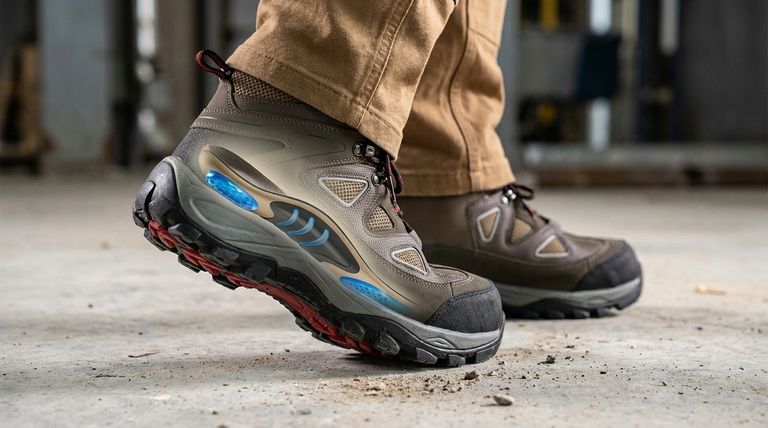
The Core Functions of an Orthotic Insole
Work boots are built for durability, but their internal comfort is often an afterthought. An orthotic insole is engineered to correct this by adding specific, functional improvements that the boot's standard liner lacks.
Personalized Arch and Heel Support
Most factory insoles are simple, flat pieces of foam. An orthotic provides a contoured structure that supports your foot's natural arch, which is critical for proper alignment.
This support prevents the arch from collapsing under strain, reducing stress on the plantar fascia and minimizing fatigue in your feet, ankles, and even knees.
Enhanced Cushioning and Shock Absorption
Workers on concrete or other hard surfaces experience constant, repetitive impact.
Insoles made from materials like gel or memory foam are specifically designed to absorb this shock. This cushioning reduces the jarring force that travels up your legs and spine, leading to less soreness at the end of the day.
Improved Foot Alignment and Stability
By properly supporting the arch and cupping the heel, an orthotic helps maintain a neutral foot position inside the boot.
This enhanced stability prevents your foot from rolling inward (pronation) or outward (supination), leading to a more efficient and less tiring stride. It also helps laces secure the boot more effectively around your foot.
Compensation for Boot Rigidity
Safety boots, particularly those with steel toes, are inherently rigid. This stiffness can create pressure points and limit natural foot movement.
A quality insole adds a crucial layer of padding that helps compensate for this rigidity, making the boot feel more forgiving and comfortable without compromising its protective features.
Understanding the Trade-offs and Limitations
While highly effective, insoles are a component of a larger comfort system, not a magic bullet. Understanding their limitations is key to using them effectively.
The Critical Issue of Interior Space
This is the most common pitfall. An orthotic insole is thicker than a factory liner and will reduce the interior volume of your boot.
If your boots are already snug, adding an insole can make them too tight, leading to pressure points and poor circulation. You may need to size up your boots to accommodate a proper orthotic.
An Insole Cannot Fix a Poorly Fitted Boot
An orthotic can enhance a good boot, but it cannot salvage a bad one.
If the boot is the wrong size or shape for your foot, or made from low-quality materials that don't break in, an insole will only be a minor fix. The foundation must be a well-constructed, properly fitted boot.
Off-the-Shelf vs. Custom Orthotics
Over-the-counter insoles provide excellent general support and cushioning for most users.
However, for those with significant foot issues like severe flat feet or plantar fasciitis, a custom orthotic created by a pedorthist offers a superior, medically-tailored solution.
Making the Right Choice for Your Goal
Select an insole based on the specific problem you need to solve.
- If your primary focus is reducing fatigue from hard floors: Choose an insole with significant gel or memory foam cushioning in the heel and forefoot for maximum shock absorption.
- If your primary focus is alleviating arch pain or flat feet: Select a structured insole with firm, semi-rigid arch support to provide proper alignment.
- If your primary focus is improving the fit of a slightly loose boot: A mid-to-high volume cushioned insole can fill the extra space while simultaneously improving comfort.
By identifying your specific need, you can choose an insole that provides a targeted, effective solution for all-day comfort.
Summary Table:
| Benefit | How It Works | Key Feature |
|---|---|---|
| Personalized Arch Support | Contoured structure supports the foot's natural arch, reducing strain. | Firm, semi-rigid arch support |
| Superior Shock Absorption | Gel or memory foam materials cushion impact from hard surfaces. | Heel and forefoot cushioning |
| Improved Foot Alignment | Cupped heel and arch support promote a neutral foot position. | Enhanced stability, reduces pronation/supination |
| Compensation for Rigidity | Adds a forgiving layer of padding to stiff safety toe boots. | Pressure point relief |
Ready to enhance the comfort and performance of your work boots?
As a large-scale manufacturer, 3515 produces a comprehensive range of high-quality footwear for distributors, brand owners, and bulk clients. Our production capabilities encompass all types of safety and work boots, designed with durability and worker comfort in mind.
Let us help you provide superior footwear solutions. Contact our team today to discuss your manufacturing needs and how we can support your business.
Visual Guide
Related Products
- Wholesale Breathable Training Shoes Custom Athletic Footwear Manufacturer
- Durable Rubber Sole Outdoor Shoes Wholesale & Custom Manufacturing
- Wholesale Waterproof Tactical Boots Custom Suede & High-Traction Soles
- Wholesale Durable Camouflage Canvas Shoes with High-Traction Cleated Rubber Sole
- Durable Leather High-Ankle Tactical Boots for Wholesale & Custom Manufacturing
People Also Ask
- What is the primary role of specialized training or orthopedic shoes? Enhance Safety in Elderly Balance Training
- Why are the slip-resistance and stability performance of training shoes critical in gait analysis? Ensure Data Accuracy
- Why are professional-grade training shoes essential for physical therapy? Ensure Patient Safety and Gait Stability
- Why is sole stiffness testing using a force gauge necessary? Build Superior Training Shoes with Precision
- Why is specialized athletic footwear necessary for ankle rehab? Unlock Safety and Stability in Recovery






