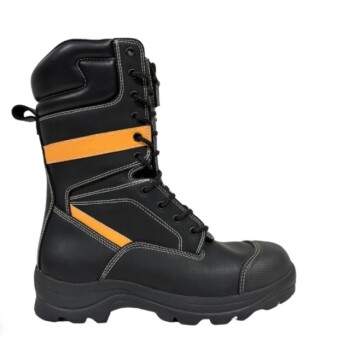
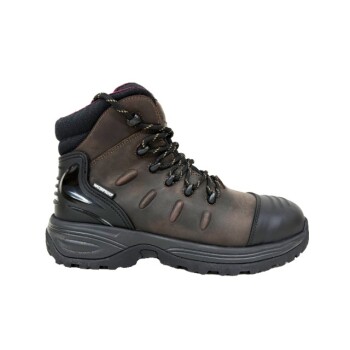
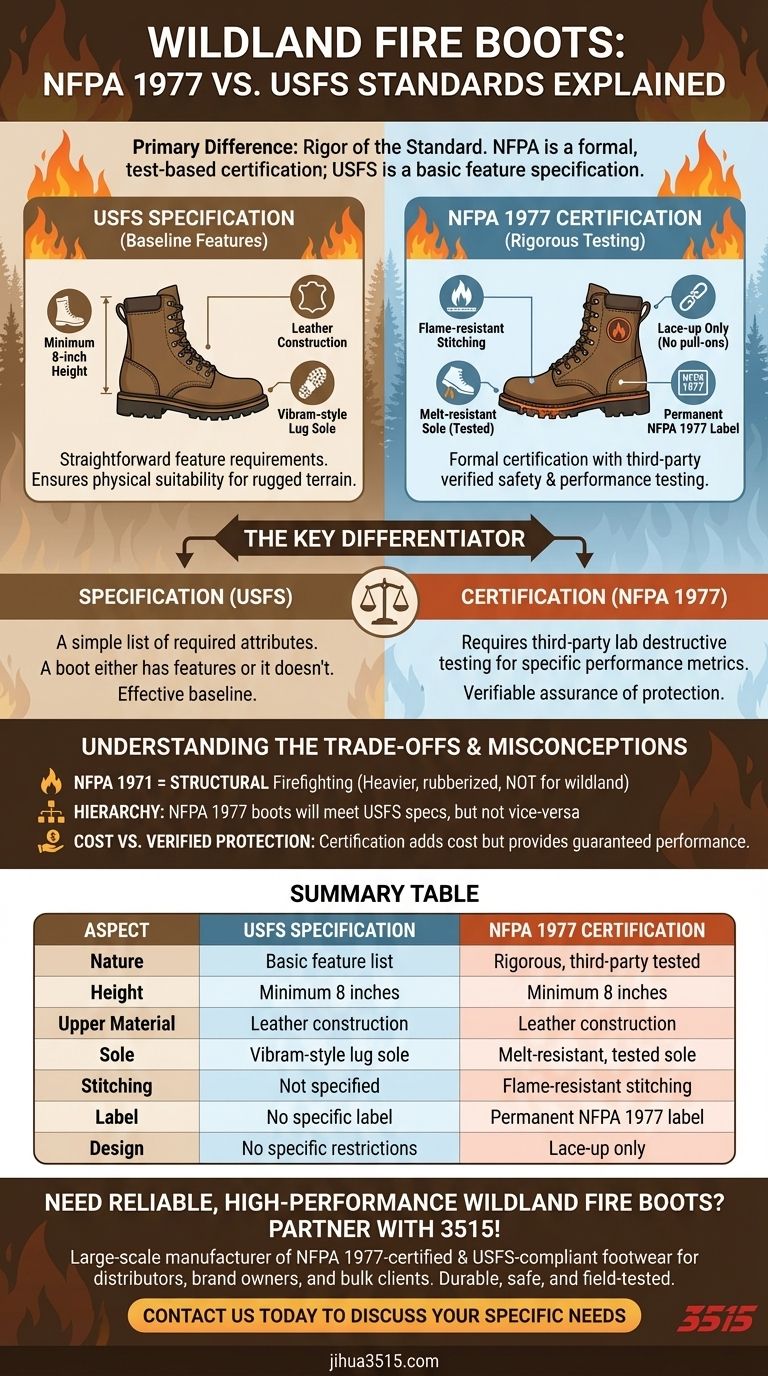
At first glance, the standards appear nearly identical, but the primary difference between NFPA and U.S. Forest Service (USFS) requirements for wildland firefighting boots lies in the rigor of the standard itself. The NFPA outlines a formal, test-based certification process, whereas the Forest Service provides a more basic set of feature specifications.
While both standards demand similar core features like leather construction and an 8-inch height, the NFPA 1977 standard represents a comprehensive, third-party-verified certification for safety and performance, which is not an explicit requirement of the basic USFS specification.
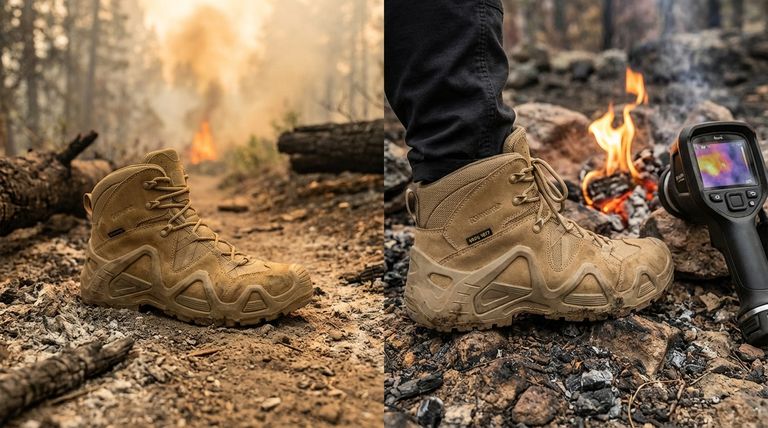
Deconstructing the Standards: A Side-by-Side Look
To understand the practical difference, it's essential to view them not as competing standards, but as two different levels of requirements.
The U.S. Forest Service (USFS) Specification
The Forest Service sets a baseline for what is acceptable for its firefighters. These are straightforward feature requirements.
A USFS-compliant boot must have:
- A minimum height of 8 inches.
- Uppers constructed primarily of leather.
- Vibram or Vibram-style lug soles for traction and durability.
These requirements ensure the boot is physically suited for the rugged terrain and demanding work of wildland firefighting.
The NFPA 1977 Standard
The National Fire Protection Association's standard—specifically NFPA 1977—is a formal certification that involves rigorous testing.
An NFPA 1977-certified boot must meet all the USFS requirements and more, including:
- Flame-resistant exterior stitching and threads.
- A sole that passes specific melt resistance testing.
- A lace-up only design (no pull-on styles permitted).
- A permanent label inside the boot explicitly stating its compliance with the NFPA 1977 standard.
This label is the key visual differentiator and serves as proof that the boot has passed the required battery of safety tests.
The Key Differentiator: Specification vs. Certification
The true gap between the two isn't just a list of features, but the philosophy behind the requirements.
What "Specification" Means (USFS)
The USFS provides a specification—a simple list of required attributes. A boot either has these features or it doesn't.
This approach is effective for ensuring a baseline of quality and function without mandating a complex and costly certification process for every piece of gear.
What "Certification" Means (NFPA)
NFPA 1977 is a certification. A boot manufacturer must submit its product to a third-party lab for destructive testing to prove it meets every component of the standard.
This process verifies specific performance metrics, such as how long the sole can resist melting when exposed to high heat. It provides a higher, verifiable assurance of thermal protection.
Understanding the Trade-offs and Common Misconceptions
Choosing the right boot means understanding what these standards do—and do not—cover.
Misconception: NFPA 1971 is for Wildland Fire
You may see references to NFPA 1971. This standard is for structural firefighting boots. These are heavier, rubberized boots designed for extreme heat and puncture hazards in buildings, making them completely unsuitable for the long-distance hiking required in wildland environments.
The Hierarchy of Compliance
An NFPA 1977-certified boot will almost certainly meet USFS specifications. However, a boot that meets basic USFS specifications is not automatically NFPA 1977 certified.
Cost vs. Verified Protection
NFPA certification adds cost due to the rigorous testing involved. The trade-off is a guaranteed level of performance. Many excellent, durable boots meet USFS specs without being NFPA certified, but the certification provides an extra layer of verified safety.
Making the Right Choice for Your Agency
Your decision should be driven by the requirements of your specific agency and your personal priorities for safety and durability.
- If your primary focus is meeting basic federal requirements: A non-certified boot with an 8-inch leather upper and a quality Vibram sole will suffice.
- If your primary focus is the highest verifiable level of safety: You must select a boot with a label explicitly stating it is compliant with NFPA 1977.
- If your primary focus is long-term investment: Look for rebuildable, NFPA-certified models, which are designed to endure multiple fire seasons with proper care.
Ultimately, choosing the right boot is about matching the level of verified protection to the known hazards of the fireline.
Summary Table:
| Aspect | USFS Specification | NFPA 1977 Certification |
|---|---|---|
| Nature | Basic feature list | Rigorous, third-party tested |
| Height | Minimum 8 inches | Minimum 8 inches |
| Upper Material | Leather construction | Leather construction |
| Sole | Vibram-style lug sole | Melt-resistant, tested sole |
| Stitching | Not specified | Flame-resistant stitching |
| Label | No specific label | Permanent NFPA 1977 label |
| Design | No specific restrictions | Lace-up only, no pull-ons |
Need Reliable, High-Performance Wildland Fire Boots? Partner with 3515!
As a large-scale manufacturer, 3515 produces a comprehensive range of NFPA 1977-certified and USFS-compliant footwear for distributors, brand owners, and bulk clients. Our production capabilities ensure durable, safe, and field-tested boots that meet the highest standards for wildland firefighting.
Contact us today to discuss your specific needs and benefit from our expertise in protective footwear manufacturing. Get in touch now!
Visual Guide
Related Products
- High Performance Fire-Retardant Waterproof Safety Boots
- Premium Flame-Retardant Waterproof Safety Boots and Shoes
- Wholesale Lightweight Tactical Boots Custom Manufacturer for Desert & Combat Use
- Durable Leather Tactical Boots Wholesale & Custom Manufacturing for Brands
- Durable Military Combat Boots with Water Drainage for Wholesale & OEM
People Also Ask
- Why are waterproof safety boots recommended for certain work environments? Essential Protection for Wet & Hazardous Jobs
- What roles do 3D vision systems and industrial robots play in the manufacturing of fire safety boots? Smart Automation
- What materials make waterproof boots durable? The Ultimate Guide to Long-Lasting Footwear
- What's the difference between waterproof and water-resistant boots? Choose the Right Footwear for Your Environment
- How should you maintain waterproof boots? A Simple 3-Step Guide to Long-Lasting Performance