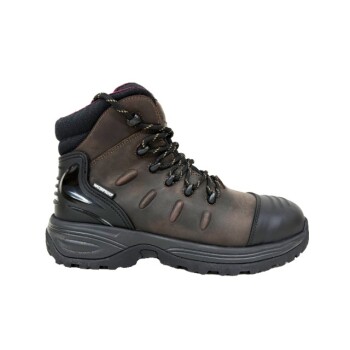
Industrial safety shoes provide a critical defensive barrier for personnel working near heavy cranes through a combination of structural reinforcement and specialized traction control. They primarily function by creating a rigid physical buffer around the foot to withstand compression from tip-overs and by utilizing high-strength anti-slip outsoles to ensure operator stability on the uneven, unpaved foundations typical of lifting zones.
Core Takeaway Safety footwear functions as both a stability platform and a compression shield in lifting environments. By mitigating the risks of crushing injuries and ensuring secure footing on unstable ground, these shoes serve as the final line of defense against the mechanical hazards inherent to heavy crane operations.
Structural Integrity Against Compression
The primary danger in crane operations involves heavy objects—either the load itself or the equipment—compressing the foot.
The Reinforced Buffer Zone
The most vital component is the reinforced toe protection structure. In the event of an accidental compression or a heavy object tip-over, this structure maintains a pocket of protective space. This physical buffer prevents the full weight of the object from crushing the toes, converting a potentially catastrophic injury into a manageable incident.
Impact Resistance from Falling Loads
Beyond static compression, personnel face dynamic risks from falling items, such as timber or crane components. Many professional safety shoes incorporate impact-resistant metatarsal guards. These guards extend protection beyond the toes to the top of the foot, effectively absorbing and dispersing the kinetic energy from falling heavy timber or debris.
Stability and Terrain Management
Crane operations rarely occur on perfectly flat, clean concrete. The ground conditions are often a hazard in themselves.
Traction on Unpaved Foundations
Cranes frequently operate on construction sites with uneven, unpaved, or weather-affected ground. High-strength anti-slip outsoles are engineered to bite into these loose surfaces. This ensures that operators and signalmen maintain their balance and stance, which is critical when guiding loads or reacting quickly to shifting equipment.
Protection Against Ground Debris
Lifting zones are often littered with sharp debris, such as rebar, nails, or wood splinters. Industrial safety shoes address this with puncture-resistant midsoles. These reinforced layers prevent sharp objects from penetrating the sole and injuring the foot, allowing personnel to move confidently across hazardous terrain without looking down at every step.
Psychological and Physiological Factors
Safety gear impacts the wearer's mental state and physical endurance, both of which are crucial for maintaining focus during dangerous lifts.
Reducing Anxiety and Improving Focus
Working under heavy loads creates significant psychological stress. By mitigating physical risks, high-quality safety shoes alleviate psychological anxiety regarding potential injuries. When workers trust their equipment, they experience lower occupational stress and can devote more mental energy to situational awareness and operational safety.
Mitigating Fatigue
Crane operations often require prolonged standing or walking. Professional safety shoes featuring comfortable inner linings help alleviate physical fatigue. Reducing foot strain is essential, as a fatigued operator is more likely to make errors or suffer from slower reaction times.
Understanding the Trade-offs
While safety shoes are essential, they are not a cure-all, and selecting the wrong type can introduce new issues.
The Weight vs. Agility Balance
Heavily reinforced shoes, particularly those with steel components, can be heavy. Excessive weight can lead to increased fatigue over long shifts, potentially impacting an operator's agility. It is crucial to balance maximum protection with the weight the wearer can comfortably manage.
The Limits of Mechanical Protection
No safety shoe can withstand the direct, full impact of a multi-ton crane load. These shoes are designed to mitigate injuries from tip-overs, glancing blows, and falling debris. They should never be viewed as a replacement for strict operational safety zones and distance protocols.
Making the Right Choice for Your Goal
To maximize safety, select footwear based on the specific role of the personnel within the crane operation.
- If your primary focus is Ground Personnel/Signalmen: Prioritize puncture resistance and metatarsal guards, as these workers are most exposed to ground debris and falling objects.
- If your primary focus is Crane Operators: Prioritize anti-slip outsoles and fatigue-reducing linings, ensuring stability while climbing equipment and comfort during long periods of operation.
- If your primary focus is Chemical/Fluid Hazard Management: Look for shoes with rubber or neoprene materials, which provide a barrier against hydraulic fluids or corrosive substances often found near heavy machinery.
Effective safety footwear transforms the foot from a vulnerable point of failure into a protected, stable foundation for safe industrial operations.
Summary Table:
| Protection Feature | Hazard Mitigated | Benefit for Lifting Zones |
|---|---|---|
| Reinforced Toe Cap | Compression & Tip-overs | Prevents crushing from heavy objects |
| Anti-slip Outsole | Uneven/Unpaved Ground | Ensures stability for signalmen & operators |
| Metatarsal Guards | Falling Loads/Debris | Disperses kinetic energy across the foot |
| Puncture-resistant Midsole | Sharp Ground Debris | Protects against rebar, nails, and splinters |
| Ergonomic Lining | Worker Fatigue | Maintains focus and fast reaction times |
Secure Your Workforce with Premium Protective Footwear
As a large-scale manufacturer serving distributors and brand owners, 3515 offers comprehensive production capabilities for all footwear types, anchored by our flagship Safety Shoes series. Whether your clients require specialized metatarsal protection for crane zones or high-traction boots for rugged construction sites, we deliver bulk solutions that meet rigorous safety standards.
Our extensive portfolio covers work and tactical boots, outdoor shoes, training shoes, and sneakers, as well as Dress & Formal shoes to meet diverse bulk requirements. Partner with us to provide your customers with the ultimate stability and compression shielding.
Ready to elevate your inventory with industry-leading safety footwear?
Contact 3515 today to discuss your bulk requirements.
References
- Bayu Aninditya, Fitri Suryani. Implementation of the Hazard Identification, Risk Assessment and Risk Control (HIRARC) Method on Erection Girder Work of South Japek II Toll Road Construction Project Package 3. DOI: 10.58631/injurity.v2i9.127
This article is also based on technical information from 3515 Knowledge Base .
Related Products
- Premium Waterproof High-Cut Industrial Safety Boots for Wholesale and Bulk Orders
- Premium Wheat Nubuck Safety Shoes for Bulk Distribution
- Wholesale Mesh Steel Toe Safety Shoes with Dial Closure Factory Production
- Wholesale Anti-Smash & Puncture-Proof Safety Shoes Custom Manufacturing for Brands
- Premium KPU Athletic Safety Shoes for Wholesale
People Also Ask
- Why are oil-resistant and anti-slip properties critical for industrial safety boots? Expert Outsole Engineering Guide
- What are the primary protective functions of industrial safety boots in oil palm plantations? Master Rough Terrain Safety
- Why are industrial safety boots with high-grip outsoles required for oil leaks and B3 waste? Ensure Worker Stability
- What dual characteristics do industrial safety boots exhibit? Balance Worker Protection with Health Recovery Efficiency
- What are the protective functions of industrial safety boots in sugar factory clarification stations? Thermal & Slip Experts