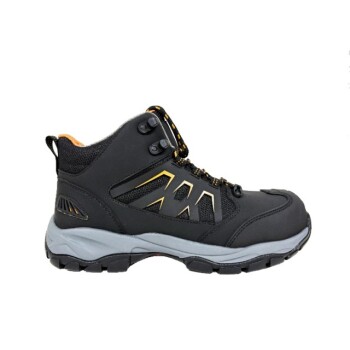
Ankle braces function as a critical mechanical stabilizer by imposing external physical limitations on the ankle joint to prevent dangerous rotation. During the high-impact landing phase of a descent, they work in direct synergy with protective footwear to absorb kinetic energy and restrict range of motion, specifically mitigating the risks of inversion (rolling out) or eversion (rolling in).
Ankle braces do not just support the joint; they act as a force-management system alongside your boots, absorbing impact energy to prevent ligament rupture and stress fractures during complex landings.
The Mechanics of Stabilization
Preventing Excessive Rotation
The primary function of an ankle brace during a descent is to mechanically define the limit of the ankle’s movement.
By providing a rigid external boundary, the brace physically stops the ankle from entering states of excessive inversion or eversion. This is critical when landing on complex or uneven terrain where the foot may naturally want to roll.
Compensating for Technique
Even experienced professionals can execute a poor flare technique or misjudge a landing.
In these instances, the brace acts as a failsafe. It ensures that mechanical alignment is maintained even when the operator's control over the descent is less than perfect.
Synergy with Protective Footwear
A Unified Energy Absorption System
An ankle brace should not be viewed as a separate entity, but rather as an integral enhancement to protective footwear.
While the boot protects the foot from external debris and surface abrasion, the brace works internally to absorb impact energy. This synergy distributes the force of the landing more effectively than footwear can achieve in isolation.
Mitigating Structural Injury
The combination of bracing and heavy-duty footwear is specifically designed to protect the skeletal structure of the lower limbs.
By dampening the shock of landing, this system prevents the cumulative stress that leads to stress fractures. It also shields the ligaments from the sudden, sharp forces that cause tearing.
Understanding the Trade-offs
Physical Limitation of Motion
The core mechanism of a brace is to apply "external physical limitations."
While this protects the joint, it inherently restricts the natural flexibility of the ankle. Users must accept that this restriction, while protective, reduces the micro-adjustments the foot can usually make during a landing.
Dependency on Integration
The effectiveness described relies entirely on the "synergy" between the brace and the boot.
If the footwear does not accommodate the brace properly, or if the brace is worn with inadequate footwear, the energy absorption capabilities are compromised. The brace enhances the boot; it does not replace the need for high-quality footwear.
Making the Right Choice for Your Goal
When gearing up for a descent, consider your primary objective:
- If your primary focus is Injury Prevention: Prioritize a brace that integrates seamlessly with your specific boots to maximize energy absorption and prevent stress fractures.
- If your primary focus is Stability on Rough Terrain: Select a brace that offers the most rigid controls against inversion and eversion to counter uneven landing surfaces.
By viewing the ankle brace as a necessary component of your energy-management system, you ensure the longevity of your lower limbs in high-impact environments.
Summary Table:
| Mechanism | Function | Key Benefit |
|---|---|---|
| Physical Limitation | Restricts inversion and eversion | Prevents ligament rupture and rolling |
| Energy Absorption | Synergizes with boot soles | Reduces impact force and stress fractures |
| Mechanical Alignment | Maintains skeletal positioning | Compensates for poor landing techniques |
| Structural Support | Acts as a rigid external boundary | Protects lower limbs on uneven terrain |
Secure Your Team's Safety with 3515 High-Performance Footwear
As a large-scale manufacturer serving distributors and brand owners, 3515 offers comprehensive production capabilities for all footwear types, anchored by our flagship Safety Shoes series. Our footwear is engineered to integrate perfectly with stabilization systems to provide maximum protection for your clients.
Our extensive portfolio covers work and tactical boots, outdoor shoes, training shoes, and sneakers, as well as Dress & Formal shoes to meet diverse bulk requirements. Partner with us to deliver energy-management systems that prevent injuries and ensure long-term durability.
Contact us today to explore our bulk manufacturing solutions!
References
- Michiel Damhuis, Edward Tan. The ground is the limit: epidemiology of skydiving accidents over 25 years and in 2.1 million jumps in the Netherlands with sub-analysis of injuries reported by medical professionals in the past five years. DOI: 10.1186/s13017-024-00535-w
This article is also based on technical information from 3515 Knowledge Base .
Related Products
- Durable High-Ankle Tactical Boots for Wholesale & Custom Manufacturing
- Durable Leather High-Ankle Tactical Boots for Wholesale & Custom Manufacturing
- Wholesale Classic Leather Lace-Up Ankle Boots for Brand Manufacturing
- Durable High-Ankle Tactical Boots Wholesale Manufacturer for Custom & Bulk Orders
- Wholesale Leather Ankle Boots with Lug Soles for Custom Brand Manufacturing
People Also Ask
- How do tactical boots protect against injuries? Discover the Integrated Safety System
- How does additive manufacturing equipment reduce environmental risks? Sustainable Tactics for Modern Footwear Production
- How is the compatibility of polymer materials demonstrated in smart footwear? Enhancing Tactical & Training Performance
- What are the different types of tactical boots available? Find the Right Boot for Your Mission
- What are the main construction similarities between tactical boots and tactical sneakers? Built for Performance & Durability