
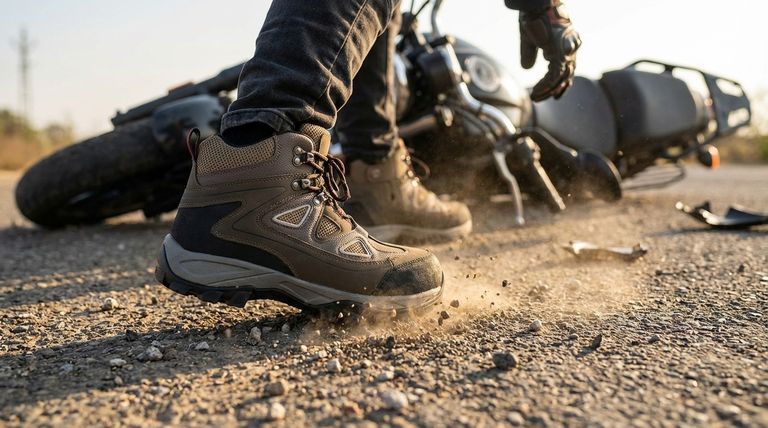
At its core, a protective motorcycle boot acts as an external skeleton for your lower leg and ankle. It is specifically engineered to prevent injuries by rigidly controlling movement, stopping your ankle from twisting, overextending, or being crushed in the dynamic and violent forces of a crash.
A proper motorcycle boot's value lies in its ability to function like a temporary cast during an accident. It combines rigid armor, secure fastenings, and intentionally limited flexibility to absorb impacts and prevent the ankle and lower leg from moving beyond their natural, safe range of motion.
The Core Mechanisms of Ankle Protection
To understand how a boot achieves this, we need to look at its key structural components and how they work together to counter the most common injury-causing forces in a motorcycle accident.
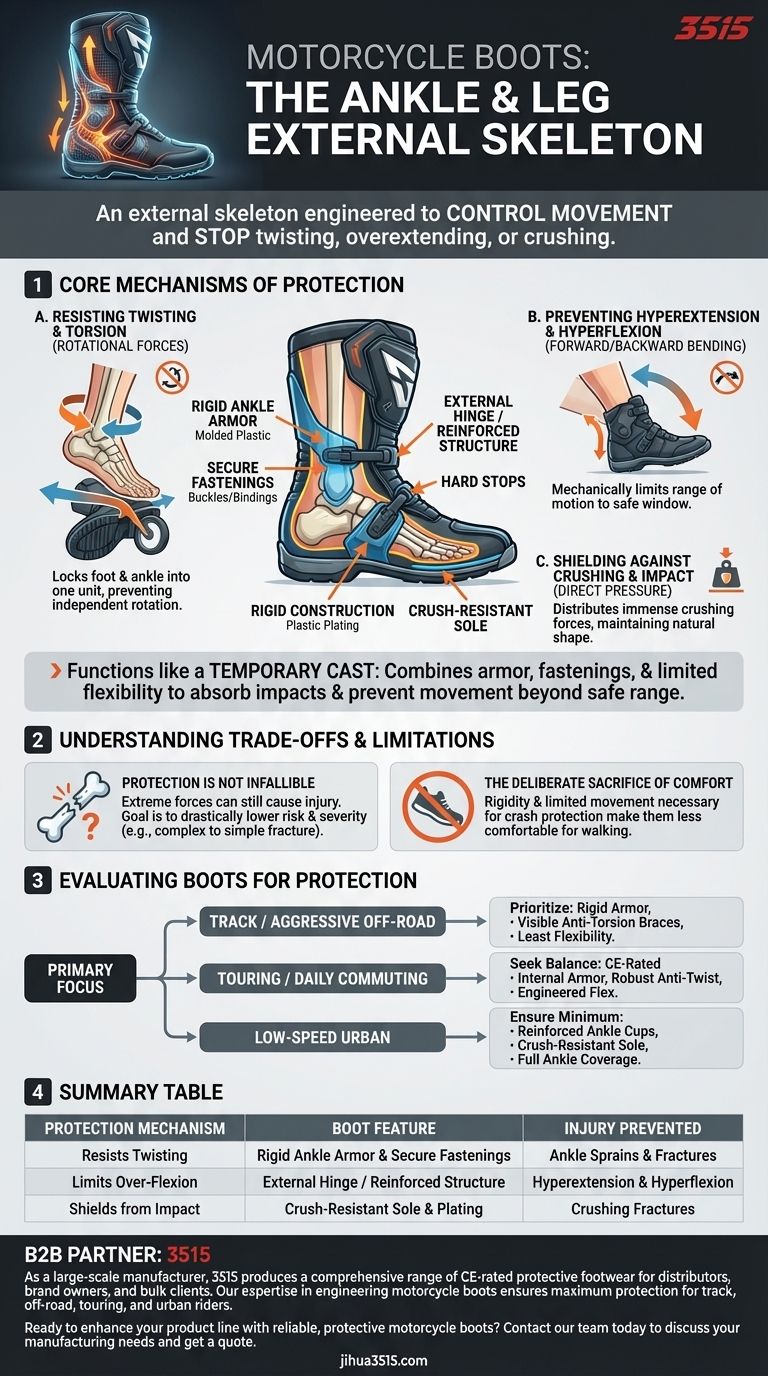
Resisting Twisting and Torsion
The most dangerous movements for an ankle are rotational. Motorcycle boots counter this with a combination of hard armor and secure fastening systems.
Hard armor, often made of molded plastic, is built into the ankle area. This armor prevents the joint from twisting laterally.
Simultaneously, the boot's buckles or bindings cinch down securely around the lower leg, locking your foot and ankle into a single, cohesive unit. This integrated system makes it incredibly difficult for the ankle to rotate independently, which is a primary cause of sprains and fractures.
Preventing Hyperextension and Hyperflexion
Another common injury occurs when the ankle is forced to bend too far forward (hyperflexion) or backward (hyperextension).
Protective boots are designed with a mechanically limited range of motion. An external hinge or a reinforced structure allows for the normal movement required to operate the bike's controls but has hard stops to prevent the joint from being forced beyond that safe window.
Shielding Against Crushing and Impact
During a crash, it is common for the bike to fall on the rider's leg or for the leg to be pinned against another object.
The boot's rigid construction, often featuring plastic plating and reinforced soles, is designed to withstand and distribute immense crushing forces. This structure maintains the natural shape of your foot and lower leg, preventing the bones from being fractured under direct pressure.
Understanding the Trade-offs and Limitations
While highly effective, it's crucial to have a realistic understanding of what motorcycle boots can and cannot do. This protection is the result of deliberate engineering compromises.
Protection is Not Infallible
Even with the best boots, extreme forces can still cause injury. A boot can significantly reduce the severity of an injury, perhaps turning a catastrophic, multi-part fracture into a simpler, cleaner break.
As some riders have experienced, a broken fibula or torn ligaments can still occur in a severe enough accident. The goal of the boot is to drastically lower the risk, not eliminate it entirely.
The Deliberate Sacrifice of Comfort
The rigidity and limited movement required for protection inherently make these boots less comfortable for walking than standard footwear. This is not a design flaw but a necessary trade-off.
The most protective boots often feel stiff and restrictive off the bike because their primary function is to perform under the extreme stress of a crash, not for casual walking.
How to Evaluate Boots for Maximum Protection
Choosing the right boot depends on understanding your primary riding environment and accepting the relevant trade-offs between protection and flexibility.
- If your primary focus is track riding or aggressive off-road use: Prioritize boots with the most rigid external armor, visible anti-torsion braces, and the least amount of flexibility.
- If your primary focus is touring or daily commuting: Seek a balance of CE-rated internal armor, robust anti-twist features, and enough engineered flex for reasonable off-bike comfort.
- If your primary focus is preventing injuries in low-speed urban incidents: Ensure any boot you choose has, at a minimum, reinforced ankle cups, a crush-resistant sole, and a height that covers the ankle completely.
Ultimately, selecting a boot is a conscious decision to shield your body from predictable forces in an unpredictable event.
Summary Table:
| Protection Mechanism | Boot Feature | Injury Prevented |
|---|---|---|
| Resists Twisting | Rigid Ankle Armor & Secure Fastenings | Ankle Sprains & Fractures |
| Limits Over-Flexion | External Hinge / Reinforced Structure | Hyperextension & Hyperflexion |
| Shields from Impact | Crush-Resistant Sole & Plating | Crushing Fractures |
As a large-scale manufacturer, 3515 produces a comprehensive range of CE-rated protective footwear for distributors, brand owners, and bulk clients.
Our expertise in engineering motorcycle boots with rigid ankle armor, anti-torsion systems, and crush-resistant soles ensures maximum protection for riders. We help you offer high-quality, safety-focused footwear that meets the demands of track, off-road, touring, and urban riders.
Ready to enhance your product line with reliable, protective motorcycle boots? Contact our team today to discuss your manufacturing needs and get a quote.
Visual Guide
Related Products
- Wholesale Tactical Boots High-Traction & Reflective for Bulk & Brand Orders
- High Performance Fire-Retardant Waterproof Safety Boots
- Durable Goodyear Welt Leather Work Boots for Wholesale & Private Label
- Wholesale High-Traction Camo Boots - Custom Manufacturer for Brands
- Heavy-Duty Waterproof Nubuck Safety Boots Safety Shoes for Bulk Supply
People Also Ask
- How do tactical boots protect against injuries? Discover the Integrated Safety System
- What are the key features to look for in the best tactical boots? A Guide to Peak Performance
- What are the advantages and disadvantages of tactical boots? Lightweight Comfort vs. Rugged Durability
- How do combat boots and tactical boots differ in design and purpose? Choose the Right Boot for Your Mission
- What are the primary characteristics of tactical boots? Lightweight, Agile, and Built for All-Day Missions



















