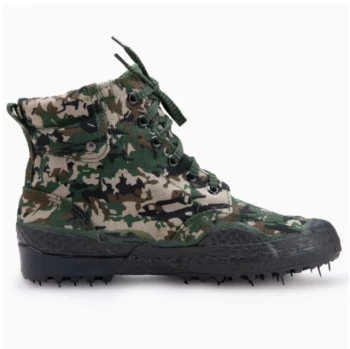
In the majority of hunting scenarios, deer do not notice the specific color of your boots, provided you are wearing standard earth tones or blaze orange. While hunters often agonize over matching camouflage patterns from head to toe, the reality is that deer perceive the lower part of the color spectrum very differently than humans do.
Core Insight: The color of your footwear is rarely the variable that ruins a hunt. Because deer vision processes specific wavelengths differently, they are far more likely to be alerted by the movement of your feet than by the shade of leather or fabric covering them.

The Mechanics of Deer Vision
To understand why your boot color matters less than you think, you must understand how a deer sees the world. They are not looking for the same visual cues that humans are.
Beyond the Myth of Color Blindness
It is a common misconception that deer are completely color-blind.
In reality, they simply perceive colors on a different spectrum. While they struggle to distinguish red and green, blues and yellows stand out vividly to them.
The Blaze Orange Anomaly
This difference in perception explains why bright safety gear does not spook game.
To a deer, blaze orange appears as a dull gray. This allows hunters to remain highly visible to humans for safety, while effectively disappearing into the monochrome background of a deer's vision.
Effectiveness of Earth Tones
Solid colors like brown or green are generally effective for hunting boots.
Deer do not seem to notice these solid earth tones as distinct threats. As long as you avoid bright blues or yellows, the specific shade of your boot is largely irrelevant to the deer.
The Real Drivers of Detection
While you might be focused on color, the deer is focused on mechanics. There is a clear hierarchy of what actually alerts a deer to your presence.
Movement is the Primary Trigger
The references are clear: movement is the single most significant factor that alerts a deer.
A deer's eyes are evolved to detect motion instantly as a survival mechanism. If you are wearing perfectly camouflaged boots but shuffle your feet, you will likely be detected.
The Danger of Contrast
While color itself is less critical, high-contrast colors can be a liability.
Because blues and yellows stand out more to deer, boots featuring these colors can act as a beacon. A blue logo or a yellow sole could theoretically catch a deer's eye more easily than a solid brown boot.
Common Pitfalls to Avoid
When selecting gear, it is easy to focus on the wrong specifications. Here are the trade-offs you should consider to ensure you are prioritizing what matters.
Overvaluing Camouflage Patterns
Do not overspend on boots simply because they feature a specific camouflage print.
Since solid browns and greens are just as effective, paying a premium for camo patterns on boots often yields diminishing returns. The mud and brush will likely obscure the pattern regardless.
Ignoring the Blue Spectrum
The biggest mistake is wearing non-hunting hiking boots that feature athletic styling.
Many hiking boots use blue or yellow accents for aesthetic appeal. These are the specific colors you must avoid to ensure you remain inconspicuous.
Making the Right Choice for Your Goal
Your gear selection should be based on biological facts, not marketing hype. Here is how to prioritize your footwear choice based on your hunting objectives.
- If your primary focus is Stealth: Prioritize boots with solid earth tones and focus your effort on remaining motionless, as movement is your biggest giveaway.
- If your primary focus is Safety: Do not hesitate to wear boots with orange accents, as these appear gray to deer and will not compromise your position.
- If your primary focus is Budget: Avoid paying extra for camouflage patterns on boots; simple brown or green work boots are visually sufficient for deer hunting.
Master your stillness first, and your boot color becomes a secondary concern.
Summary Table:
| Factor | Importance for Deer Detection | Key Insight |
|---|---|---|
| Movement | High | The primary trigger for alerting deer. Mastering stillness is crucial. |
| Contrast | Medium | Avoid high-contrast colors like bright blues and yellows. |
| Specific Boot Color | Low | Standard earth tones (brown, green) are generally effective. |
| Blaze Orange | Low | Appears as a dull gray to deer, making it safe for hunters. |
Ready to Gear Up with Confidence?
As a large-scale manufacturer, 3515 produces a comprehensive range of high-performance hunting and tactical footwear for distributors, brand owners, and bulk clients. Our expertise ensures your gear is built for stealth, durability, and comfort, based on real-world biological facts—not just marketing hype.
Let us help you equip your customers with the right boots for the hunt.
Contact our team today to discuss your footwear needs and explore our production capabilities.
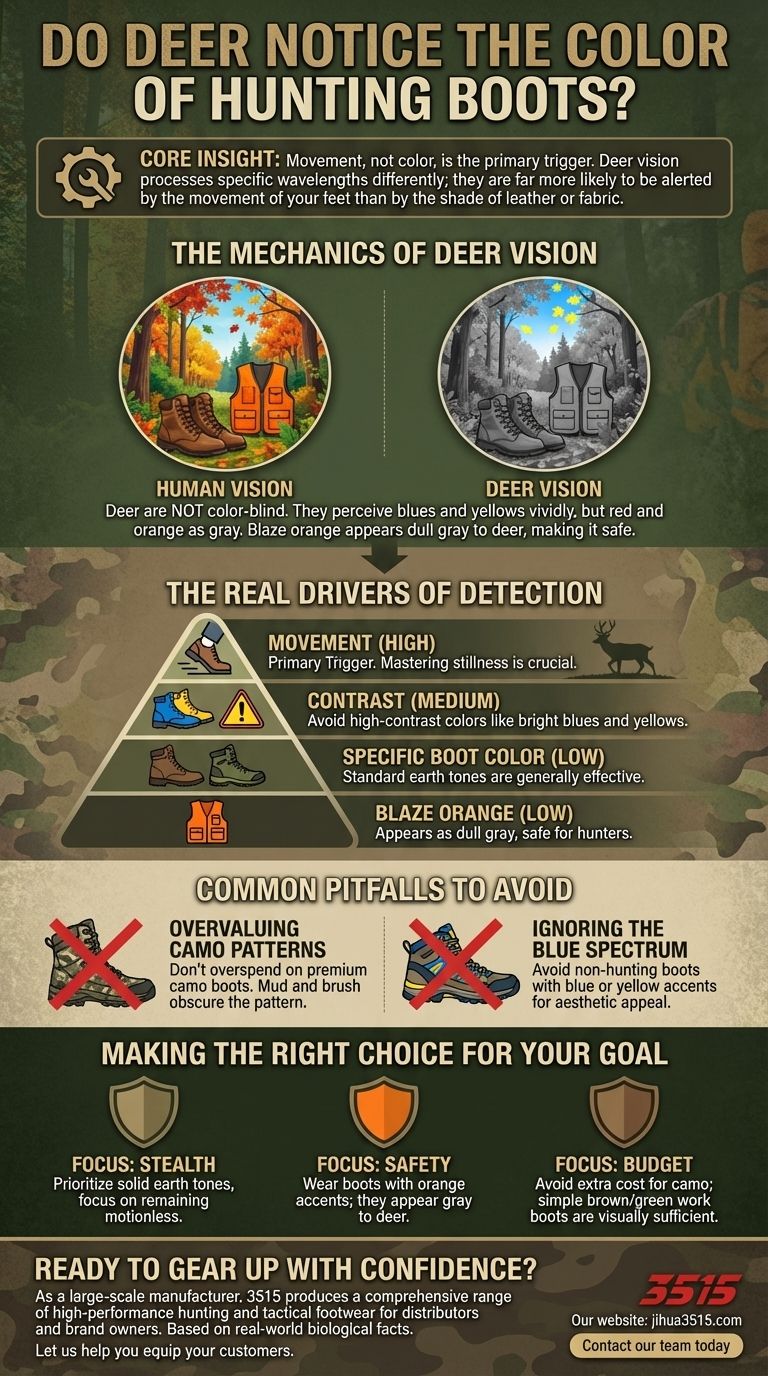
Visual Guide
Related Products
- Wholesale Lightweight Tactical Boots Custom Manufacturer for Desert & Combat Use
- High-Traction Suede Tactical Boots Wholesale & Custom Manufacturing
- Durable Leather Tactical Boots Wholesale & Custom Manufacturing for Brands
- Durable Military Combat Boots with Water Drainage for Wholesale & OEM
- Wholesale Waterproof Tactical Boots Custom Suede & High-Traction Soles
People Also Ask
- What are the common types of combat boots? Find the Right Boot for Your Mission
- What specialized protections do tactical boots offer? Maximize Endurance with High-Performance Footwear
- What are the different types of tactical boots available? Find the Right Boot for Your Mission
- What is the role of high-frequency acquisition hardware in technical skill analysis for outdoor and tactical boots?
- How does additive manufacturing equipment reduce environmental risks? Sustainable Tactics for Modern Footwear Production