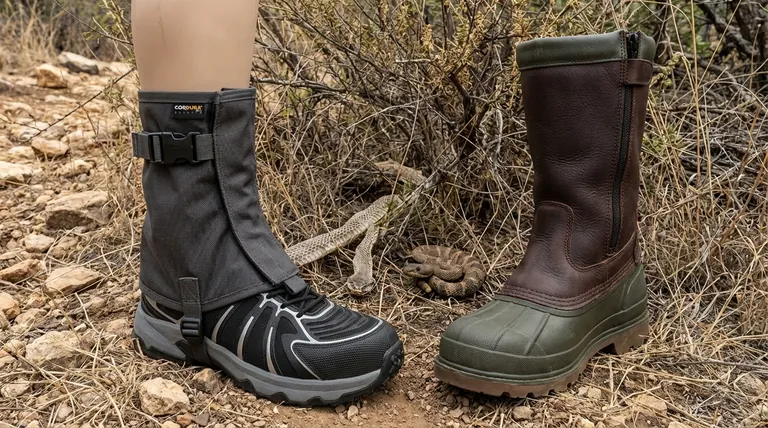
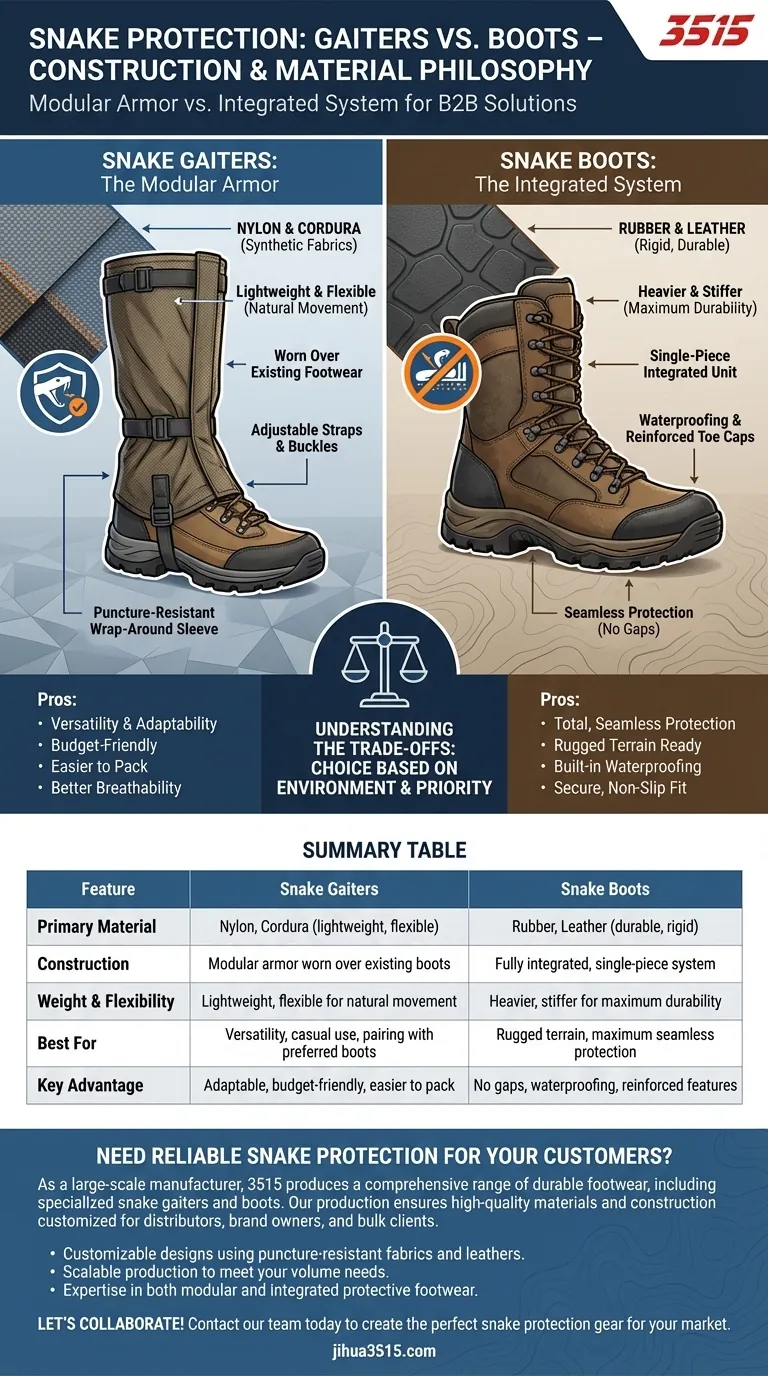
At their core, snake gaiters and snake boots differ fundamentally in their construction philosophy. Gaiters are modular leg armor made from durable fabrics like nylon or Cordura, designed to be worn over your existing footwear. In contrast, snake boots are a fully integrated system, built as a single piece of footwear from tougher, less flexible materials like rubber and leather.
The choice between gaiters and boots is not just about protection, but about deciding between the adaptable, lightweight nature of an add-on armor system versus the seamless, all-in-one durability of purpose-built footwear.
Deconstructing the Design Philosophy
To understand the material differences, you must first appreciate the distinct purpose each piece of gear is designed to fulfill. One is an accessory, the other is a complete tool.
Snake Gaiters: The Modular Armor
Snake gaiters function as a protective sleeve that wraps around your lower leg. Their construction is focused on providing puncture resistance while remaining lightweight and flexible.
They are secured over your pants and hiking boots using a system of adjustable straps and buckles, allowing them to conform to different leg sizes and footwear types.
Snake Boots: The Integrated System
Snake boots are purpose-built from the ground up to offer seamless protection. The entire boot, from the sole to the upper calf, is constructed as a single protective unit.
This integrated design often incorporates features not found in gaiters, such as waterproofing, reinforced toe caps, and either lace-up or pull-on closures for a secure, non-slip fit.
A Material-by-Material Comparison
The choice of materials directly reflects the design philosophy of each item, creating a clear distinction in performance, weight, and feel.
Flexibility and Weight (Nylon & Cordura)
Gaiters primarily use dense-weave synthetic fabrics like nylon and Cordura. These materials offer an excellent balance of puncture resistance, low weight, and flexibility, allowing for a more natural range of motion while hiking.
Durability and Puncture Resistance (Rubber & Leather)
Boots rely on inherently tougher and more rigid materials. Thick rubber and heavy-duty leather provide a higher degree of durability against constant abrasion and a more formidable barrier against potential bites, though this comes at the cost of increased weight and stiffness.
Understanding the Trade-offs
Neither option is universally superior; they represent two different solutions to the same problem, each with inherent benefits and drawbacks.
The Versatility of Gaiters
The primary advantage of gaiters is versatility. You can pair them with your favorite, most comfortable hiking boots, adapting them to the specific needs of your trip. They are also typically more budget-friendly and easier to pack.
The Total Protection of Boots
Snake boots offer complete, uninterrupted protection from the sole of your foot to your calf. There are no gaps between the footwear and the leg covering, which can provide greater peace of mind in high-risk environments.
The Comfort and Breathability Factor
Because they are an external layer, gaiters allow for more air circulation around the foot and ankle. Boots, with their rubber or thick leather construction, are often hotter and can feel significantly heavier during long treks.
Making the Right Choice for Your Activity
Your decision should be based on your environment, the duration of your activity, and your personal priorities for comfort and convenience.
- If your primary focus is versatility and casual use: Gaiters provide excellent, adaptable protection that you can add or remove as needed.
- If your primary focus is maximum durability in rugged terrain: Boots offer superior, seamless protection and are built to withstand extended wear and harsh conditions.
- If your primary focus is pairing protection with your preferred footwear: Gaiters are the only option that allows you to use your own trusted hiking boots.
Ultimately, choosing the right protection means matching the gear's construction to the demands of your specific outdoor environment.
Summary Table:
| Feature | Snake Gaiters | Snake Boots |
|---|---|---|
| Primary Material | Nylon, Cordura (lightweight, flexible) | Rubber, Leather (durable, rigid) |
| Construction | Modular armor worn over existing boots | Fully integrated, single-piece system |
| Weight & Flexibility | Lightweight, flexible for natural movement | Heavier, stiffer for maximum durability |
| Best For | Versatility, casual use, pairing with preferred boots | Rugged terrain, maximum seamless protection |
| Key Advantage | Adaptable, budget-friendly, easier to pack | No gaps, waterproofing, reinforced features |
Need Reliable Snake Protection for Your Customers?
As a large-scale manufacturer, 3515 produces a comprehensive range of durable footwear, including specialized snake gaiters and boots. Our production capabilities ensure high-quality materials and construction tailored for distributors, brand owners, and bulk clients.
We offer:
- Customizable designs using puncture-resistant fabrics and leathers.
- Scalable production to meet your volume needs.
- Expertise in both modular and integrated protective footwear.
Let's collaborate to create the perfect snake protection gear for your market. Contact our team today to discuss your requirements and get a quote!
Visual Guide
Related Products
- Lightweight Breathable Sneakers with Wet-Traction Grip for Wholesale & Private Label
- Wholesale Breathable Athletic Sneakers - Custom Lightweight Cushioned Footwear Manufacturer
- Wholesale Lightweight Cushioned Athletic Sneakers for Custom Bulk Production
- Durable High-Ankle Tactical Boots Wholesale Manufacturer for Custom & Bulk Orders
- Wholesale Durable Camouflage Canvas Shoes with High-Traction Cleated Rubber Sole
People Also Ask
- Why are breathable sneakers necessary for tropical commuting? Stay Cool and Dry in High Humidity
- What role do lightweight training shoes play in urban traffic? Boost Agility and Reaction for Safer City Navigation
- How do lightweight shoes provide support? The Science of Efficient Cushioning & Stability
- How do lightweight shoes improve breathability? Discover the Science of Cool, Dry Feet
- What are the style advantages of lightweight shoes? Sleek, Versatile & Modern Comfort