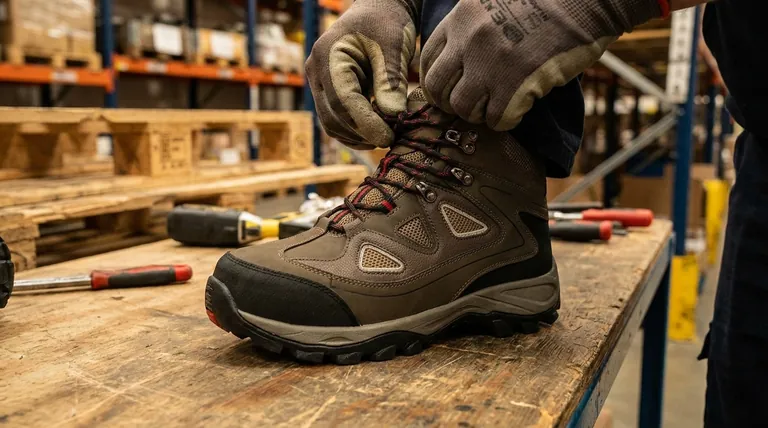
The Illusion of Passive Safety
A warehouse operator, with a decade of experience, needs to grab a torque wrench from a restricted zone. The walk is thirty feet. He's wearing sneakers because his work boots felt a bit stiff this morning. It’s a "quick task," a familiar path. Nothing happens.
But in that moment, the entire multi-million-dollar safety program was rendered useless. It wasn't a failure of equipment or policy; it was a failure of behavior.
We often fall for the illusion of passive safety. We issue a steel-toed boot and believe we have "provided protection." But safety equipment is not a shield that works independently. Its effectiveness is determined in the final yard—in the mind and actions of the person wearing it. The real challenge isn't just engineering a better boot, but engineering a culture of active ownership.
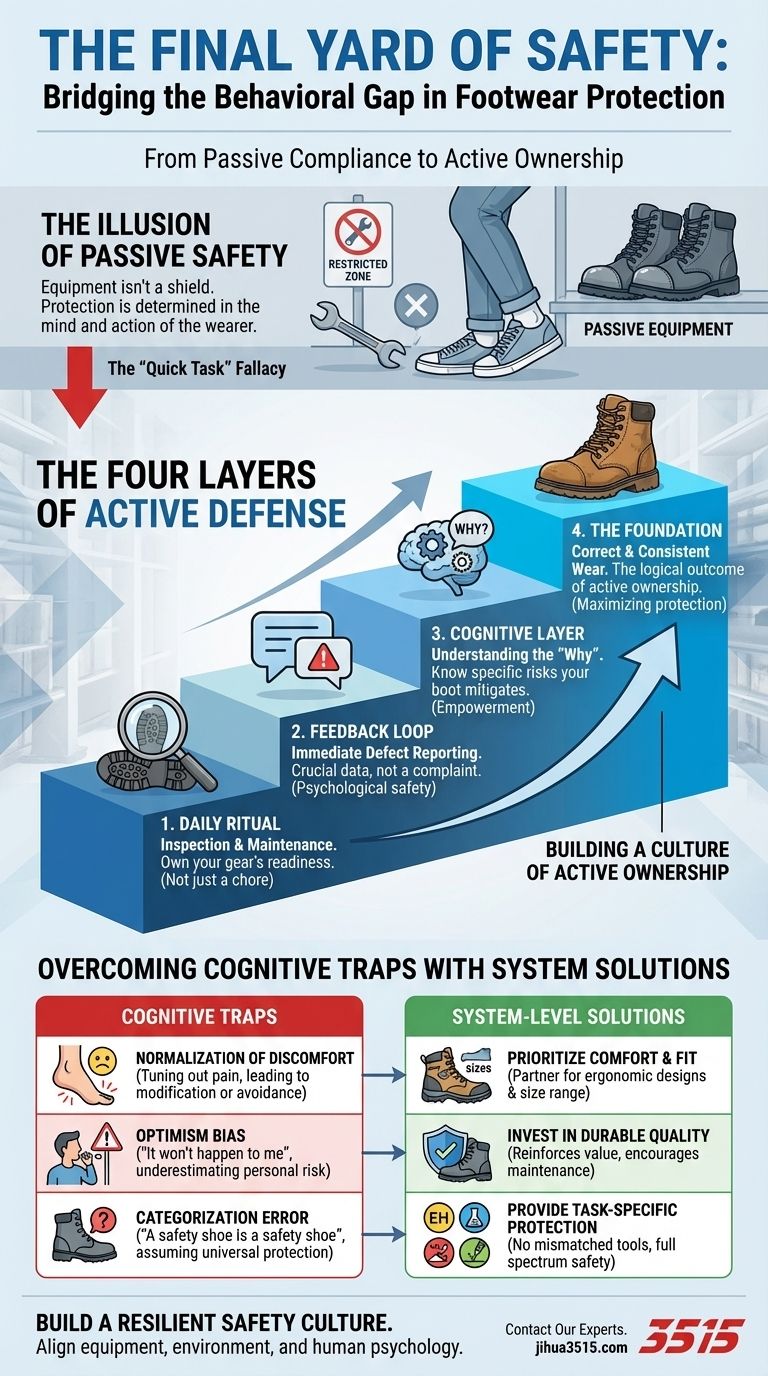
From Mandate to Mindset: The Four Layers of Active Defense
An employee's relationship with their safety footwear shouldn't be one of passive compliance. It must be an active, daily engagement. This transforms a piece of equipment from a mandate into a personal tool for risk management. This mindset is built on four principles.
1. The Daily Ritual: Inspection and Maintenance
A pilot performs a pre-flight check not because they expect to find a fault, but because they understand the consequences if they miss one. The same discipline applies to safety footwear.
A brief, daily inspection for cracks, sole separation, or exposed protective elements is not a chore; it's a professional ritual. It shifts the employee's mindset from "the company gave me these shoes" to "this is my equipment, and I am responsible for its readiness." Cleaning the gear is part of this—it's hard to spot a developing fissure under a layer of mud.
2. The Feedback Loop: Immediate Defect Reporting
A worn-out sole that has lost its slip resistance is a critical piece of data. If it goes unreported, it's a data point that can only be logged by an incident report.
Employees must feel psychologically safe to report a defect, no matter how minor. This isn't a complaint; it's crucial feedback for the entire safety system. It can signal a faulty batch, indicate that a shoe has reached its end-of-life, or highlight a mismatch between the equipment and the work environment. A culture that punishes or dismisses these reports is a culture that is choosing to fly blind.
3. The Cognitive Layer: Understanding the 'Why'
Safety training often focuses on the "what" (wear your boots) but fails on the "why." Why is this specific boot required for this specific task?
An employee who understands that their boot is rated for Electrical Hazard (EH) protection will think twice before wading through a chemical spill. Active participation in training—asking questions, understanding limitations—builds a cognitive layer of safety. It empowers the worker to spot new risks or recognize when their standard-issue PPE is no longer the right tool for a changing job.
4. The Foundation: Correct and Consistent Wear
This is the ultimate outcome of the other three layers. When an employee inspects their gear, feels empowered to report issues, and understands the risks it mitigates, consistent wear becomes a logical conclusion, not just a rule.
Lacing boots snugly for ankle support or ensuring the tongue is properly aligned isn't just about comfort; it's about maximizing the engineered protection. It's the final, critical step in activating the equipment's potential.
Three Cognitive Traps That Undermine Protection
Even with the best intentions, the human mind takes shortcuts. Recognizing these cognitive biases is the first step toward building a system that accounts for them.
The Normalization of Discomfort
An ill-fitting boot creates a low-level, persistent distraction. The human brain is brilliant at tuning out such "noise," but this normalization of discomfort is dangerous. It reduces focus and can lead workers to modify their boots or avoid wearing them entirely. A proper fit isn't a luxury; it's a core safety feature.
The Optimism Bias: "It Won't Happen to Me"
This is the psychological trap behind the "quick task" fallacy. The brain systematically underestimates personal risk in familiar environments. Complacency is a cognitive bias, not a character flaw. It's the reason we need systems and rituals—like the daily inspection—to force a conscious check against our own automatic sense of safety.
The Categorization Error: "A Safety Shoe is a Safety Shoe"
The human brain loves to simplify. This leads to the dangerous assumption that all safety footwear is the same. An employee might see a steel toe and assume they are protected from everything, unaware that their boot has no puncture resistance or chemical protection. This false sense of security is often more dangerous than no protection at all.
Building a System That Supports the Human
You cannot eliminate cognitive bias, but you can build a safety program that makes it easier for people to do the right thing. This starts with the equipment itself.
Choosing the right manufacturing partner is fundamental to removing the initial barriers to active safety ownership.
| Behavioral Challenge | System-Level Solution |
|---|---|
| Normalization of Discomfort | Prioritize comfort and fit. Partner with a manufacturer capable of producing a comprehensive range of sizes and ergonomic designs. A comfortable boot is a boot that gets worn correctly. |
| Categorization Error | Provide task-specific protection. Work with a supplier offering a full spectrum of safety footwear—from impact and puncture resistance to EH and chemical protection—to ensure no employee has a mismatched tool. |
| Complacency & Lack of Ownership | Invest in high-quality, durable equipment. When footwear withstands the rigors of the job, it reinforces its value and makes employees more likely to inspect and maintain it. |
A safety program succeeds when it aligns the equipment, the environment, and human psychology. Providing footwear that is comfortable, purpose-built, and durable is the first and most critical step in encouraging employees to transition from passive recipients to active owners of their own safety. As a large-scale manufacturer, 3515 produces a comprehensive range of footwear precisely for this purpose, enabling organizations to build a resilient safety culture from the ground up.
If you're ready to build a system that bridges the gap between policy and human behavior, Contact Our Experts.
Visual Guide
Related Products
- Premium Suede Sport Safety Shoes for Wholesale & Bulk Orders
- Premium Lightweight Safety Shoes for Wholesale & Bulk Orders
- Wholesale Anti-Smash & Puncture-Proof Safety Shoes Custom Manufacturing for Brands
- Premium KPU Injection Athletic Style Safety Shoes
- Premium Safety Shoes with Rotating Buckle Safety Sneakers
Related Articles
- The Ghost in the Machine: Why an Obsolete Footwear Standard Creates Modern Risk
- Beyond the Steel Toe: The Hidden Ergonomics of Workplace Safety
- Why Traditional Laces Are a Hidden Safety Risk—And What to Do About It
- The True Cost of Skipping Safety Shoes: Long-Term Risks and Smart Protection
- How Safety Shoe Engineering Prevents Workplace Injuries Across Industries



















