We Misunderstand "Safe"
We have a cognitive bias for simplicity. When we see a worker in a hard hat and heavy boots, our brain registers "safe." We see the thick leather and the reinforced toe and assume the person is protected.
This mental shortcut is dangerous.
A boot that can stop a falling brick might offer zero protection against an invisible electrical current. A sole that can resist a nail puncture might do nothing to prevent a static discharge that could destroy a thousand-dollar circuit board.
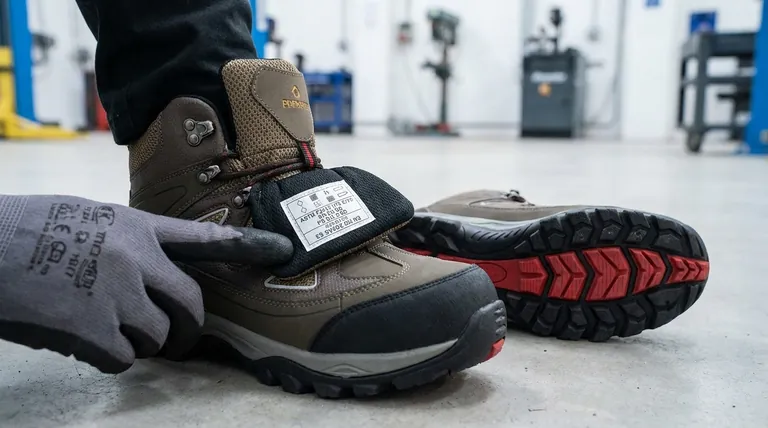
True safety isn't found in the appearance of a boot, but in the hidden language of standards stamped on its tongue. This is the system that translates the chaotic physics of the workplace into a predictable code of protection.
A Universal Benchmark Against Chaos
Before standards like ASTM F2413 and EN ISO 20345, "safety footwear" was a loose promise. An employer's choice was based on guesswork and trust.
The purpose of a global standard is to eliminate that uncertainty. It creates a universal, reliable benchmark. It ensures that a boot marketed as "puncture-resistant" has survived a specific, repeatable test with a calibrated, sharp object.
This isn't about bureaucracy; it's about creating a predictable system for life-and-death situations. It’s the engineer's romance of turning complex risk into a simple, reliable rating.
Decoding the Two Global Languages
While the goal is universal safety, the world speaks two primary languages for footwear standards. Understanding the philosophy behind each is key to making the right choice.
ASTM F2413: The American Standard
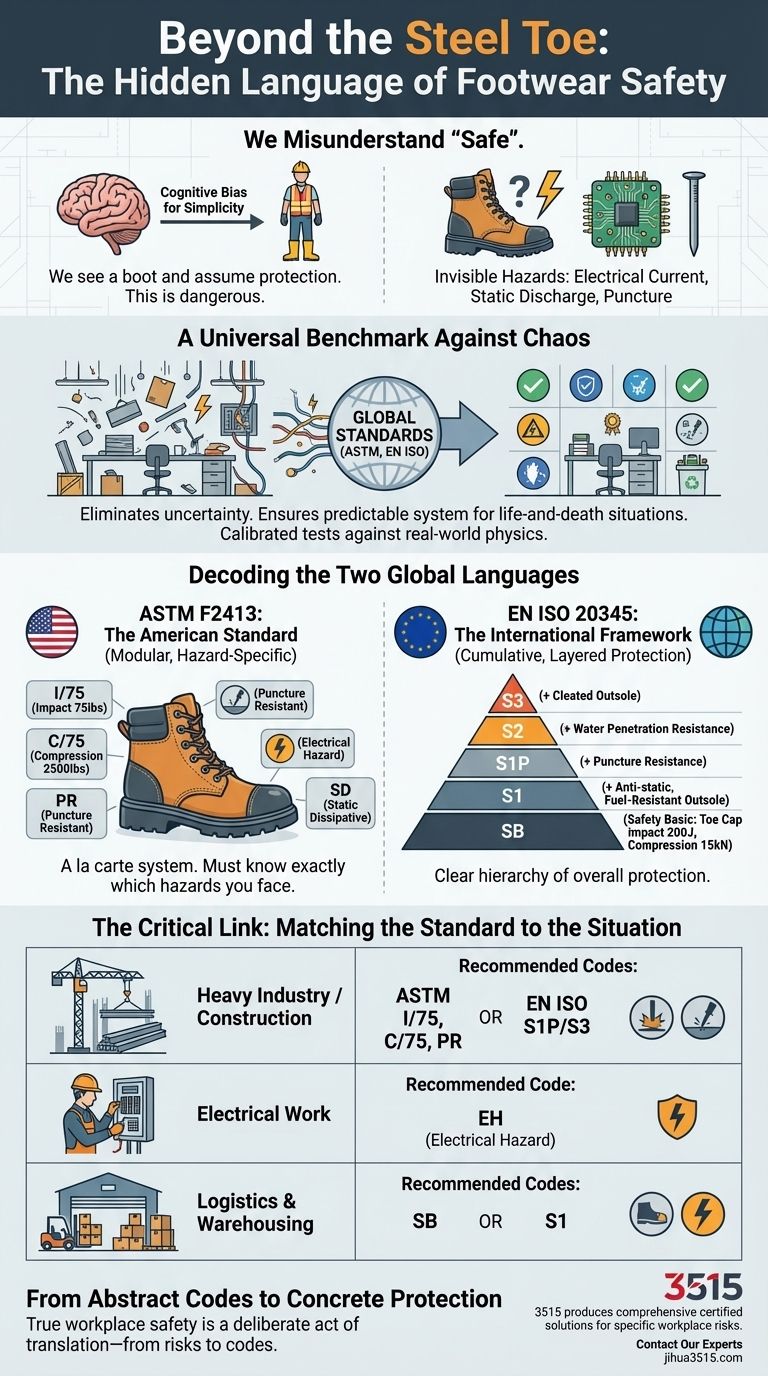
The US standard, enforced by OSHA, is fundamentally modular. It treats each hazard as a separate line item. A boot's label is a list of its certified capabilities.
- I/75: The toe box has withstood a 75-pound object dropped from a set height.
- C/75: The toe box has resisted 2,500 pounds of compressive force.
- PR: The sole is Puncture Resistant against sharp objects from below.
- EH: Protects against Electrical Hazards from open circuits.
- SD: Is Static Dissipative, preventing static buildup.
This "a la carte" system demands that you know exactly which hazards you face.
EN ISO 20345: The International Framework
The European and international standard is progressive. It starts with a baseline and adds protections in cumulative layers.
All footwear under this standard must first meet the SB (Safety Basic) requirement: a toe cap that withstands a 200-joule impact and 15 kilonewtons of compression.
From there, the ratings build:
- S1: SB + anti-static properties + fuel-resistant outsole.
- S1P: S1 + puncture resistance.
- S2: S1 + resistance to water penetration.
- S3: S2 + puncture resistance + a cleated outsole.
This system creates a clear hierarchy of overall protection.
| Standard | Region | Key Philosophy | Common Ratings |
|---|---|---|---|
| ASTM F2413 | United States | Modular, hazard-specific | I/75, C/75, PR, EH, SD |
| EN ISO 20345 | Europe & Global | Cumulative, layered protection | SB, S1, S1P, S3 |
The Critical Link: Matching the Standard to the Situation
A safety standard on a boot is meaningless until it's matched to a specific environmental risk. The most common mistake is assuming a high-level certification covers all hazards.
An S3 certified boot is impressively robust, but it may not carry the specific EH rating an electrician needs. Likewise, an ASTM I/75, C/75 boot is tough, but without an SD rating, it's a liability in an electronics cleanroom.
The selection process must begin not with the boot, but with a simple question: "What are the specific, predictable dangers of this job?"
- Heavy Industry / Construction: Your non-negotiables are impact, compression, and puncture resistance (ASTM I/75, C/75, PR or EN ISO S1P/S3).
- Electrical Work: The primary concern is insulation from live circuits. The EH rating is the only one that matters here.
- Logistics & Warehousing: Impact and compression are key, but puncture risk may be low. An SB or S1 boot is often the right tool.
From Abstract Codes to Concrete Protection
True workplace safety is a deliberate act of translation—from the risks of the environment to the codes on the footwear. It requires moving beyond the simple idea of a "steel toe" and engaging with the nuanced language of protection.
As a large-scale manufacturer for brands and distributors, we specialize in this translation. 3515 produces a comprehensive range of footwear meticulously engineered to meet the specific requirements of both ASTM and EN ISO standards. We don't just build boots; we build certified solutions for specific workplace risks.
Ensuring every member of your team has precisely the right protection for their task is the foundation of a safe and productive operation. Contact Our Experts
Visual Guide
Related Products
- Premium Suede Sport Safety Shoes for Wholesale & Bulk Orders
- Premium Lightweight Safety Shoes for Wholesale & Bulk Orders
- Wholesale Anti-Smash & Puncture-Proof Safety Shoes Custom Manufacturing for Brands
- Premium KPU Injection Athletic Style Safety Shoes
- Premium Safety Shoes with Rotating Buckle Safety Sneakers
Related Articles
- The Ghost in the Machine: Why an Obsolete Footwear Standard Creates Modern Risk
- Beyond the Steel Toe: The Hidden Ergonomics of Workplace Safety
- Why Traditional Laces Are a Hidden Safety Risk—And What to Do About It
- The True Cost of Skipping Safety Shoes: Long-Term Risks and Smart Protection
- How Safety Shoe Engineering Prevents Workplace Injuries Across Industries