The Margin of Error
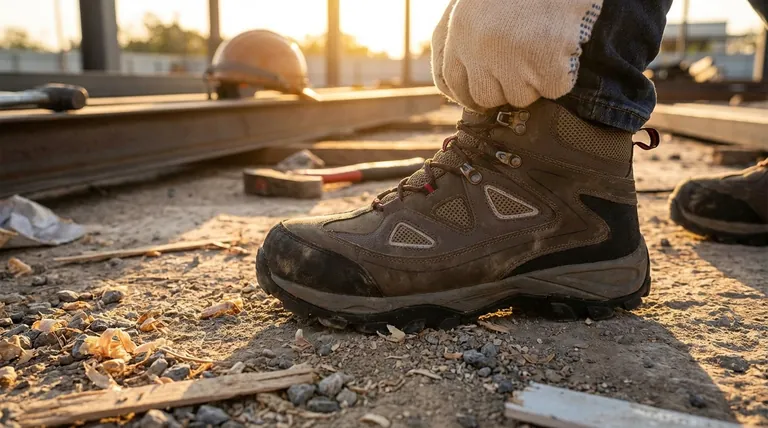
A seasoned construction foreman once recounted a near-miss on his site. It wasn't a falling beam or a catastrophic equipment failure. An experienced electrician, stepping off the last rung of a ladder, simply rolled his ankle and fell.
The cause? His boots. They were the highest-rated for impact protection, but they were heavy, inflexible, and ill-fitting. After ten hours on his feet, fatigue had narrowed his margin of error to zero.
This story reveals a fundamental truth we often overlook: the most critical safety feature isn't just the one that protects against the most extreme hazard, but the one that supports the human wearing it, hour after hour.
The Misconception of "Maximum Protection"
In safety, our minds are drawn to dramatic, high-impact events. We prioritize the steel toe that can withstand a crushing force, or the puncture plate that can stop a nail. These are, without question, essential.
But this focus can create a cognitive bias. We over-index on the low-probability, high-consequence event, while underestimating the high-probability, chronic risks: fatigue, distraction, and discomfort.
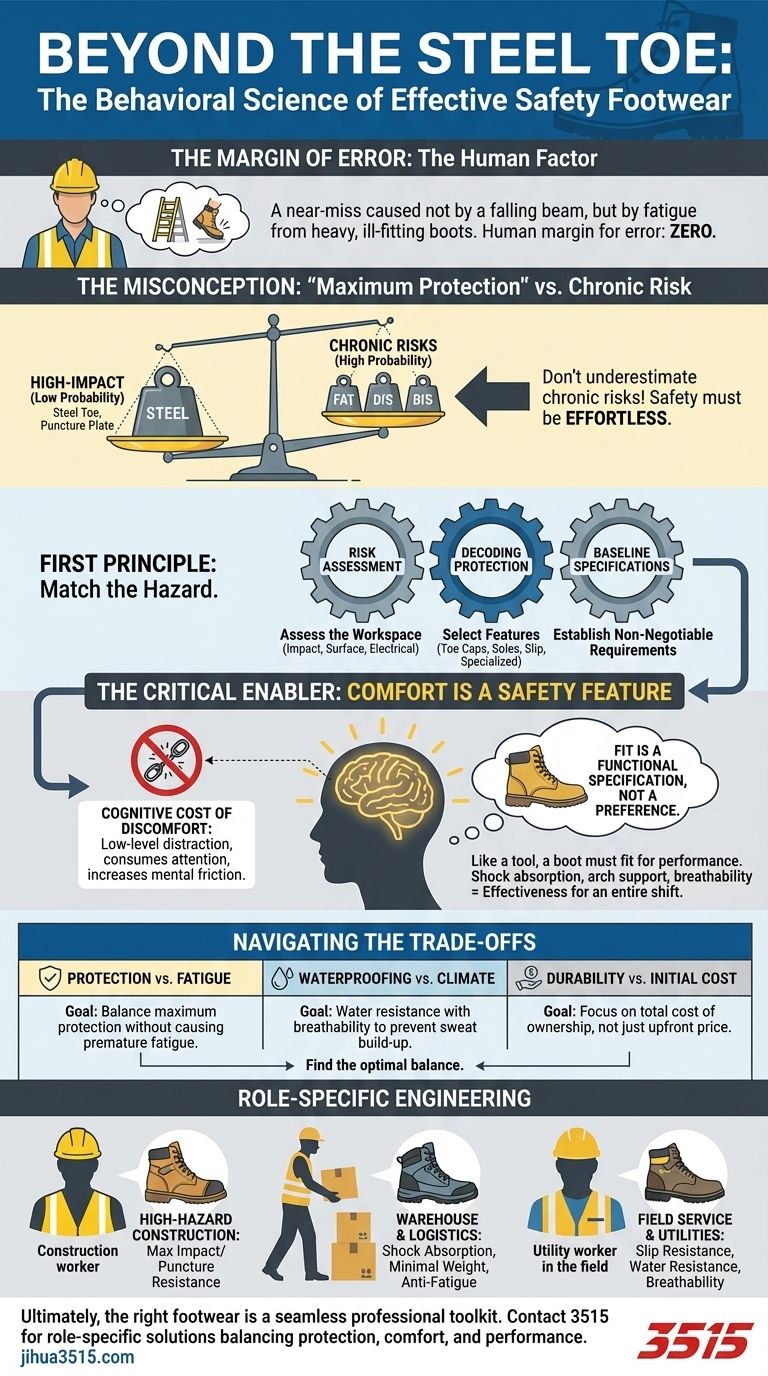
The most effective safety footwear isn't the one with the most features. It's the one with the right features, engineered for the person and the environment, creating a system where safety is effortless, not a burden.
First Principle: Match the Hazard, Not the Hype
Before any discussion of comfort or weight, the foundation must be set. The primary purpose of safety footwear is to mitigate specific, identified dangers. This is a non-negotiable, data-driven decision.
The Risk Assessment Imperative
The process doesn't begin in a product catalog. It begins with an honest assessment of the workspace.
- What are the primary impact risks? (Falling objects, heavy machinery)
- What is the nature of the ground surface? (Rebar, scattered nails, wet floors, oil)
- Are there electrical hazards? (Live circuits, static discharge)
The answers to these questions dictate the baseline specifications.
Decoding the Language of Protection
Once the risks are known, you can select the tools to mitigate them. The core features are a language of function:
- Protective Toe Caps: The first line of defense against impact (steel, alloy, or composite).
- Puncture-Resistant Soles: Essential for environments where sharp objects are underfoot.
- Slip-Resistant Outsoles: Critical for maintaining stability on compromised surfaces.
- Specialized Protection: Guards against electrical hazards, extreme temperatures, or chemicals.
Only after these baseline requirements are met does the real challenge of optimization begin.
The Critical Enabler: Why Comfort is a Hard-Edged Safety Feature
Once protection is assured, comfort becomes the most important factor. This isn't a luxury; it is a critical enabler of safety itself.
The Cognitive Cost of Discomfort
Uncomfortable footwear is a constant, low-level distraction. It consumes a small but persistent amount of a worker's attention. In an environment where focus is paramount, this "cognitive load" is a direct threat. It's the mental friction that leads to a misstep on a ladder or a moment of inattention around machinery.
A poor fit doesn't just cause blisters; it quietly degrades performance and widens the margin for human error.
Fit is a Functional Specification, Not a Preference
Think of a safety boot not as apparel, but as a tool. A wrench that doesn't fit the bolt is useless. A boot that doesn't fit the foot is a failed tool. It compromises stability, increases fatigue, and actively works against the wearer.
Key elements like shock absorption, arch support, and breathability aren't just for comfort—they are functional specifications that determine whether the tool will be effective for an entire shift.
Navigating the Inevitable Trade-offs
Choosing the perfect safety footwear is an exercise in engineering trade-offs. Understanding these compromises is key to making an intelligent decision.
| Trade-off | The Challenge | The Goal |
|---|---|---|
| Protection vs. Fatigue | Maximum protection (e.g., steel plates) adds weight and reduces flexibility. | Find the optimal balance that meets hazard standards without causing premature fatigue. |
| Waterproofing vs. Climate | A fully waterproof boot can trap sweat, leading to discomfort and skin issues. | Select materials that offer necessary water resistance while allowing breathability. |
| Durability vs. Initial Cost | Higher-quality materials and construction offer a longer lifespan at a higher price. | Focus on the total cost of ownership, not just the upfront purchase price. |
The System in Action: Role-Specific Engineering
The right choice becomes clear when you synthesize these principles for a specific role.
-
High-Hazard Construction: The priority is maximum impact and puncture resistance. Here, a heavier, more robust boot is a necessary trade-off for mitigating severe, immediate dangers.
-
Warehouse & Logistics: Workers spend long hours on concrete floors. The focus shifts to balancing mandatory toe protection with exceptional shock absorption and minimal weight to combat fatigue.
-
Field Service & Utilities: The environment is variable. The ideal boot requires a blend of slip resistance for outdoor surfaces, water resistance for weather, and breathability for all-day wear.
Ultimately, the right footwear is a seamlessly integrated part of a worker's professional toolkit. It doesn't just protect them; it enables them to perform their job safely and effectively. At 3515, we specialize in manufacturing a comprehensive range of footwear that honors this balance, ensuring that every pair is engineered for the specific hazards and human factors of your workplace.
For a solution that perfectly balances protection, comfort, and role-specific performance, Contact Our Experts.
Visual Guide
Related Products
- Premium Suede Sport Safety Shoes for Wholesale & Bulk Orders
- Premium Lightweight Safety Shoes for Wholesale & Bulk Orders
- Wholesale Anti-Smash & Puncture-Proof Safety Shoes Custom Manufacturing for Brands
- Premium KPU Injection Athletic Style Safety Shoes
- Premium Safety Shoes with Rotating Buckle Safety Sneakers
Related Articles
- The Ghost in the Machine: Why an Obsolete Footwear Standard Creates Modern Risk
- Beyond the Steel Toe: The Hidden Ergonomics of Workplace Safety
- Why Traditional Laces Are a Hidden Safety Risk—And What to Do About It
- The True Cost of Skipping Safety Shoes: Long-Term Risks and Smart Protection
- How Safety Shoe Engineering Prevents Workplace Injuries Across Industries