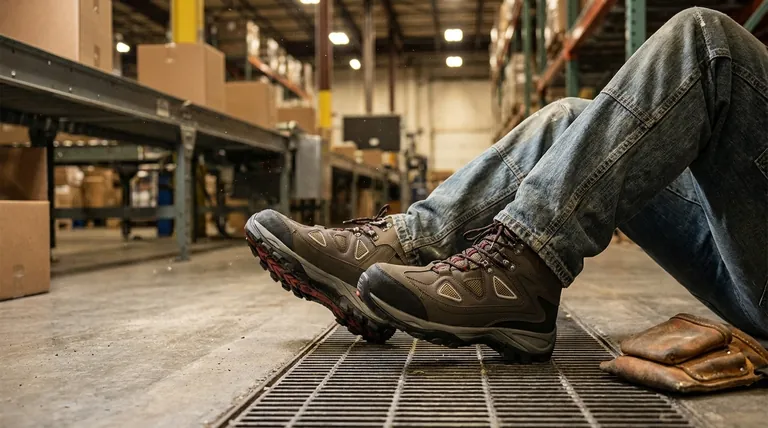
An experienced assembly line worker ends his shift with a familiar, dull ache in his lower back. A warehouse operator makes a minor misstep in the late afternoon, nearly causing an accident.
These incidents aren't failures of skill or training. They are symptoms of a hidden problem, one often dismissed as a minor inconvenience: the subtle tyranny of poorly fitted safety footwear.
The psychological cost of discomfort is a powerful, yet underestimated, force. It acts as a constant, low-level distraction, draining cognitive resources that should be dedicated to the task at hand. When a worker's focus is divided between their job and the pain in their feet, safety compliance becomes a negotiation rather than a habit.
The Cognitive Bias in Footwear Selection
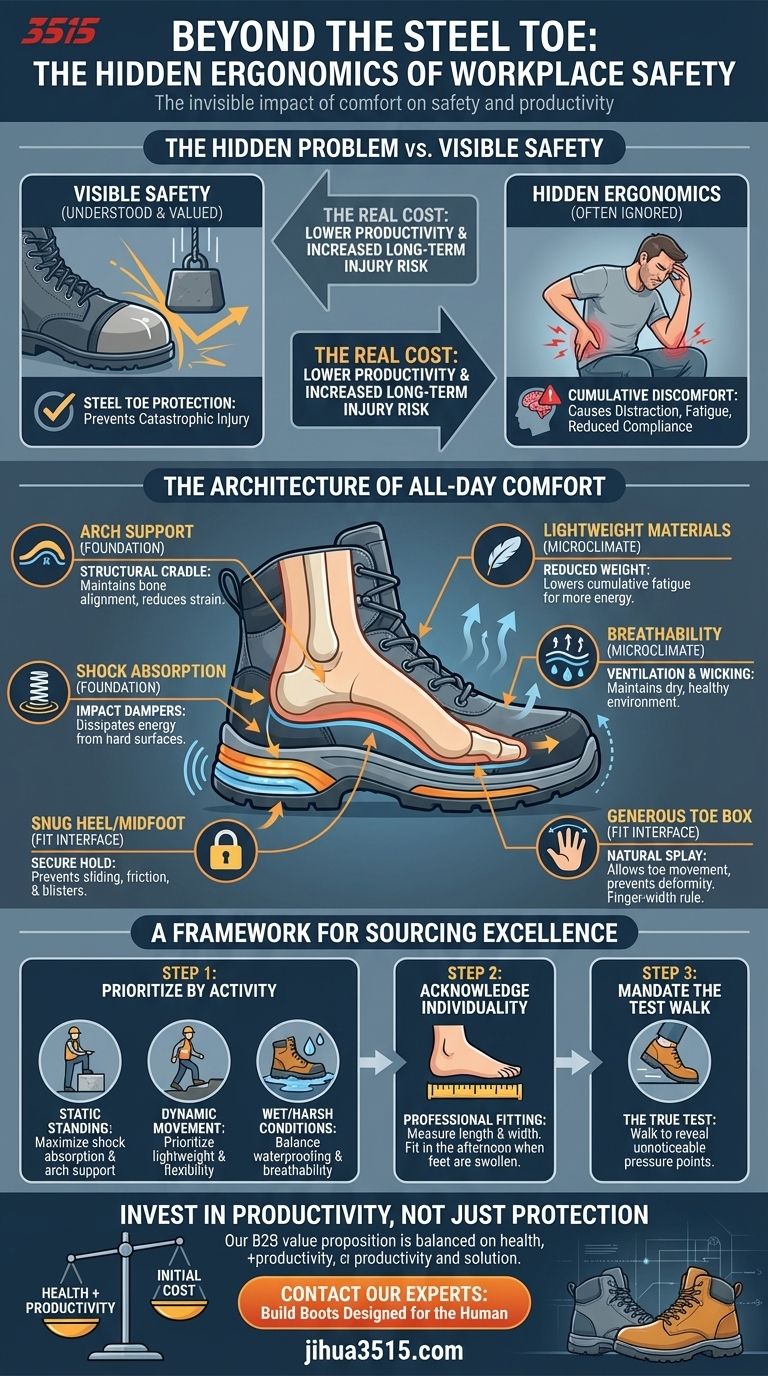
We are wired to assess clear and present dangers. A steel toe cap's ability to stop a falling object is easy to understand and value. The slow, cumulative damage from improper arch support is abstract and easy to ignore.
This leads to a critical error in procurement and personal choice: we overvalue the visible safety feature (the steel) and undervalue the invisible ergonomic features (the fit and support). We fixate on the initial price tag, forgetting the long-term costs of fatigue, reduced productivity, and potential injury.
True safety isn't just about preventing a catastrophic event. It's about creating an environment where workers can perform their best, unimpeded by their own equipment.
The Architecture of All-Day Comfort
A truly effective safety boot is a marvel of ergonomic engineering. Its comfort is not a single feature but an integrated system designed to support the human body.
The Foundation: Internal Support
The internal structure of a boot is its chassis. It manages the relentless forces of gravity and impact.
-
Arch Support: This isn't just a cushion; it’s a structural component. A well-designed footbed cradles the foot's natural arch, maintaining proper alignment of the bones and ligaments. Without it, the foot flattens with each step, straining the plantar fascia and sending misaligned forces up through the ankles, knees, and back.
-
Shock Absorption: Hard, unforgiving surfaces are the enemy of the human skeleton. Midsoles engineered with shock-absorbing materials act as dampers, dissipating the impact energy of each footstep before it can travel up the kinetic chain.
The Interface: A Fit Measured in Millimeters
A boot that fits poorly is worse than a distraction; it's a hazard.
A proper fit is a study in contrasts. The heel and midfoot must be held snugly to prevent the foot from sliding. This micro-instability is a primary cause of friction, leading to blisters and calluses that actively discourage workers from wearing their PPE correctly.
Simultaneously, the toe box must be generous. Toes need space to splay naturally during a step. A cramped toe box restricts this movement, leading to discomfort and long-term foot deformities. The standard is simple: a finger-width of space between your longest toe and the end of the boot.
The Microclimate: Materials and Energy
The materials used in a boot's construction dictate its weight and internal environment.
-
Weight: Every extra ounce on your feet requires muscular energy to lift, thousands of times a day. Lightweight, modern composites reduce this cumulative fatigue, leaving more energy for the job itself.
-
Breathability: The foot is one of the sweatiest parts of the body. A boot without proper ventilation traps moisture, creating a damp environment ripe for fungal infections and blisters. Linings that wick moisture away and uppers that allow air to circulate are critical for maintaining a dry, healthy microclimate.
Navigating the Necessary Trade-offs
Choosing the right footwear is rarely about finding a single "best" option. It's about making the most intelligent compromise for a specific application.
| Priority | The Trade-off | The Strategic Choice |
|---|---|---|
| Protection | Heavy-duty protective elements (steel plates) can add weight and reduce flexibility. | Find designs where these features are ergonomically integrated, minimizing their impact on natural foot movement. |
| Durability | Robust, waterproof materials may offer less breathability than lighter synthetics. | Match the material to the primary environmental hazard. A chemical plant needs impermeability; a dry warehouse does not. |
| Cost | A lower initial price often correlates with inferior materials and poor ergonomics. | View high-quality footwear as an investment in productivity and health, not an expense. The ROI is fewer injuries and higher compliance. |
A Framework for Sourcing Excellence
For distributors, brand owners, and large-scale employers, selecting footwear is a systemic challenge. The goal is to provide a solution that workers will want to wear.
-
Prioritize by Primary Activity: Use the daily reality of the job as your guide. Is the worker standing on concrete, walking on uneven terrain, or moving with agility? Each scenario demands a different balance of features.
- Static Standing: Maximize shock absorption and arch support.
- Dynamic Movement: Prioritize lightweight construction and flexibility.
- Wet/Harsh Conditions: Balance waterproofing with the highest possible breathability.
-
Acknowledge Individuality: One size does not fit all. Feet swell during the day, so fittings should occur in the afternoon. Encourage workers to be professionally measured for both length and width, as foot shape changes over time.
-
Mandate the Test Walk: The only true test of a boot's fit is to walk in it. This reveals pressure points and rubbing that are unnoticeable when sitting.
Solving the safety footwear challenge at scale requires a partner who understands this complex interplay of ergonomics, material science, and human psychology. As a large-scale manufacturer, we specialize in producing footwear that balances protection with the nuanced comfort features that ensure all-day wearability and compliance.
We build boots designed for the human, not just the hazard. To equip your team with footwear that enhances safety by eliminating the distraction of discomfort, Contact Our Experts.
Visual Guide
Related Products
- Premium Suede Sport Safety Shoes for Wholesale & Bulk Orders
- Premium Lightweight Safety Shoes for Wholesale & Bulk Orders
- Premium KPU Injection Athletic Style Safety Shoes
- Advanced KPU Athletic Safety Shoe with Steel Toe Cap Anti-Slip Rotary Lacing System
- Premium Safety Shoes with Rotating Buckle Safety Sneakers
Related Articles
- The Ghost in the Machine: Why an Obsolete Footwear Standard Creates Modern Risk
- Why Traditional Laces Are a Hidden Safety Risk—And What to Do About It
- The True Cost of Skipping Safety Shoes: Long-Term Risks and Smart Protection
- How Safety Shoe Engineering Prevents Workplace Injuries Across Industries
- Beyond the Steel Toe: The Cognitive Science of Choosing the Right Work Boot


















