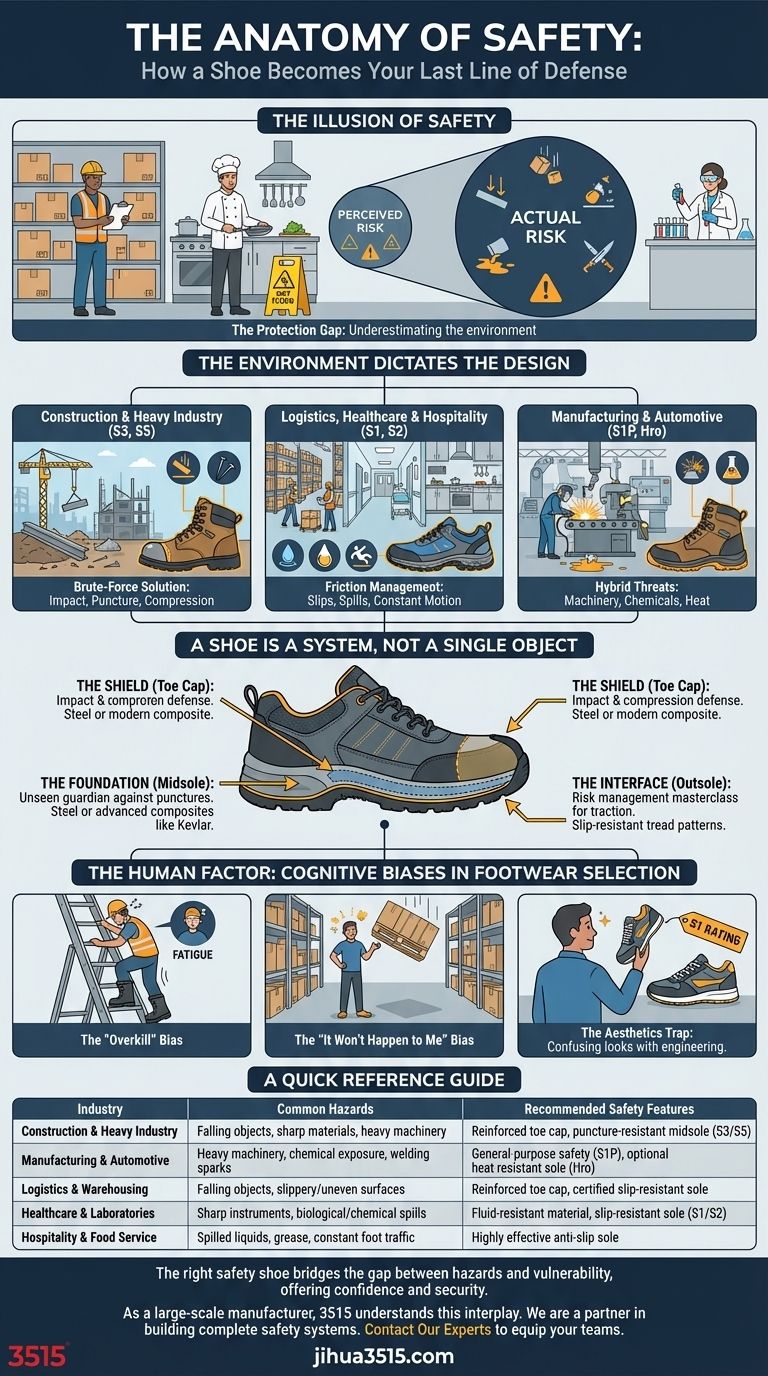
The Illusion of Safety
A warehouse worker moves down an aisle, focused on a picklist. A chef pivots on a freshly mopped kitchen floor. A lab technician handles delicate, sharp instruments.
None of them work on a high-rise construction site, yet each faces a constant, low-grade risk of a debilitating foot injury. The human mind is excellent at normalizing risk. We grow accustomed to our environment and begin to underestimate the potential energy stored in a falling box or the catastrophic loss of friction from a small grease spill.
This is the protection gap: the space between perceived risk and actual risk. It’s why the most important piece of safety equipment is often the one we think about least. A safety shoe isn’t just an accessory; it's a highly engineered system designed to manage the specific physics and hazards of your environment.
The Environment Dictates the Design
The purpose of a safety shoe isn't just durability. It's to provide targeted, uncompromising protection against the foreseeable dangers of a given job. The environment is the problem, and the shoe is the engineering solution.
The Battlefield of Impact and Puncture
In construction and heavy industry, gravity and sharp objects are the constant adversaries. Falling debris, upturned nails, and the immense compression force of machinery demand a brute-force solution.
This is the world of S3 and S5-rated boots. They are built as personal fortresses for the feet, integrating reinforced toe caps and puncture-resistant midsoles as non-negotiable features.
The Arena of Slips, Spills, and Constant Motion
For professionals in logistics, healthcare, and hospitality, the primary threat isn't a falling beam—it's the floor itself. Water, grease, and polished surfaces turn a simple step into a complex negotiation with friction.
Here, the most critical component is a scientifically designed slip-resistant outsole. The engineering focus shifts to material science and tread patterns that can channel fluids and maintain grip. Shoes rated S1 or S2, often with fluid-resistant uppers, are essential to provide stability without sacrificing the mobility required for a fast-paced job.
The Controlled Chaos of the Modern Factory
Manufacturing and automotive floors present a hybrid of threats. Workers face potential impacts from machinery, but also specialized hazards like chemical splashes or the intense heat from welding sparks.
The footwear must be just as versatile. A general-purpose S1P shoe provides a baseline of protection, while specialized classifications like Hro indicate a sole engineered to withstand high-contact heat—a small detail that makes all the difference.
A Shoe is a System, Not a Single Object
To appreciate its function, you have to stop seeing a safety shoe as a single item. It is a system of interlocking components, each designed to solve a specific problem.
-
The Shield (Toe Cap): The iconic "steel toe" is the ultimate defense against impact and compression. Modern material science has introduced lighter composite alternatives, solving the age-old trade-off between protection and weight, reducing fatigue over a long shift.
-
The Foundation (Midsole): Hidden within the sole lies a flexible but impenetrable plate of steel or advanced composites like Kevlar. This is the unseen guardian, neutralizing threats from below like nails, glass, or sharp metal scraps.
-
The Interface (Outsole): Perhaps the most dynamic component, the outsole is the shoe's direct interface with the world. Its design is a masterclass in risk management, engineered to provide unwavering traction on treacherous surfaces.
The Human Factor: Cognitive Biases in Footwear Selection
Choosing the wrong shoe is rarely a failure of information. It is often a failure of psychology. We are susceptible to cognitive biases that lead us to create our own protection gaps.
The "Overkill" Bias
We assume more protection is always better. But wearing a heavy-duty S5 construction boot for a job that requires agility, like an automotive technician, doesn't just cause discomfort. It creates a new risk. The cumbersome design can reduce dexterity and increase fatigue, potentially leading to other kinds of accidents.
The "It Won't Happen to Me" Bias
A lightweight kitchen clog feels perfectly safe in a warehouse—until a pallet is dropped. This optimism bias leads us to under-protect, creating a false sense of security. The correct shoe feels like an unnecessary burden right up to the moment it becomes the most important thing you own.
The Aesthetics Trap
Modern safety shoes often mimic the style of casual sneakers. While this is a brilliant innovation for comfort and all-day wearability, it introduces a new trap: confusing the look of safety with the engineering of safety. The shoe's official rating (e.g., S1, S3, EH) is the only language that matters, regardless of its appearance.
A Quick Reference Guide
Choosing the right footwear begins with an honest assessment of your environment.
| Industry | Common Hazards | Recommended Safety Features |
|---|---|---|
| Construction & Heavy Industry | Falling objects, sharp materials, heavy machinery | Reinforced toe cap, puncture-resistant midsole (S3/S5) |
| Manufacturing & Automotive | Heavy machinery, chemical exposure, welding sparks | General-purpose safety (S1P), optional heat-resistant sole (Hro) |
| Logistics & Warehousing | Falling objects, slippery/uneven surfaces | Reinforced toe cap, certified slip-resistant sole |
| Healthcare & Laboratories | Sharp instruments, biological/chemical spills | Fluid-resistant material, slip-resistant sole (S1/S2) |
| Hospitality & Food Service | Spilled liquids, grease, constant foot traffic | Highly effective anti-slip sole |
Ultimately, the right safety shoe bridges the gap between environmental hazards and human vulnerability. It is a quiet, reliable piece of engineering that allows people to perform their jobs with confidence and security.
As a large-scale manufacturer, 3515 understands this complex interplay of risk, psychology, and design. We produce a comprehensive range of footwear to meet the specific, nuanced demands of every industry. For distributors, brand owners, and bulk clients, we are more than a supplier; we are a partner in building a complete safety system from the ground up.
Let us help you equip your teams with footwear that offers the perfect balance of protection, comfort, and compliance. Contact Our Experts
Visual Guide
Related Products
- Premium Suede Sport Safety Shoes for Wholesale & Bulk Orders
- Premium Lightweight Safety Shoes for Wholesale & Bulk Orders
- Wholesale Anti-Smash & Puncture-Proof Safety Shoes Custom Manufacturing for Brands
- Premium KPU Injection Athletic Style Safety Shoes
- Premium Safety Shoes with Rotating Buckle Safety Sneakers
Related Articles
- The Ghost in the Machine: Why an Obsolete Footwear Standard Creates Modern Risk
- Beyond the Steel Toe: The Hidden Ergonomics of Workplace Safety
- Why Traditional Laces Are a Hidden Safety Risk—And What to Do About It
- The True Cost of Skipping Safety Shoes: Long-Term Risks and Smart Protection
- How Safety Shoe Engineering Prevents Workplace Injuries Across Industries