A Dangerous Assumption
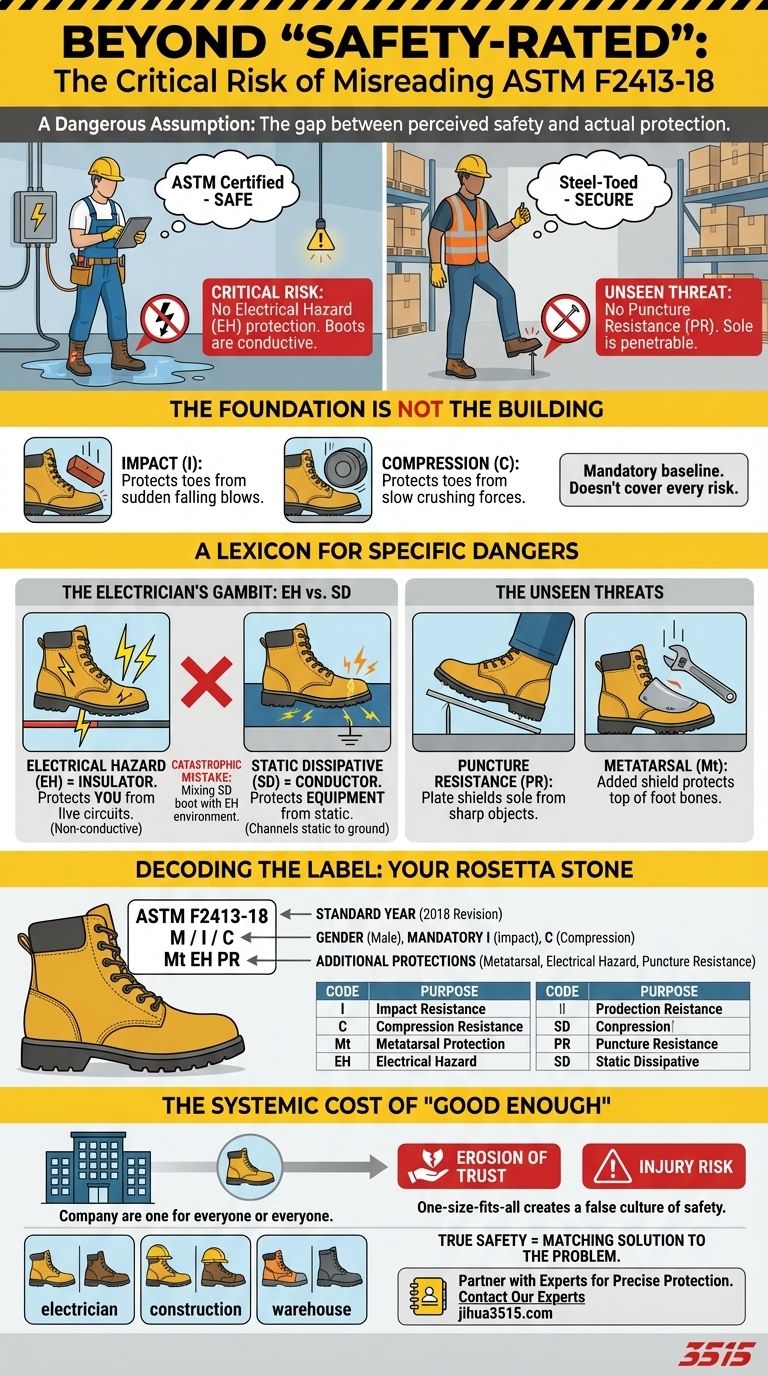
An electrician stands on a damp concrete floor, confident in his "ASTM-certified" work boots. He doesn't realize his boots only protect against impact, not electrical hazards. Across town, a warehouse worker feels secure in their steel-toed shoes, unaware they offer no protection from the nail they are about to step on.
These are not failures of equipment. They are failures of interpretation.
The human mind loves shortcuts. We see a label like "ASTM F2413-18 Certified" and our brain files it under a simple, comforting category: "safe." This mental heuristic saves us energy, but in a high-stakes environment, it creates a dangerous gap between perceived safety and actual protection. The standard is not a simple checkmark; it's a precise language, and misunderstanding its grammar can have serious consequences.
The Foundation is Not the Entire Building
At its core, any footwear bearing the ASTM F2413-18 label must meet two foundational performance requirements. Think of these as the non-negotiable alphabet of foot protection.
- Impact (I): Protects the toes from a sudden, heavy blow from a falling object.
- Compression (C): Protects the toes from being crushed by a slow-moving, heavy rolling object.
This is the baseline. But assuming this baseline covers every risk is like assuming a foundation can shield you from the rain. The real, specialized protection lies in the additional ratings—the ones that are easy to overlook.
A Lexicon for Specific Dangers
A risk assessment isn't a generic exercise. It identifies specific threats. The ASTM standard provides a specific code for each one. The most critical errors often happen when we confuse these specialized terms.
The Electrician's Gambit: EH vs. SD
Nowhere is the need for precision more apparent than with electrical work. The standard has two ratings that sound similar but are functional opposites:
- Electrical Hazard (EH): These boots are insulators. Their soles are built to be non-conductive, providing a secondary layer of protection to you from accidental contact with a live circuit. This is about saving your life.
- Static Dissipative (SD): These boots are conductors. They are designed to safely channel the body's static electricity to the ground, preventing a discharge that could damage sensitive electronic components. This is about saving the equipment.
Placing an SD boot in an EH environment is a catastrophic mistake. It's an invitation for current to find a path to the ground through the wearer. The label tells the truth, but only if you know the language.
The Unseen Threats: PR and Mt
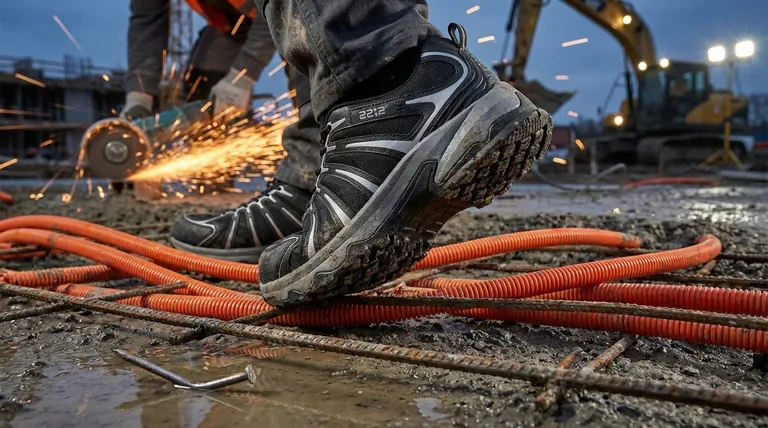
Hazards aren't always falling from above. In construction, demolition, or scrap yards, the ground itself is a minefield of upturned nails, sharp metal, and rebar.
- Puncture Resistance (PR): This rating signifies a protective plate embedded in the sole, engineered specifically to stop sharp objects from piercing the bottom of the foot.
- Metatarsal (Mt): The standard I/C ratings protect the toes, but a dropped tool or a falling box can easily strike the fragile metatarsal bones on the top of the foot. The Mt rating means there's an added shield covering this vulnerable area.
These protections address the physics of accidents that occur beyond the simple toe-crush scenario. They account for the three-dimensional, unpredictable nature of a worksite.
Decoding the Label: Your Rosetta Stone
Every ASTM F2413-18 compliant boot contains a label that acts as a clear, unambiguous contract. It tells you exactly what it is, and is not, designed to do.
A typical label reads like this:
Line 1: ASTM F2413-18
Confirms the boot meets the performance standards set in the 2018 revision.
Line 2: M / I / C
Specifies the Gender (Male/ Female) and confirms it meets the mandatory Impact and Compression ratings.
Line 3: Mt EH PR
This is the most important line for specialized roles. It lists every additional protection the boot provides. In this case: Metatarsal, Electrical Hazard, and Puncture Resistance. If this line is blank, the boot has no specialized protections.
| Protection Type | Code | Purpose |
|---|---|---|
| Impact Resistance | I | Protects toes from falling objects |
| Compression Resistance | C | Protects toes from rolling/crushing forces |
| Metatarsal Protection | Mt | Protects the top of the foot from impact |
| Electrical Hazard | EH | Provides secondary protection from live circuits |
| Puncture Resistance | PR | Shields the sole from sharp objects |
| Static Dissipative | SD | Safely dissipates static electricity |
The Systemic Cost of "Good Enough"
The psychological shortcut of "it's certified" scales up to an organizational level. Procurement departments, aiming for efficiency, may purchase a single type of "ASTM-certified" boot for the entire workforce.
This creates a false culture of safety. The company has technically provided PPE, but it hasn't solved the actual problem. The electrician is still at risk. The demolition worker is still vulnerable. When an injury inevitably occurs, it erodes trust in the entire safety program.
True safety lies in matching the specific solution to the specific problem. It requires moving past the policy and engaging with the granular reality of each worker's environment.
This is where the right manufacturing partner becomes critical. A one-size-fits-all approach to safety is no approach at all. As a large-scale manufacturer, 3515 produces a comprehensive range of footwear to meet every line item of the ASTM F2413-18 standard, enabling distributors and brand owners to equip teams with the precise protection they need, not just the one that's available. To align your safety program with the real-world hazards your team faces, Contact Our Experts.
Visual Guide