Picture this: you're a procurement manager or safety officer tasked with outfitting hundreds of employees with new safety boots. You're staring at a supplier catalog filled with terms like "steel toe," "composite," "ASTM F2413," "200 Joules," and "15 kN." Your goal is simple: keep your team safe and your company compliant. But the path to achieving that goal feels unnecessarily complex.
Which material is really the safest? Are you overpaying for a feature that doesn't matter? Or worse, are you unknowingly choosing footwear that only looks the part, leaving your company exposed to risk? This feeling of uncertainty is a common, and dangerous, place to be.
The High Cost of Common Assumptions
When faced with this complexity, many organizations fall back on a few familiar but flawed decision-making shortcuts.
- The Material Myth: The most common trap is to equate a specific material with safety. "We've always used steel-toed boots; they must be the strongest." Or, "Let's get composite toes; they're modern and lighter." This debate completely misses the point.
- The "Check-the-Box" Compliance: Another common approach is to simply look for "ASTM Certified" on the box and assume all certifications are equal. This overlooks the different levels of protection and whether they match the specific hazards in your workplace.
These assumptions aren't just inefficient; they have serious business consequences. An injury resulting from improperly specified footwear can lead to devastating workers' compensation claims, lost productivity, project delays, and potential OSHA violations. The simple act of choosing a boot becomes a high-stakes decision, yet most are forced to make it with incomplete information.
The Real Villains: Impact and Compression
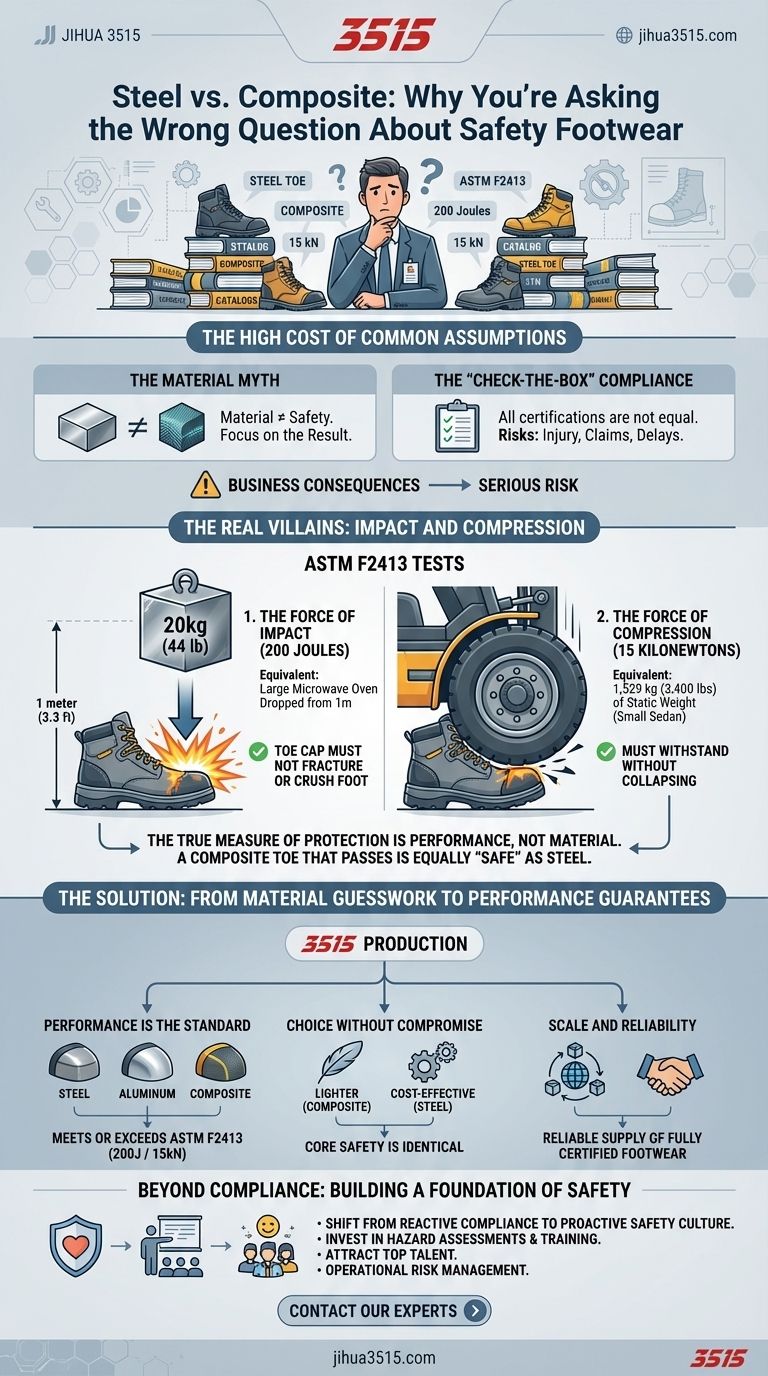
Here is the turning point. The safety of a protective toe cap has nothing to do with whether it's made of steel, aluminum, or a composite material.
The true measure of protection is its proven ability to withstand two specific, brutal forces defined by the ASTM F2413 standard. These are the real-world hazards the boot is designed to defeat.
1. The Force of Impact (200 Joules)
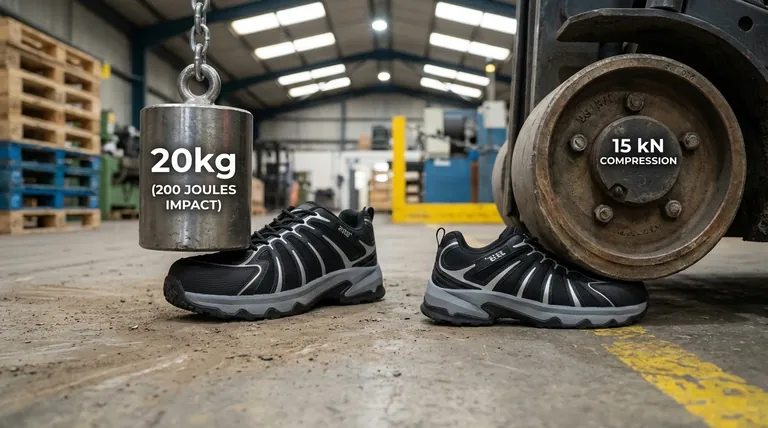
This test measures the toe cap's ability to protect a worker's foot from a sudden, heavy blow from a falling object. But what is 200 Joules in reality?
Imagine a 20-kilogram (44 lb) block of steel—roughly the weight of a large microwave oven—being dropped from a height of one meter (3.3 ft) directly onto the toe of the boot. To pass, the toe cap cannot fracture or deform to a degree that it would crush the foot inside.
2. The Force of Compression (15 kilonewtons)
This test simulates a slow, crushing force, like a forklift wheel or heavy cart rolling over the foot. The 15 kilonewton (kN) requirement is immense.
It's the equivalent of placing 1,529 kilograms (nearly 3,400 lbs) of static weight on the toe cap. That's the weight of a small sedan. The boot must withstand this immense pressure without collapsing.
The common solutions fail because they focus on the ingredient (the material) instead of the result (the certified performance). A composite toe that passes these two tests is equally as "safe" as a steel toe that passes the same tests. The debate was never about the material; it was always about passing the test.
The Solution: From Material Guesswork to Performance Guarantees
To truly solve this problem, you need to shift your focus from "what is it made of?" to "what has it been certified to do?". This requires a manufacturing partner who builds their products around these non-negotiable performance standards, not just marketing features.
This is the principle upon which our entire safety footwear production operates. As a large-scale manufacturer, 3515 produces footwear where the core promise is verified compliance.
- Performance is the Standard: Every safety boot we manufacture, whether it features a steel, aluminum, or composite toe, is designed and tested to meet or exceed the rigorous 200 Joule impact and 15 kN compression requirements of ASTM F2413.
- Choice Without Compromise: By guaranteeing the core safety performance across all materials, we empower you to make choices based on secondary needs. Need a lighter boot for workers on their feet all day? Choose composite. Need maximum cost-effectiveness for a massive crew? Steel may be the answer. In either case, the fundamental protection remains identical.
- Scale and Reliability: For distributors and large organizations, we provide a reliable supply chain for fully certified footwear, eliminating the guesswork and ensuring every single pair meets the standards your workforce and regulators demand.
Beyond Compliance: Building a Foundation of Safety
When you stop worrying about the nuances of Joules and kilonewtons because you have a partner who manages that for you, something powerful happens. Your focus can shift from reactive compliance to proactive safety culture.
Instead of spending time deciphering spec sheets, you can invest that time in better hazard assessments, more effective training, and building a workplace where every employee feels genuinely protected. You move from simply avoiding fines to creating an environment that attracts and retains top talent. A reliable footwear program becomes the literal foundation upon which a safer, more productive, and more profitable operation is built.
Choosing the right safety footwear is more than a line item—it's a critical component of your operational risk management. Don't leave it to guesswork. Let our team help you navigate the complexities of ASTM standards and build a footwear program that guarantees both compliance and the genuine safety of your team. Contact Our Experts.
Visual Guide
Related Products
- Premium Suede Sport Safety Shoes for Wholesale & Bulk Orders
- Premium Lightweight Safety Shoes for Wholesale & Bulk Orders
- Wholesale Anti-Smash & Puncture-Proof Safety Shoes Custom Manufacturing for Brands
- Premium KPU Injection Athletic Style Safety Shoes
- Premium Safety Shoes with Rotating Buckle Safety Sneakers
Related Articles
- The Ghost in the Machine: Why an Obsolete Footwear Standard Creates Modern Risk
- Beyond the Steel Toe: The Hidden Ergonomics of Workplace Safety
- Why Traditional Laces Are a Hidden Safety Risk—And What to Do About It
- The True Cost of Skipping Safety Shoes: Long-Term Risks and Smart Protection
- How Safety Shoe Engineering Prevents Workplace Injuries Across Industries