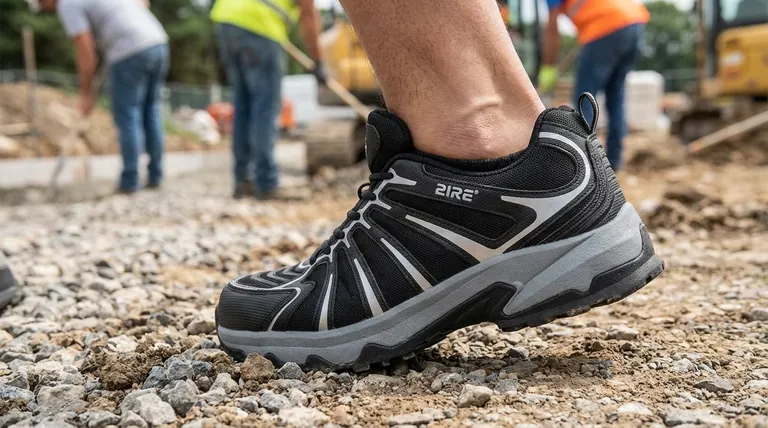
The Anatomy of an Accident
Picture a worker on a bustling construction site. The most obvious danger is a falling beam or a misplaced tool. This is the acute, visible risk that a steel toe cap is designed to mitigate.
But another, more insidious threat is at play. It’s the constant, low-grade stress from walking on uneven rubble, the repetitive strain of climbing ladders, and the cumulative load of an eight-hour shift spent on their feet.
We are psychologically wired to focus on sudden, dramatic threats. We often overlook the slow, grinding forces that cause the majority of workplace injuries. This is where the true engineering of safety footwear reveals itself—not in the hardened toe, but in the unseen architecture of its support system.
Beyond the Steel Toe: The Biomechanics of a Safer Stride
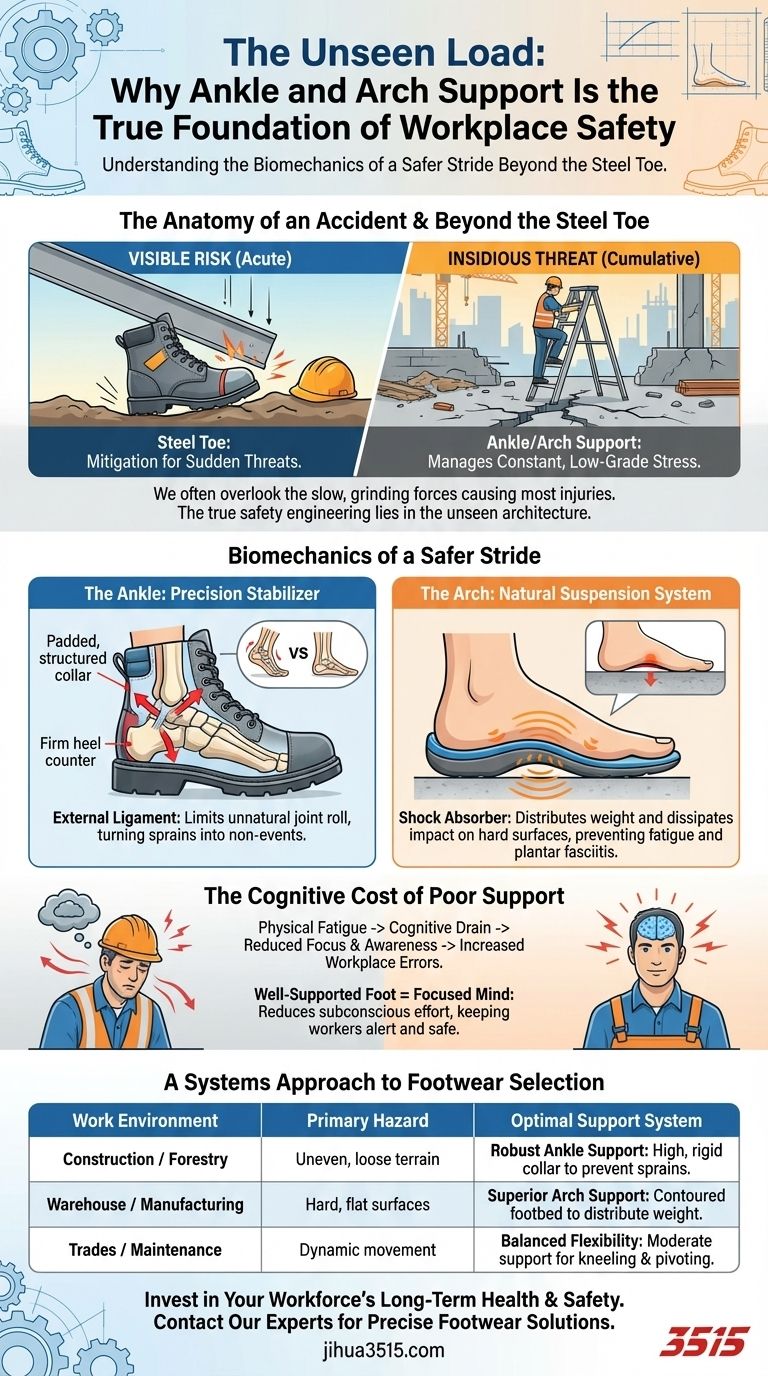
While the steel toe is the celebrated hero of safety boots, the ankle and arch support structures are the unsung champions. They manage the relentless forces of gravity and motion that wear down the human body over time. They form a boot's foundational safety system.
The Ankle as a Precision Stabilizer
The ankle joint is a marvel of mobility, but that mobility makes it vulnerable to twists and sprains. On an unpredictable surface—like loose gravel or a cluttered factory floor—a single misstep can lead to a sidelining injury.
Proper ankle support, engineered through features like a padded, structured collar and a firm heel counter, acts as an external ligament. It physically limits the joint's ability to roll into an unnatural position, providing the stability needed to turn a potential sprain into a non-event.
The Arch as a Natural Suspension System
The arch of the foot is designed to be a natural shock absorber. With every step, it flexes to distribute the body's weight and dissipate impact forces.
On hard, unforgiving surfaces like concrete, this natural system is pushed to its limits. Without proper support from a contoured footbed, the arch can begin to fatigue and flatten, concentrating pressure on the heel and ball of the foot. This is the direct cause of chronic pain and conditions like plantar fasciitis—an injury that doesn't happen in a single moment, but over thousands of accumulated steps.
The Cognitive Cost of Poor Support
When the feet are not mechanically supported, the body must compensate. Dozens of small, stabilizing muscles in the feet, legs, and lower back are forced to constantly fire just to maintain balance.
This isn't just physically tiring; it's a significant cognitive drain.
This constant, low-level muscular activity consumes mental energy, reducing focus and draining a worker's capacity for situational awareness. Fatigue is a leading contributor to workplace errors. The worker who feels drained at the end of their shift is not just uncomfortable—they are measurably less safe.
A well-supported foot is the foundation for a focused mind. By reducing the body's subconscious effort to stay stable, a well-designed boot frees up cognitive resources, helping workers stay alert and safe throughout their entire shift.
A Systems Approach to Footwear Selection
Choosing the right boot isn't about finding the "most" support; it's about matching the engineering of the boot to the demands of the work environment. It requires a balance between rigidity and flexibility.
| Work Environment | Primary Hazard | Optimal Support System |
|---|---|---|
| Construction / Forestry | Uneven, loose terrain | Robust Ankle Support: High, rigid collar to prevent sprains. |
| Warehouse / Manufacturing | Hard, flat surfaces | Superior Arch Support: Contoured footbed to distribute weight. |
| Trades / Maintenance | Dynamic movement | Balanced Flexibility: Moderate support with flexibility for kneeling. |
This nuanced understanding is crucial for any organization serious about safety. A boot that is perfect for a warehouse floor might be dangerously restrictive for an electrician who needs to crouch and pivot frequently.
Investing in footwear isn't just a purchase; it's a strategic decision about the long-term health and daily performance of your workforce. As a large-scale manufacturer, we engineer a comprehensive range of footwear because we know that true safety lies in providing the precise solution for each unique operational demand.
To build a safer, more resilient workforce from the ground up, Contact Our Experts.
Visual Guide
Related Products
- Premium Safety Shoes with Rotating Buckle Safety Sneakers
- Premium Suede Sport Safety Shoes for Wholesale & Bulk Orders
- Premium KPU Athletic Safety Shoes for Wholesale
- Athletic Safety Shoes with Dial Closure & Steel Toe for Wholesale & Custom Manufacturing
- Advanced KPU Athletic Safety Shoe with Steel Toe Cap Anti-Slip Rotary Lacing System
Related Articles
- Why Traditional Laces Are a Hidden Safety Risk—And What to Do About It
- Beyond the Steel Toe: The Hidden Ergonomics of Workplace Safety
- The Ghost in the Machine: Why an Obsolete Footwear Standard Creates Modern Risk
- The True Cost of Skipping Safety Shoes: Long-Term Risks and Smart Protection
- How Safety Shoe Engineering Prevents Workplace Injuries Across Industries


















