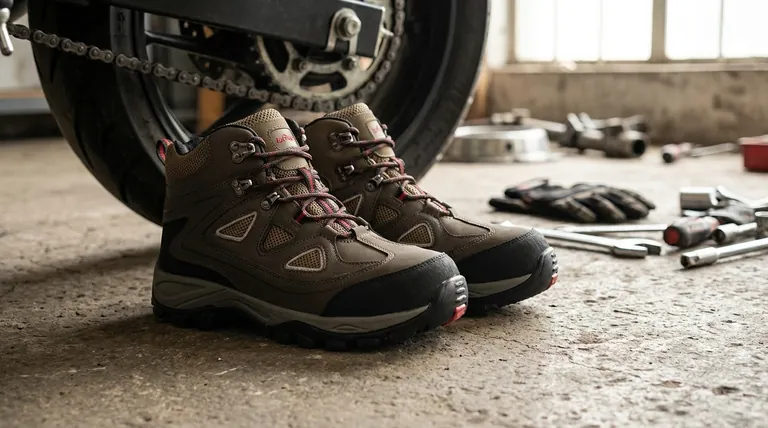
The Illusion of "Tough Enough"
We are notoriously bad at assessing risk. We see a pair of sturdy work boots, feel the thick leather, and our brain tells us, "This is tough enough."
This is a cognitive error. It mistakes the appearance of strength for engineered resilience.
A motorcycle crash is a sudden, violent event governed by brutal physics. It doesn't care how tough a boot looks. It only cares how that boot manages forces of impact, abrasion, and torsion. Casual footwear is designed for walking. Motorcycle boots are a piece of technical safety equipment designed to keep you walking for the rest of your life.
The Physics of a Single, Violent Second
To understand a motorcycle boot, you must first understand the violence it's designed to negate. A fall isn't a single event; it's a rapid sequence of destructive forces applied to the most fragile parts of your body.
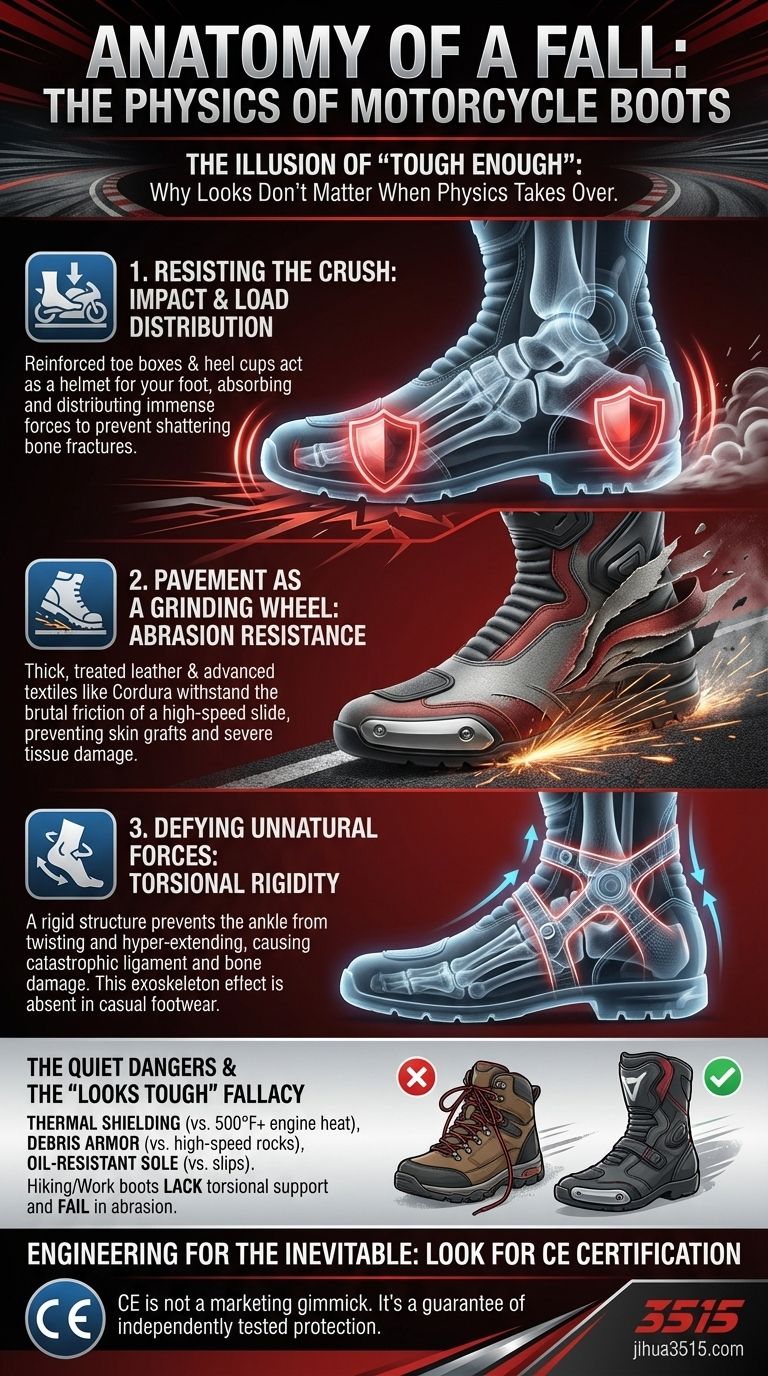
Resisting the Crush: Impact and Load Distribution
In a crash, your foot is often the first point of contact or gets pinned between a 400-pound machine and the unyielding road. The force is immense and focused.
Proper motorcycle boots feature heavily reinforced toe boxes, heel cups, and ankle armor. These aren't just padding. They act like a helmet for your foot—an external shell designed to absorb the initial shock and distribute the crushing force over a wider area. It turns a bone-shattering pinpoint impact into a manageable, survivable pressure.
The Pavement as a Grinding Wheel: Abrasion Resistance
Once you're sliding, the pavement becomes a high-speed belt sander. Denim, canvas, and even standard leather are shredded in less than a second, exposing skin, muscle, and bone.
Motorcycle boots are built from materials selected specifically for their ability to withstand this brutal friction. Thick, treated leather and advanced synthetic textiles like Cordura are chosen not for style, but for the seconds of abrasion resistance they provide. Those seconds are the difference between walking away with scuffs and needing skin grafts.
Defying Unnatural Forces: Torsional Rigidity
Your ankle is an anatomical marvel, but it's designed to hinge, not to twist. A common crash scenario involves your foot catching the pavement while your body's momentum continues forward, forcing the ankle into a sideways rotation it was never meant to endure.
This is where torsional stiffness is critical. A quality boot is engineered to be rigid along this axis, acting as an exoskeleton. It physically prevents your ankle from twisting, hyper-extending, or bending in ways that cause catastrophic ligament and bone damage. This single feature is completely absent in any form of casual shoe.
The Quiet Dangers of a Normal Ride
The most profound engineering isn't just for the worst-case scenario. It also mitigates the constant, smaller risks of daily riding that compound to affect safety and focus.
- Thermal Shielding: Engine cases and exhaust pipes can easily exceed 500°F (260°C), just inches from your foot. A boot's heavy construction provides a crucial thermal barrier against severe contact burns.
- Debris Armor: A rock kicked up by a car at 60 mph is a dangerous projectile. A proper boot shields the 26 bones in your foot from impacts that could otherwise cause fractures.
- The Foundation of Control: The sole of a riding boot is an engineered interface. It's made of oil-resistant compounds that grip pavement securely when you stop, preventing a simple slip on an unseen patch of oil from turning into a low-speed drop.
The "Looks Tough" Fallacy
Trusting any boot that isn't purpose-built for motorcycling is a dangerous gamble. Hiking boots, military boots, and work boots fail in predictable ways.
Their long laces can become entangled in controls. Their materials offer minimal abrasion resistance. Most critically, they lack any meaningful torsional support, offering a false sense of security while leaving your ankle completely vulnerable.
To counter this, look for CE (Conformité Européenne) certification. This isn't a marketing gimmick; it's a guarantee. It means the boot has been independently tested and proven to meet specific, measurable standards for impact, abrasion, and rigidity. It’s the difference between a company claiming protection and proving it.
Engineering for the Inevitable
Choosing the right boot is an acknowledgment of physics. It's a decision to invest in a piece of equipment meticulously engineered for a predictable set of forces.
For distributors, brand owners, and organizations outfitting their teams, providing this level of engineered protection is a fundamental responsibility. It's a commitment to safety that builds trust and protects riders. This requires a manufacturing partner who understands that a boot is not just a product, but a critical safety system.
| Key Feature | Protection Provided |
|---|---|
| Impact Absorption | Reinforced toe/heel areas spread crash forces to prevent fractures. |
| Abrasion Resistance | Tough leather/textiles protect against road rash and pavement grinding. |
| Torsional Rigidity | A rigid structure prevents unnatural ankle twisting and hyper-extension. |
| Everyday Safety | Shields from engine heat, road debris, and enhances control and grip. |
As a large-scale manufacturer, 3515 produces the full spectrum of CE-certified motorcycle boots and other protective footwear. We partner with brands and distributors to deliver the precise engineering riders depend on, ensuring every pair meets the highest standards of safety and quality.
To build a product line based on proven protection, Contact Our Experts
Visual Guide
Related Products
- Wholesale Tactical Boots High-Traction & Reflective for Bulk & Brand Orders
- High Performance Fire-Retardant Waterproof Safety Boots
- Durable Goodyear Welt Leather Work Boots for Wholesale & Private Label
- Wholesale High-Traction Camo Boots - Custom Manufacturer for Brands
- Wholesale Waterproof Tactical Boots Custom Suede & High-Traction Soles
Related Articles
- Why Your Tactical Boots Keep Failing—And Why 'Tougher' Isn't the Answer
- The Agility-Protection Paradox: Deconstructing Safety in Modern Tactical Footwear
- Why Your Tactical Boots Wear Out So Fast—And the Procurement Mistake Behind It
- How WWII Revolutionized Camouflage: Tactical Adaptations That Shaped Modern Warfare
- The Jump Boot Fallacy: Why Your 'Classic' Tactical Boots Are Failing Customers



















