
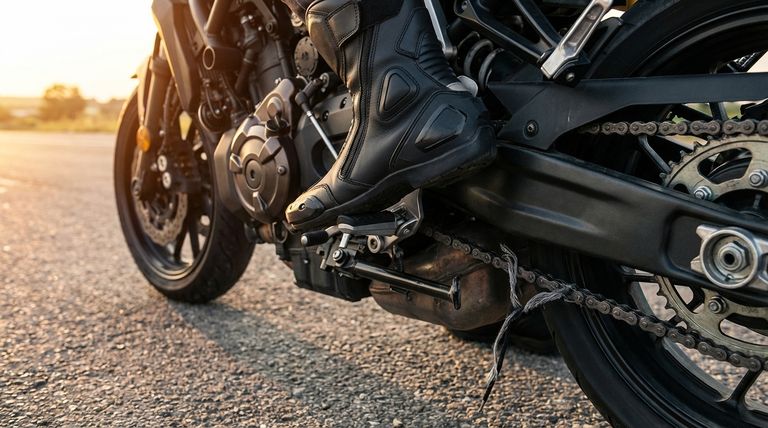
The primary reason streetbike riders must avoid boots with exposed laces is the significant and preventable risk of entanglement. A loose lace can easily get caught on your foot controls, drive chain, or other moving parts of the motorcycle, leading to a sudden and catastrophic loss of control.
The core issue isn't the laces themselves, but their potential to become snagged on the machine. This can prevent you from placing your foot down at a stop or, in a worst-case scenario, pull your foot into the drivetrain, causing severe injury and an immediate crash.
The Mechanics of the Hazard
To truly appreciate the risk, it's important to understand the specific ways a simple bootlace can compromise your safety. The motorcycle is a dynamic machine with numerous potential snag points located precisely where your feet are.
Entanglement with Foot Controls
A loop of lace can easily catch on your brake pedal or gear shift lever. This is the most common form of entanglement.
If your lace snags the shifter, you may be unable to change gears. More dangerously, if it catches the brake pedal or a footpeg, it can prevent you from putting your foot down firmly when you come to a stop, leading to a simple, low-speed tip-over that can still cause injury and damage.
The Chain and Sprocket Danger
This represents a catastrophic failure. If a lace is caught by the motorcycle's drive chain, it can violently pull your entire foot backward into the rear sprocket.
This scenario almost guarantees a severe crushing or amputation injury to the foot and an immediate, uncontrollable crash as the rider is pulled off balance.
What Defines Safe Motorcycle Footwear?
Understanding the lace hazard naturally leads to a deeper question: what makes a boot truly safe for riding? Proper motorcycle boots are purpose-built systems designed to mitigate multiple risks, not just entanglement.
Secure Closure Systems
Modern riding boots and shoes eliminate the lace hazard by design. They use superior closure methods like zippers, hook-and-loop straps (Velcro), buckle systems, or ratcheting dials.
These systems offer a secure, adjustable fit with no loose ends that could ever get caught in the bike's machinery. Many "riding shoes" that do have laces incorporate a built-in strap specifically to cover and secure the knot.
Torsional Rigidity
A key feature of a real riding boot is its resistance to twisting. It is engineered to prevent your ankle from flexing in unnatural directions during a crash.
Regular work boots or sneakers offer almost zero torsional support, leaving your ankle highly vulnerable to fractures and ligament damage in even a minor accident.
Abrasion and Impact Resistance
Motorcycle boots are constructed from thick leather or advanced abrasion-resistant textiles. They also incorporate armor, typically made of thermoplastic polyurethane (TPU), over critical areas like the ankle, heel, and toe box. This protects you from both the slide on the pavement and the initial impact.
Understanding Common Pitfalls
Many riders attempt to justify using unsafe footwear. It's crucial to recognize these fallacies to make an informed decision about your safety.
The "Tucked-In" Fallacy
Some riders believe that simply tucking their laces into their boots is a sufficient solution. This is an unreliable and dangerous assumption.
The constant vibration of the motorcycle, combined with wind and the movement of your feet, can easily work a tucked-in lace loose during a ride without you ever noticing.
The "Sturdy Hiking Boot" Myth
While a heavy-duty hiking boot may feel substantial, it is not a riding boot. It lacks the critical torsional ankle support, impact armor, and abrasion resistance required for a motorcycle crash. It also still presents the fundamental lace hazard.
Making the Right Choice for Your Ride
Your footwear is not an accessory; it is a critical piece of safety equipment. Choosing the right boot means matching its features to your primary riding needs.
- If your primary focus is daily commuting or casual riding: Look for dedicated motorcycle shoes or short boots that use a zipper, hook-and-loop, or a lace-retention strap.
- If your primary focus is touring or performance riding: Invest in a full-height boot with certified armor, robust ankle support, and a secure buckle or zipper closure system.
- If you believe you cannot afford proper boots: Consider that the most basic, entry-level riding boot without exposed laces is infinitely safer than the most expensive hiking boot or sneaker.
Investing in proper motorcycle footwear is a direct investment in your own well-being on every ride.
Summary Table:
| Risk Factor | Consequence | Safer Alternative |
|---|---|---|
| Lace Entanglement with Controls | Inability to shift/brake, tip-over at stops | Zippers, Buckles, Ratcheting Dials |
| Lace Caught in Chain/Sprocket | Severe foot injury, crash, amputation risk | Boots with secure, snag-free closures |
| Lack of Torsional Support | Ankle fractures in a crash | Boots with built-in ankle armor and rigidity |
Protect your ride with purpose-built safety. As a large-scale manufacturer, 3515 produces a comprehensive range of certified motorcycle boots for distributors, brand owners, and bulk clients. Our boots feature secure closure systems, impact armor, and superior abrasion resistance—eliminating lace hazards and enhancing rider safety. Contact us today to explore our full catalog and secure your supply of reliable riding footwear.
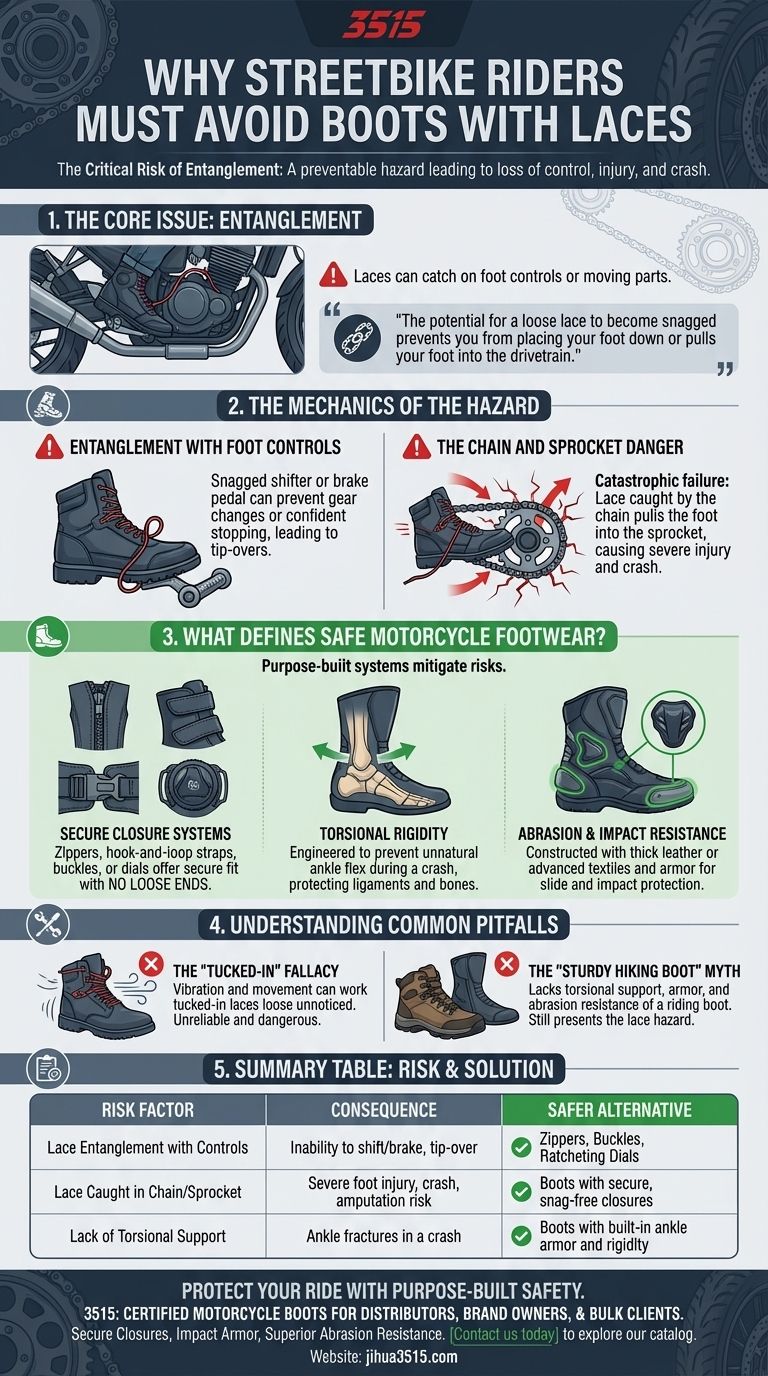
Visual Guide
Related Products
- Wholesale Tactical Boots High-Traction & Reflective for Bulk & Brand Orders
- High Performance Fire-Retardant Waterproof Safety Boots
- Durable Goodyear Welt Leather Work Boots for Wholesale & Private Label
- Wholesale High-Traction Camo Boots - Custom Manufacturer for Brands
- Heavy-Duty Waterproof Nubuck Safety Boots Safety Shoes for Bulk Supply
People Also Ask
- How do tactical boots protect against injuries? Discover the Integrated Safety System
- What are the key features to look for in the best tactical boots? A Guide to Peak Performance
- What is the necessity of high-performance tactical boots in exoskeletons? Enhancing Load Efficiency and Safety
- What are the primary characteristics of tactical boots? Lightweight, Agile, and Built for All-Day Missions
- How do manufacturing processes for electronic textiles balance durability with wearing comfort? Innovation in Footwear



















