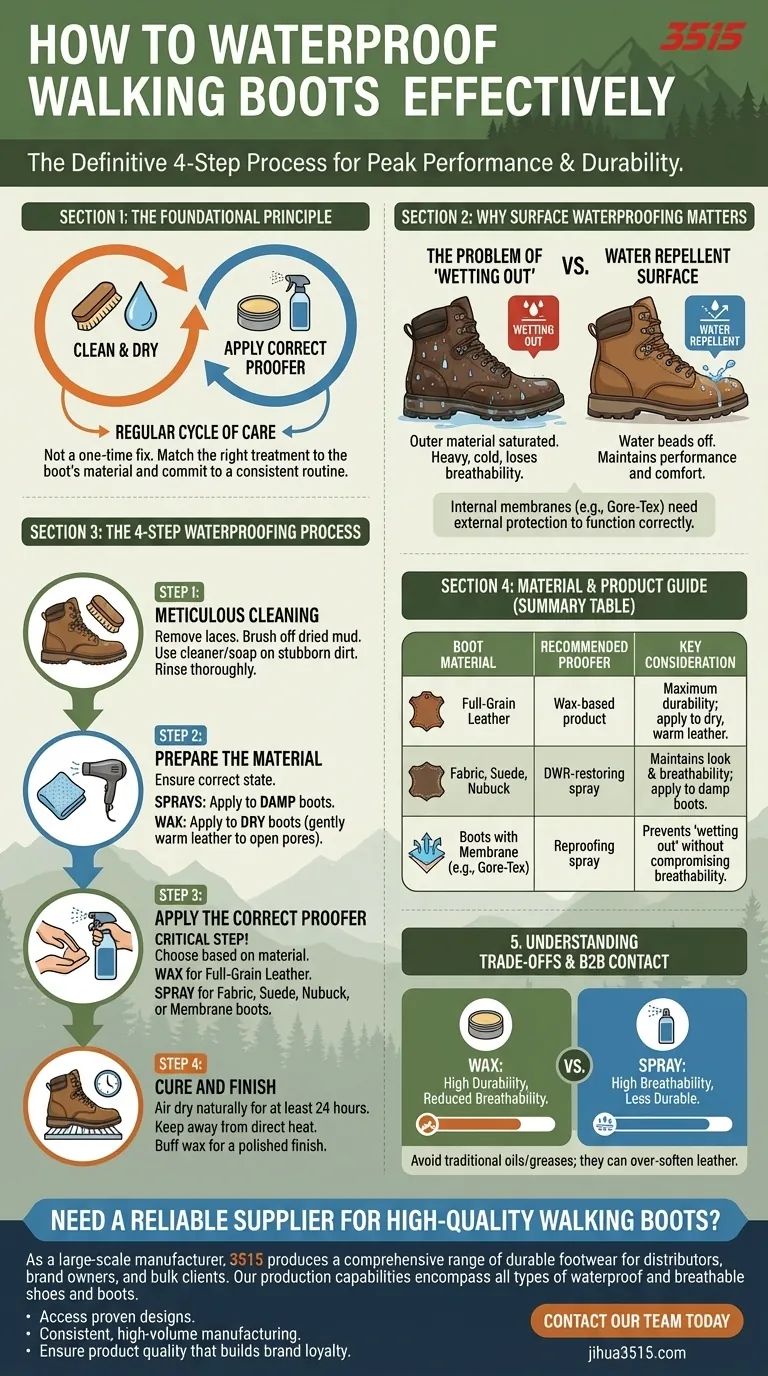
To effectively waterproof your walking boots, you must first meticulously clean and dry them. The next step is to apply the correct proofing product for your boot's specific material—typically a wax-based proofer for full-grain leather or a specialized spray for fabric, suede, or nubuck boots—and allow it to cure completely.
The core principle is that true waterproofing is not a one-time fix. It is a system of matching the right treatment to your boot's material and committing to a cycle of regular cleaning and reapplication to maintain the protective barrier.
Why Surface Waterproofing is Non-Negotiable
Many modern boots come with an internal waterproof membrane, like Gore-Tex. This can lead to a false sense of security, making you think external care is unnecessary.
The Problem of "Wetting Out"
When the outer material of your boot becomes saturated with water, it's called "wetting out." While the internal membrane may still keep your foot dry, the boot becomes heavy, cold, and loses its breathability.
A proper external waterproof treatment prevents this. It causes water to bead up and roll off the surface, maintaining the boot's performance and your comfort.
The Definitive 4-Step Waterproofing Process
Regardless of your boot's material, this foundational process ensures the best possible result.
Step 1: Meticulous Cleaning
You cannot waterproof dirt. A new treatment must bond directly with the boot material.
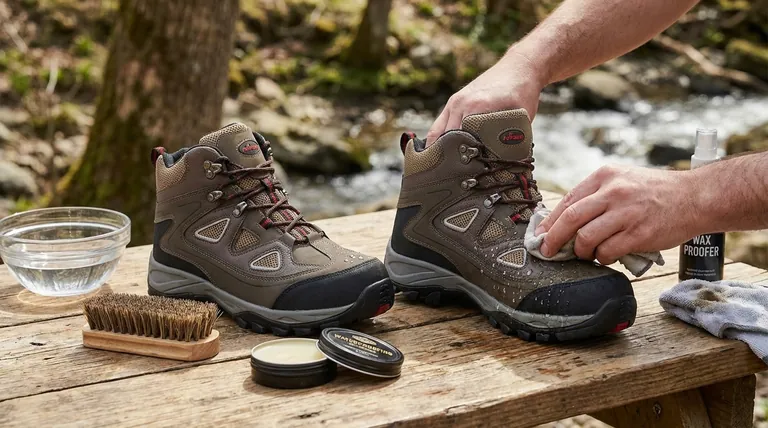
Start by removing the laces. Use a stiff brush to remove all dried mud and debris. For stubborn dirt, use a specialized footwear cleaning solution or mild soap with a damp rag, then rinse thoroughly.
Step 2: Prepare the Material
Boots must be in the right state to accept treatment. For most spray-on applications, this means applying them while the boots are still damp, as this helps the proofer soak in.
For wax-based applications on leather, the boot should be completely dry. You can gently warm the leather with a hairdryer on a low setting to open its pores, which helps the wax absorb more deeply. Do not overheat the leather, as this can cause it to crack.
Step 3: Apply the Correct Proofer
This is the most critical step. Using the wrong product can be ineffective or even damage your boots.
For Full-Grain Leather Boots (The Wax Method)
Wax-based products provide a durable physical barrier that also nourishes the leather.
Apply a small amount of wax evenly with your fingers or a clean cloth, paying special attention to seams and welting where the upper joins the sole. The warmth from your hands helps the wax melt into the leather.
For Fabric, Suede, or Nubuck Boots (The Spray Method)
Reproofing sprays are designed to restore the Durable Water Repellent (DWR) finish without damaging delicate materials or changing their appearance.
Hold the bottle several inches away and apply an even coating across the entire boot. Check the product instructions, as some are best applied to damp boots. Work in a well-ventilated area.
Step 4: Cure and Finish
Patience is key. Allow your boots to air dry naturally at room temperature for at least 24 hours. Keep them away from direct heat sources like radiators or fires, which can damage adhesives and warp leather.
If you used wax, you may see some excess on the surface. Gently buff this off with a clean, dry cloth for a polished finish.
Understanding the Trade-offs
Choosing a waterproofing method involves balancing durability with other performance factors.
Wax vs. Spray: Durability and Breathability
A heavy wax application on leather offers the most robust and long-lasting waterproof barrier. However, it can slightly reduce the breathability of the leather.
Sprays are designed to maintain maximum breathability, which is critical for boots with waterproof membranes like Gore-Tex. The trade-off is that they are less durable and require more frequent reapplication.
A Note on Oils and Greases
Traditional oils and greases can waterproof leather, but they can also over-soften it. This may compromise the boot's structural integrity and support over time. It is generally safer to stick with modern, purpose-made waxes and conditioners.
Making the Right Choice for Your Boots
Your boot's material dictates the correct approach. Always follow the manufacturer's care instructions if they are available.
- If your primary focus is maximum durability for full-grain leather boots: A quality wax-based proofer offers the best protection and conditions the leather.
- If your primary focus is maintaining the look and breathability of fabric, suede, or nubuck boots: A DWR-restoring spray is the only appropriate choice.
- If your primary focus is performance for boots with a waterproof membrane (e.g., Gore-Tex): Use a reproofing spray to prevent "wetting out" without compromising the membrane's crucial breathability.
A consistent care routine is the definitive factor in keeping your feet dry and your boots performing for years to come.
Summary Table:
| Boot Material | Recommended Proofer | Key Consideration |
|---|---|---|
| Full-Grain Leather | Wax-based product | Offers maximum durability; apply to dry, warm leather. |
| Fabric, Suede, Nubuck | DWR-restoring spray | Maintains look & breathability; apply to damp boots. |
| Boots with Membrane (e.g., Gore-Tex) | Reproofing spray | Prevents 'wetting out' without compromising breathability. |
Need a reliable supplier for high-quality walking boots?
As a large-scale manufacturer, 3515 produces a comprehensive range of durable footwear for distributors, brand owners, and bulk clients. Our production capabilities encompass all types of waterproof and breathable shoes and boots, ensuring your customers get the best performance on any terrain.
Partner with us to:
- Access a wide catalog of proven designs.
- Benefit from consistent, high-volume manufacturing.
- Ensure product quality that builds brand loyalty.
Contact our team today to discuss your footwear needs and request a catalog.
Visual Guide
Related Products
- Wholesale Premium Waterproof Nubuck Safety Shoes Boots
- Premium Waterproof Nubuck Safety Boots for Wholesale
- Premium Wholesale Waterproof Safety Boots High Performance Protection for Industrial Markets
- High Performance Fire-Retardant Waterproof Safety Boots
- Durable Waterproof Rain Boots | Custom Manufacturer for Wholesale & Brands
People Also Ask
- Why are waterproof safety boots recommended for certain work environments? Essential Protection for Wet & Hazardous Jobs
- What materials are commonly used in waterproof boots? The Complete Guide to Durable, Breathable Protection
- What are the drawbacks of waterproof boots? The Breathability vs. Protection Trade-Off
- What is the advantage of one-piece construction in waterproof boots? Unbeatable Seamless Protection
- What is the difference between waterproof, water-resistant, and water-repellent boots? Choose the Right Protection for Your Feet