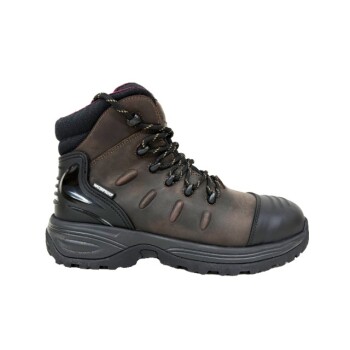
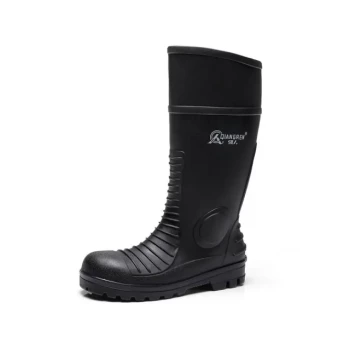
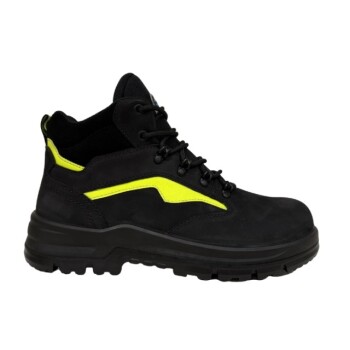
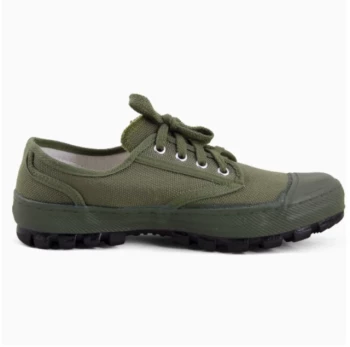
Safety is the non-negotiable top priority when selecting oilfield work boots because the worksite is an inherently high-risk environment. Unlike a standard construction site, an oilfield presents a unique combination of hazards—from crushing weight and falling tools to slick surfaces coated in oil and the constant threat of electrical discharge. Your boots are not just footwear; they are a critical piece of Personal Protective Equipment (PPE) designed to mitigate these specific, severe risks.
The core principle is this: choosing oilfield boots is an exercise in risk management, not a matter of preference. The right boot is defined by its certified ability to protect against the specific impact, puncture, slip, and electrical hazards mandated by safety standards like ASTM F2413.
Deconstructing the Essential Safety Features
To understand why safety is paramount, you must first understand the specific dangers and the corresponding features engineered to counter them. A compliant oilfield boot is a system of protective technologies.
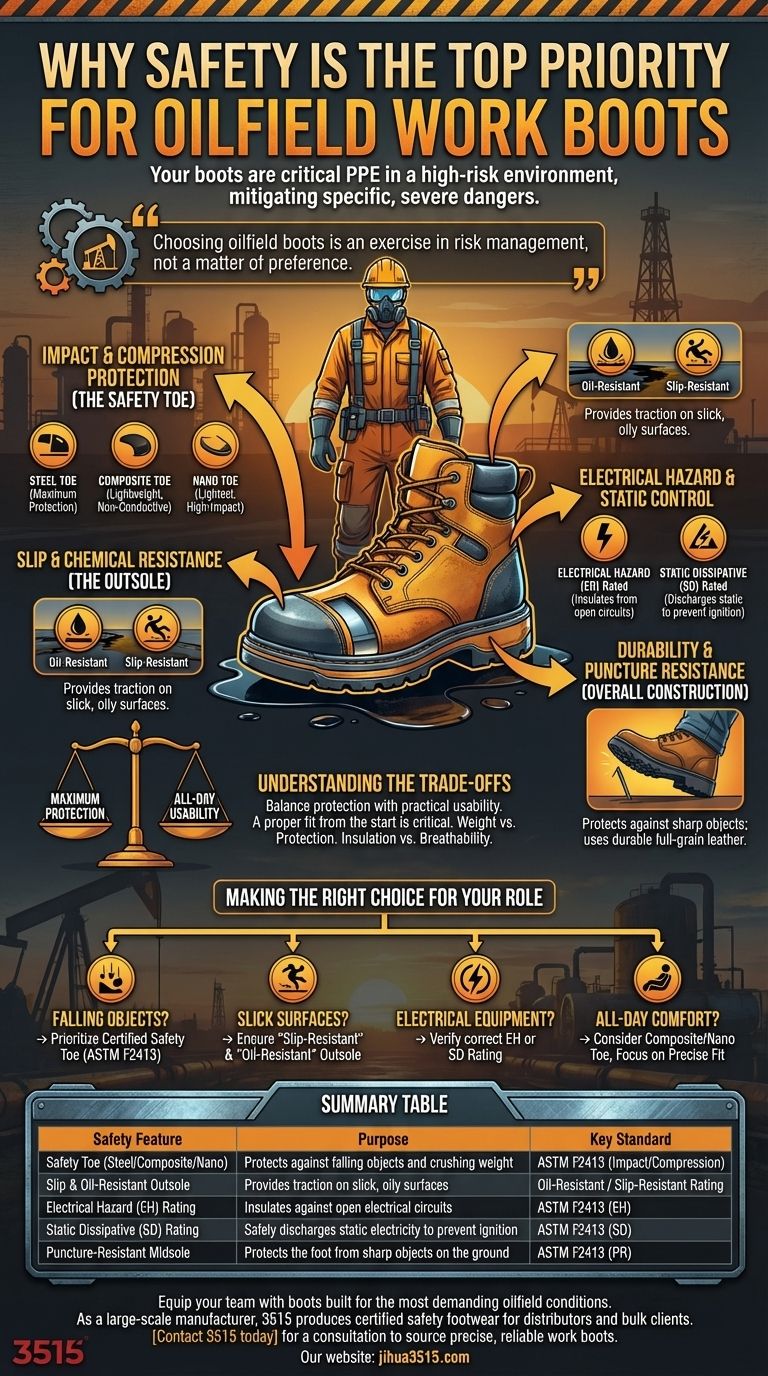
Impact and Compression Protection (The Safety Toe)
The most recognized safety feature is the protective toe cap, which guards against falling objects and heavy, rolling machinery. It must meet specific standards for both impact and compression.
There are three primary types:
- Steel Toe: The traditional standard, offering maximum protection.
- Composite Toe: Made from materials like carbon fiber or Kevlar, these are lighter than steel and do not conduct electricity.
- Nano Toe: The most modern option, offering the lightest weight with high-impact resistance.
Slip and Chemical Resistance (The Outsole)
Oilfield platforms and work areas are consistently exposed to water, drilling fluids, and oil, creating dangerously slick surfaces.
An effective outsole must be explicitly rated as oil-resistant and slip-resistant. This ensures the material won't degrade when exposed to petrochemicals and that the tread pattern provides maximum traction on treacherous surfaces.
Electrical Hazard and Static Control
The risk of electrical incidents is significant in oil and gas operations. Work boots offer two distinct types of electrical protection that are often confused.
- Electrical Hazard (EH) Rated: These boots are designed to protect you from open electrical circuits by providing a secondary source of insulation from the ground.
- Static Dissipative (SD) Rated: These boots are crucial in environments where a buildup of static electricity could ignite flammable materials. They are engineered to safely discharge static electricity into the ground.
Durability and Puncture Resistance (Overall Construction)
The boot's construction must be robust enough to withstand the harsh environment. This includes protection from sharp objects on the ground.
Look for durable materials like full-grain leather, reinforced with twin-line stitching for added strength. Many boots also include waterproof membranes to keep feet dry, which is both a comfort and a safety feature, as it prevents blisters and focus-breaking discomfort.
Understanding the Trade-offs
Selecting the right boot requires balancing absolute protection with practical, all-day usability. The "safest" boot on paper may not be the right choice if it introduces other risks.
The Myth of the "Break-In" Period
While quality leather boots have a settling-in period, a truly ill-fitting boot will not become comfortable. Pain, blisters, and rubbing are distractions that can lead to accidents. A proper fit from the start is a critical safety feature.
Weight vs. Protection
A heavy-duty steel toe boot offers immense protection but can contribute to fatigue over a 12-hour shift. A lighter composite or nano toe might be a better choice for roles requiring significant walking or climbing, reducing fatigue without compromising on certified impact resistance.
Insulation and Breathability
Boots may need insulation for work in extreme cold, but this must be balanced with breathability. Feet that overheat and sweat excessively can lead to blisters and fungal infections. A boot that keeps your feet dry from both external moisture and internal sweat is essential for long-term safety and health.
Making the Right Choice for Your Role
The final decision must be based on the specific requirements of your job and worksite. Always begin by researching the mandatory PPE for your role and consulting with experienced peers.
- If your primary focus is protection from falling objects: Prioritize a certified safety toe (steel, composite, or nano) that meets ASTM F2413 impact and compression standards.
- If your primary focus is preventing slips on slick surfaces: Ensure the outsole is explicitly rated as both "slip-resistant" and "oil-resistant."
- If your primary focus is working near electrical equipment: Verify the boot has the correct rating—Electrical Hazard (EH) for insulation from open circuits or Static Dissipative (SD) to prevent static buildup.
- If your primary focus is all-day comfort and reducing fatigue: Pay close attention to boot weight, consider a composite toe, and never compromise on a precise, comfortable fit achieved by trying boots on in the afternoon with your work socks.
Ultimately, the right work boot is the one that allows you to focus completely on your job, confident that your feet are properly protected from every relevant hazard.
Summary Table:
| Safety Feature | Purpose | Key Standard |
|---|---|---|
| Safety Toe (Steel/Composite/Nano) | Protects against falling objects and crushing weight | ASTM F2413 (Impact/Compression) |
| Slip & Oil-Resistant Outsole | Provides traction on slick, oily surfaces | Oil-Resistant / Slip-Resistant Rating |
| Electrical Hazard (EH) Rating | Insulates against open electrical circuits | ASTM F2413 (EH) |
| Static Dissipative (SD) Rating | Safely discharges static electricity to prevent ignition | ASTM F2413 (SD) |
| Puncture-Resistant Midsole | Protects the foot from sharp objects on the ground | ASTM F2413 (PR) |
Equip your team with boots built for the most demanding oilfield conditions.
As a large-scale manufacturer, 3515 produces a comprehensive range of certified safety footwear for distributors, brand owners, and bulk clients. Our production capabilities encompass all types of industrial boots, engineered to meet the highest safety standards while ensuring all-day comfort and durability.
Contact 3515 today for a consultation and let us help you source the precise, reliable work boots your workforce needs to stay safe and productive.
Visual Guide
Related Products
- Premium Oil Wax Leather Safety Boots for Bulk Purchase
- Durable Leather Work Boots for Wholesale & Custom Manufacturing
- Durable Leather Work Boots for Wholesale & Custom OEM Manufacturing
- Durable Leather Work Boots Wholesale Manufacturer & Custom Factory
- Durable Leather Moc Toe Work Boots for Wholesale & Custom Manufacturing
People Also Ask
- What materials are commonly used for outsoles in safety boots? A Guide to Durability, Grip, and Comfort
- How do safety boots reduce cutting hazards? Essential Protection for Your Workforce
- What are the common types of safety boots and their primary uses? A Guide to Industrial Footwear
- Which organizations develop safety standards for work boots? Ensure Compliance & Worker Safety
- What primary protective functions do professional safety boots provide in urban solid waste recovery and waste picking processes? Discover Dual-Layer Protection.