At their core, recommended Western-style work boots merge traditional ruggedness with modern safety and comfort engineering. Key features include full-grain leather construction for durability, certified safety toes for impact protection, specialized outsoles rated for electrical hazards, and advanced multi-layer footbeds designed for all-day support.
The most critical feature of any work boot is not a single piece of technology, but how well its combination of materials and safety ratings matches the specific demands of your job site and daily tasks.
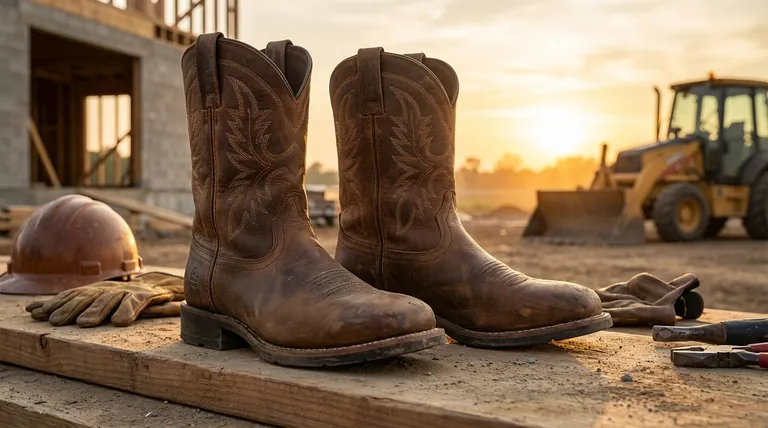
Deconstructing the Modern Western Work Boot
To choose the right boot, you must understand how its individual components work together to provide protection, support, and longevity. A quality boot is a system where each part has a distinct and vital role.
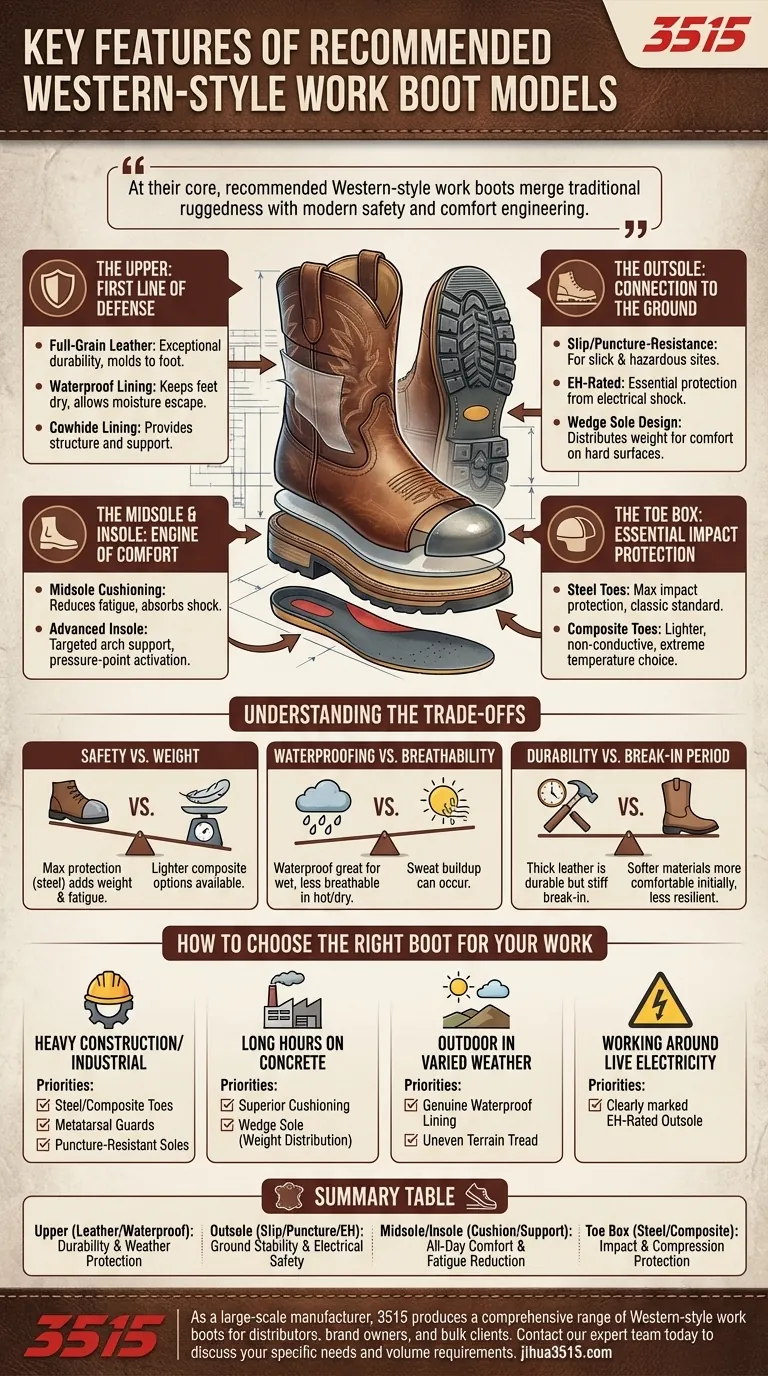
The Upper: Your First Line of Defense
The upper is everything above the sole, responsible for protecting your foot from the elements and workplace hazards.
High-quality boots almost universally use full-grain cowhide leather. This material is chosen for its exceptional durability, breathability, and ability to mold to your foot over time.
For wet environments, a dedicated waterproof lining is non-negotiable. This internal membrane keeps your feet dry while allowing moisture to escape, preventing discomfort and blisters.
Pay close attention to the internal lining as well. A cowhide lining provides structure and comfort, unlike cheaper pigskin or synthetic linings which can break down and offer less support.
The Outsole: Your Connection to the Ground
The outsole is the layer that makes direct contact with the ground and is critical for both safety and stability.
Look for task-specific properties like slip-resistance for slick surfaces and puncture-resistance for construction sites.
For electricians or anyone working near live circuits, an Electrical Hazard (EH) rated outsole is an essential safety feature that can provide critical protection from shock.
The sole's design also impacts comfort. A wedge sole, for example, has a flat bottom that distributes weight evenly, making it ideal for carpenters and others who spend long hours on hard, flat surfaces.
The Midsole and Insole: The Engine of Comfort
The comfort and support of a boot come from its internal structure, primarily the midsole and insole (or footbed).
The midsole provides the primary layer of cushioning and shock absorption, reducing the fatigue felt in your joints after a long day.
The insole or footbed is the removable layer that directly supports your foot. Modern insoles feature advanced foam technology, targeted arch support, and even pressure-point activation for cloud-like comfort.
The Toe Box: Essential Impact Protection
The toe box is the most recognized safety feature, designed to protect your feet from falling objects and compression.
Steel toes offer the maximum level of impact protection and are a classic standard in heavy industrial settings.
Composite toes, made from materials like carbon fiber or Kevlar, offer similar protection levels but are lighter and do not conduct heat or cold, making them a better choice for extreme temperature environments.
Understanding the Trade-offs
No single boot is perfect for every situation. Making an informed choice requires acknowledging the inherent compromises in boot design.
Safety vs. Weight
Features like steel toes and thick, puncture-proof soles offer maximum protection but add significant weight. This can increase fatigue over a long shift compared to lighter composite toes or standard soles.
Waterproofing vs. Breathability
A fully waterproof boot is excellent for wet conditions but can be less breathable in hot, dry climates. This can lead to sweat and internal moisture buildup if your environment doesn't truly require a waterproof membrane.
Durability vs. Break-in Period
Thick, full-grain leather boots are incredibly durable but often come with a stiff, lengthy break-in period. Softer leathers or synthetic materials may feel comfortable out of the box but will not offer the same long-term resilience.
How to Choose the Right Boot for Your Work
Evaluate the specific hazards and conditions you face every day. Use that knowledge to prioritize the features that will serve you best.
- If your primary focus is heavy construction or industrial sites: Prioritize boots with certified steel or composite safety toes, metatarsal guards, and puncture-resistant soles.
- If your primary focus is long hours on concrete (carpentry, manufacturing): Look for boots with superior cushioning and a wedge sole to distribute your weight evenly and fight fatigue.
- If your primary focus is outdoor work in varied weather: Ensure the boot has a genuine waterproof lining and an outsole with a tread designed for uneven, slippery terrain.
- If your primary focus is working around live electricity: You must select a boot with a clearly marked Electrical Hazard (EH) rated outsole.
By focusing on the features that solve your specific daily challenges, you can invest in a boot that works as hard as you do.
Summary Table:
| Feature Category | Key Components | Primary Benefit |
|---|---|---|
| Upper | Full-Grain Leather, Waterproof Lining | Durability & Weather Protection |
| Outsole | Slip/Puncture-Resistant, EH-Rated | Ground Stability & Electrical Safety |
| Midsole/Insole | Advanced Cushioning, Arch Support | All-Day Comfort & Fatigue Reduction |
| Toe Box | Steel or Composite Toe | Impact & Compression Protection |
As a large-scale manufacturer, 3515 produces a comprehensive range of Western-style work boots for distributors, brand owners, and bulk clients. Our production capabilities encompass all types of safety footwear, ensuring durability, comfort, and compliance with the highest safety standards. Let us help you equip your workforce with boots that are built to last. Contact our expert team today to discuss your specific needs and volume requirements.
Visual Guide
Related Products
- Durable Goodyear Welt Leather Work Boots for Wholesale & Private Label
- Durable Leather Work Boots for Wholesale & Custom Manufacturing
- Durable Leather Work Boots for Wholesale & Custom OEM Manufacturing
- Durable Moc-Toe Wedge Work Boots | Wholesale Manufacturing for Brands
- Wholesale Leather Work Boots with Customizable Wedge Sole for Brands
People Also Ask
- What is the difference between full-grain and top-grain leather? Premium Material Guide for Boot Manufacturers
- What are the advantages of leather as an upper material for work boots? Unmatched Durability & Custom Comfort
- Why is it important to waterproof leather work boots? Protect Your Investment and Performance
- How should new leather work boots be broken in? A Guide to Comfort and Durability
- What are the advantages of leather uppers in work boots? Unmatched Durability & Protection