Regular cleaning is the single most effective maintenance habit to extend the lifespan of Goodyear welted footwear. Dust, dirt, and debris act as micro-abrasives that degrade leather quality over time, compromising both the aesthetic appeal and the structural integrity of the shoe. By consistently removing these contaminants, you prevent premature aging and ensure the leather remains a viable candidate for future resoling.
The core value of a Goodyear welt is its repairability, but this relies entirely on the condition of the upper leather. Regular cleaning is not merely cosmetic; it is a structural necessity to prevent the leather from failing before the sole does.
The Mechanics of Leather Degradation
The Abrasive Impact of Dirt
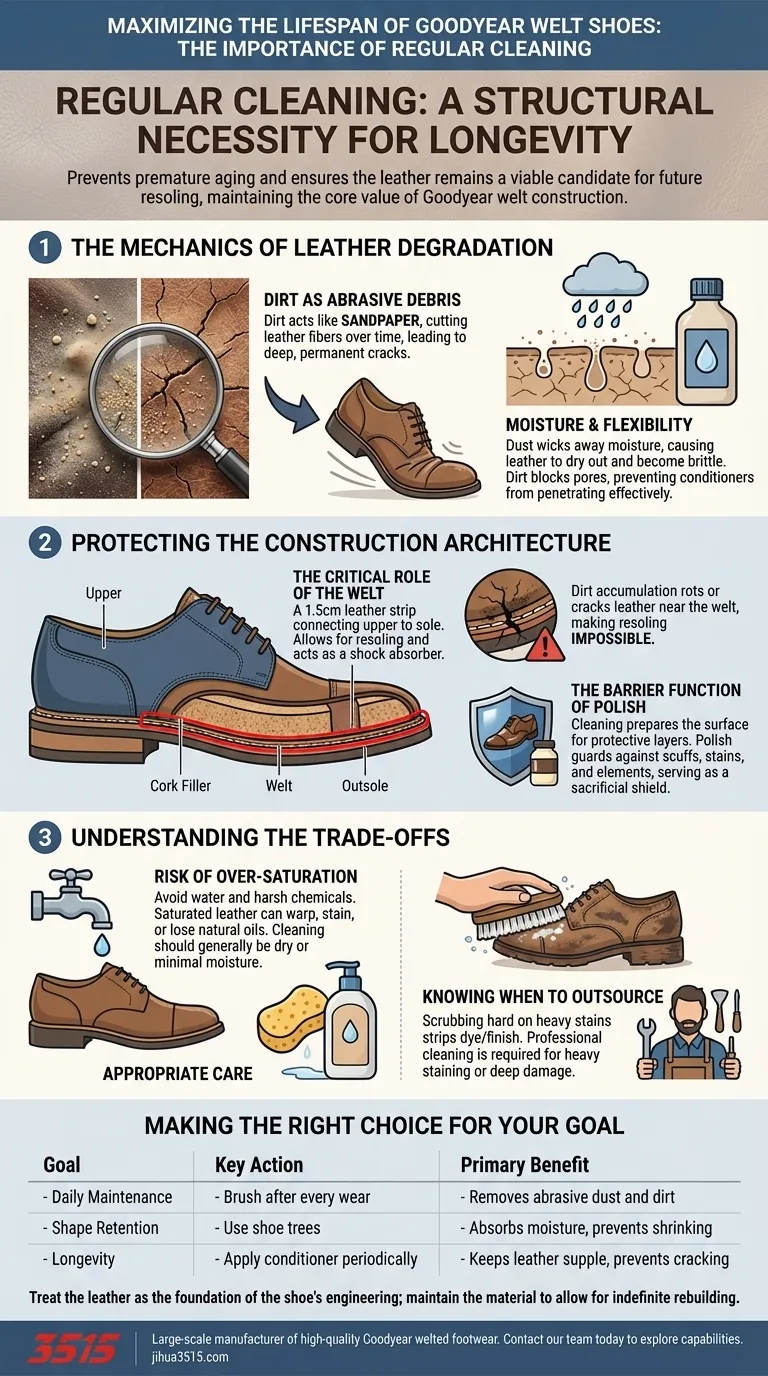
Dirt is rarely just "dirty"; it is physical debris. When dust settles into the creases of your shoe, it acts like sandpaper against the leather fibers as the shoe flexes during walking.
Over time, this friction cuts the fibers, leading to deep, permanent cracks. Regular cleaning with a soft brush removes these particles before they can cause irreversible mechanical damage.
Moisture and Flexibility
Leather is organic material that behaves similarly to skin; it requires hydration to remain flexible. A heavy layer of dust can wick moisture away from the leather, causing it to dry out and become brittle.
Furthermore, dirt blocks the pores of the leather. This prevents conditioners from penetrating effectively, rendering your maintenance efforts useless if the surface isn't clean first.
Protecting the Construction Architecture
The Critical Role of the Welt
The specific advantage of your footwear is the welt—a strip of leather approximately 1.5cm wide connecting the upper to the sole. This architecture allows for resoling, acting as a shock absorber and a bridge for repairs.
However, a cobbler can only stitch a new sole onto the welt if the upper leather remains sound. If dirt accumulation rots or cracks the leather near the welt, the shoe becomes impossible to resole, negating the investment value of the Goodyear construction.
The Barrier Function of Polish
Cleaning prepares the canvas for protection. Once the leather is free of dirt, applying cream and wax polishes adds a protective layer to the surface.
This layer guards against scuffs, stains, and elements. It serves as a sacrificial shield, ensuring that minor impacts damage the wax rather than the leather hide itself.
Understanding the Trade-offs
The Risk of Over-Saturation
While cleaning is vital, water and harsh chemicals are enemies of leather. Saturated leather can warp, stain, or lose its natural oils, leading to the very stiffness you are trying to avoid.
Cleaning should generally be dry (brushing) or use minimal moisture. High-quality conditioners should be applied in small amounts, worked into the pores without flooding the material.
Knowing When to Outsource
Home care is excellent for maintenance, but it has limitations. Scrubbing too hard on heavy stains can strip the dye or finish of the shoe.
As noted in standard care guidelines, heavy staining or deep damage requires professional cleaning. A professional has the tools to extract debris without abrading the surface.
Making the Right Choice for Your Goal
To maximize the return on your footwear investment, align your care routine with your specific objectives.
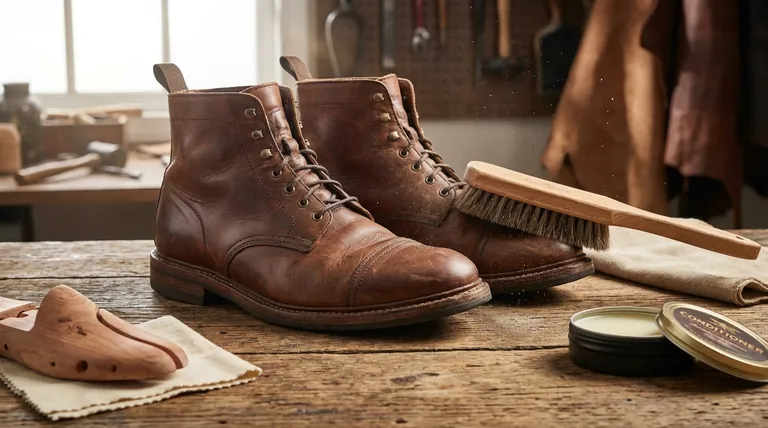
- If your primary focus is Daily Maintenance: Use a soft horsehair brush after every wear to remove surface dust before it has time to settle into creases.
- If your primary focus is Shape Retention: Insert shoe trees immediately after wearing to absorb internal moisture and keep the leather taut against shrinking.
- If your primary focus is Longevity: Apply a high-quality leather conditioner periodically to keep the fibers supple, preventing the cracking that kills a shoe's structural viability.
Treat the leather as the foundation of the shoe's engineering; if you maintain the material, the Goodyear welt construction will allow you to rebuild the rest indefinitely.
Summary Table:
| Goal | Key Action | Primary Benefit |
|---|---|---|
| Daily Maintenance | Brush after every wear | Removes abrasive dust and dirt |
| Shape Retention | Use shoe trees | Absorbs moisture, prevents shrinking |
| Longevity | Apply conditioner periodically | Keeps leather supple, prevents cracking |
Ready to build a durable footwear collection? As a large-scale manufacturer, 3515 produces a comprehensive range of high-quality Goodyear welted and other footwear for distributors, brand owners, and bulk clients. Our production capabilities ensure you receive durable, repairable shoes built to last. Let's discuss your needs and how we can support your business. Contact our team today to explore our capabilities and place your order.
Visual Guide
Related Products
- Durable Goodyear Welt Leather Work Boots for Wholesale & Private Label
- Wholesale Durable Leather Work Boots | 8-Inch Goodyear Welt Manufacturer
- Wholesale Durable & Breathable Training Shoes for Custom Brands
- Custom OEM Training Shoes Wholesale Manufacturer Durable & Breathable
- Lightweight Breathable Training Shoes for Wholesale & Custom OEM Manufacturing
People Also Ask
- What is the difference between full-grain and top-grain leather? Premium Material Guide for Boot Manufacturers
- What are the advantages of leather as an upper material for work boots? Unmatched Durability & Custom Comfort
- Why is it important to waterproof leather work boots? Protect Your Investment and Performance
- How should new leather work boots be broken in? A Guide to Comfort and Durability
- What are the advantages of leather uppers in work boots? Unmatched Durability & Protection