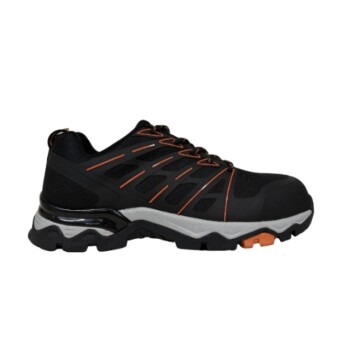
Reliable outsole traction is the critical defense against falls when urban lighting obscures ground hazards. In environments characterized by insufficient light, glare, or heavy shadows, a high-grip sole provides the physical stability necessary to navigate unseen surface changes. This is particularly vital for individuals with vision impairments, as the mechanical grip compensates for the lack of depth perception and visual clarity.
Inconsistent lighting creates a disconnect between what you see and what you step on. High-traction outsoles bridge this gap, offering a stable foundation that compensates for visual disorientation and enhances psychological security.
Navigating Visual Uncertainty
Compensating for Glare and Shadows
Urban environments are rarely evenly lit. Glares and shadows can effectively camouflage wet spots, loose gravel, or uneven pavement.
When your eyes cannot accurately detect these hazards, the shoe's grip must act as a fail-safe. High-traction outsoles instantly counteract the loss of friction that visual scanning failed to predict.
Assisting with Vision Impairments
For individuals with conditions such as diabetic retinopathy, navigating the city is distinctively challenging. These users often struggle to perceive depth or identify subtle surface changes.
In these scenarios, the outsole serves a sensory function. It ensures that a step remains stable even if the foot placement was not visually verified with precision.
The Role of Psychological Safety
Reducing the Fear of Movement
Physical stability has a direct correlation with mental state. For those facing visual disorientation, the fear of falling can be a significant barrier to mobility.
Knowing that their footwear provides a superior grip helps mitigate this anxiety. It allows users to focus on navigation rather than the constant threat of slipping.
Providing a Stable Foundation
A secure grip acts as a reliable anchor in a chaotic environment. The primary reference notes that this stability is essential for movement through complex cityscapes.
By providing a dependable point of contact with the ground, high-traction shoes effectively compensate for the sensory gaps caused by poor lighting or poor vision.
Understanding the Limitations
Traction vs. Obstacle Detection
It is important to recognize that while traction mitigates slipping, it does not resolve all mobility issues. A high-grip sole provides stability on a surface, but it cannot alert the user to vertical obstacles.
Users must understand that enhanced grip compensates for surface texture uncertainty, but it does not remove the risk of tripping over unseen curbs or debris in low light.
Making the Right Choice for Your Goal
When selecting safety footwear for urban environments, consider your specific challenges:
- If your primary focus is General Urban Safety: Prioritize high-traction outsoles to act as a physical backup system against the glares and shadows that hide slip hazards.
- If your primary focus is Supporting Vision Impairment: Choose footwear with maximum grip to compensate for depths perception issues and to provide the psychological confidence needed for independent movement.
True safety in the city requires gear that performs when your senses cannot.
Summary Table:
| Feature | Impact in Low Light/Urban Settings | Benefit for Users |
|---|---|---|
| Slip Resistance | Compensates for camouflaged hazards like wet spots or gravel. | Prevents falls when visual detection fails. |
| Mechanical Grip | Acts as a sensory fail-safe for depth perception issues. | Critical for vision impairments and glare. |
| Physical Stability | Provides a reliable anchor on uneven pavement. | Enhances mobility in complex cityscapes. |
| Traction Quality | Reduces anxiety related to visual disorientation. | Increases psychological safety and confidence. |
Partner with 3515 for High-Performance Safety Footwear
As a large-scale manufacturer serving global distributors and brand owners, 3515 delivers the technical precision required for challenging urban environments. Our flagship Safety Shoes series is engineered with superior outsole traction to protect workers and individuals navigating unpredictable lighting and surfaces.
Beyond safety boots, our extensive portfolio includes tactical boots, outdoor shoes, training sneakers, and formal dress shoes to meet your diverse bulk procurement needs. Contact us today to discuss your custom manufacturing requirements and see how our production capabilities can add value to your brand.
References
- Hisham Abusaada, Abeer Elshater. Revisiting Urban Street Planning and Design Factors to Promote Walking as a Physical Activity for Middle-Class Individuals with Metabolic Syndrome in Cairo, Egypt. DOI: 10.3390/ijerph21040402
This article is also based on technical information from 3515 Knowledge Base .
Related Products
- Premium Suede Sport Safety Shoes for Wholesale & Bulk Orders
- Premium Lightweight Safety Shoes for Wholesale & Bulk Orders
- Wholesale Anti-Smash & Puncture-Proof Safety Shoes Custom Manufacturing for Brands
- Premium KPU Injection Athletic Style Safety Shoes
- Premium Safety Shoes with Rotating Buckle Safety Sneakers
People Also Ask
- What are the primary functions of professional safety shoes? Maximize Safety in Water Supply Confined Spaces
- What industries have specific OSHA footwear requirements? Ensure Compliance & Protect Your Workforce
- What role do specialized safety shoes play in preventing falls? Engineering Stability in Industrial Environments
- Why are customized foot sensors or professional safety shoes incorporated into biomechanical testing? Precision Insights
- What core functions do professional safety shoes serve? Enhance Construction & Industrial Safety Standards