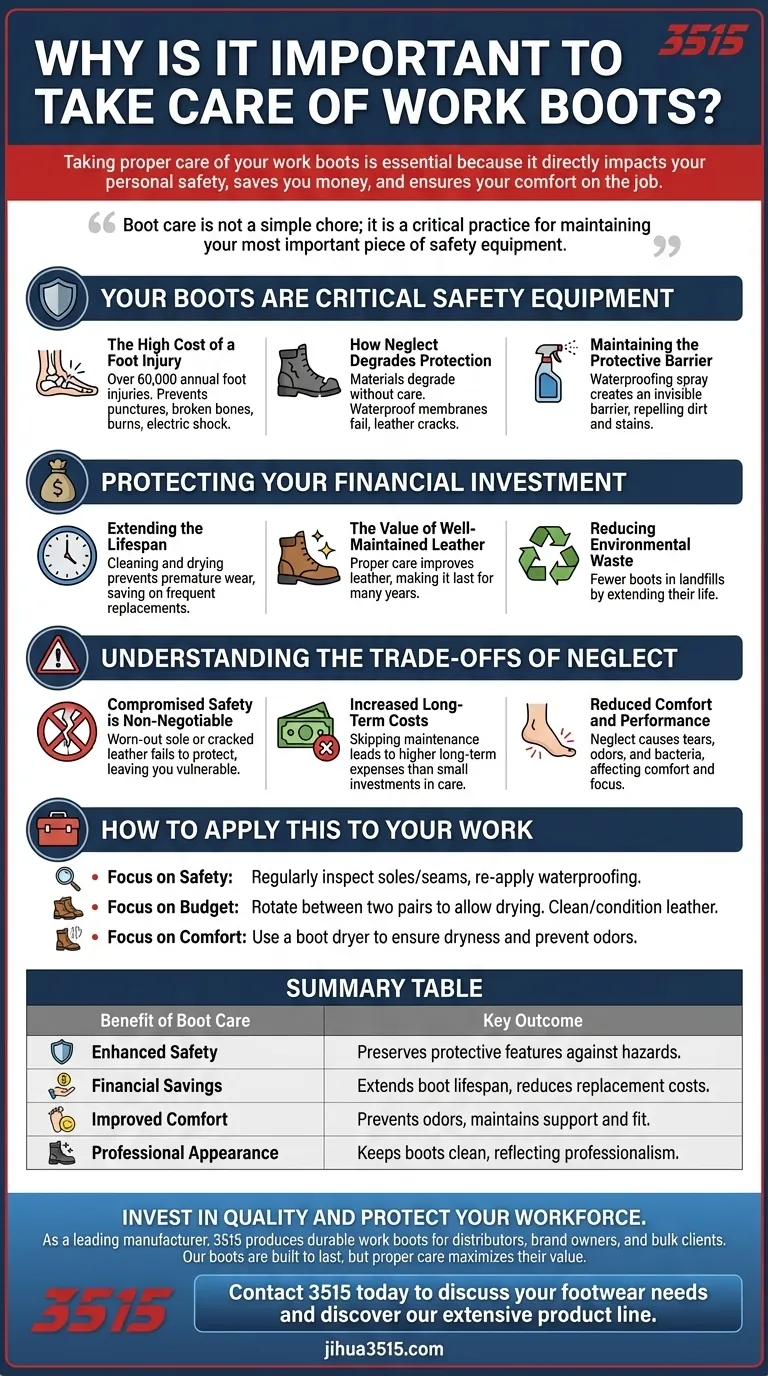
Taking proper care of your work boots is essential because it directly impacts your personal safety, saves you money, and ensures your comfort on the job. Proper maintenance preserves the critical protective features of the boots, significantly extends their usable lifespan, and maintains a professional appearance by preventing the buildup of debris and odor.
Boot care is not a simple chore; it is a critical practice for maintaining your most important piece of safety equipment. Neglecting your boots compromises their ability to protect you, costs you more money in the long run, and can lead to significant discomfort.
Your Boots Are Critical Safety Equipment
The primary function of a work boot is protection. The human foot is a complex structure of bones, muscles, and tendons that endures immense stress, and proper footwear is the first line of defense against serious, long-term injury.
The High Cost of a Foot Injury
With over 60,000 foot injuries reported annually among American workers, the risks are clear. Well-maintained boots are designed to prevent injuries from punctures, broken bones, sprains, burns, cuts, and even electric shock.
How Neglect Degrades Protection
Safety boots are durable, but they are not invincible. Without regular care, the materials degrade. Waterproof membranes can fail, leaving your feet wet and cold, while leather can crack and weaken, compromising its structural integrity.
Maintaining the Protective Barrier
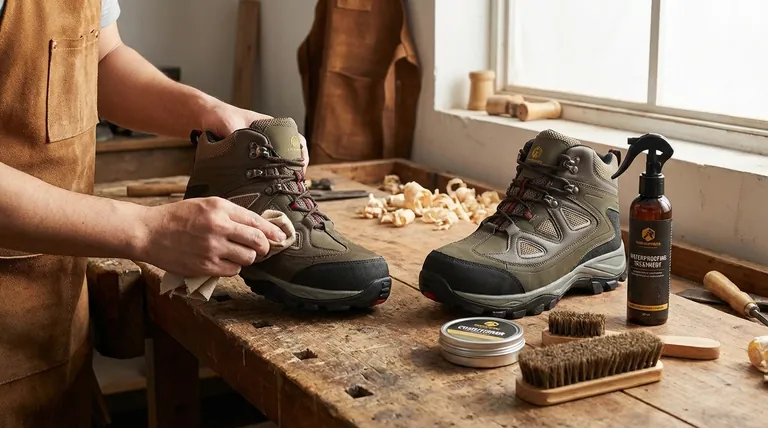
Simple maintenance maintains the boot's protective qualities. Applying a waterproofing spray, for instance, creates an invisible barrier that repels not only water but also dirt and stains, preserving the material for longer.
Protecting Your Financial Investment
Work boots are a significant expense. Treating them as a long-term investment rather than a disposable tool yields substantial financial and environmental benefits.
Extending the Lifespan of Your Boots
The single most significant benefit of regular care is extending the life of your boots. Simple acts like cleaning them after a shift and allowing them to dry completely can prevent premature wear and tear, saving you money on frequent replacements.
The Value of Well-Maintained Leather
For leather boots, proper care does more than just preserve them; it improves them. Well-maintained leather ages beautifully, with its color and texture evolving over time. A boot that is cared for can last for many years, even decades.
Reducing Environmental Waste
By extending the life of your footwear, you reduce the number of boots that end up in a landfill. This simple habit is a practical way to minimize your environmental impact.
Understanding the Trade-offs of Neglect
Ignoring boot maintenance has direct and predictable consequences. Understanding these downsides makes the importance of care immediately clear.
Compromised Safety is Non-Negotiable
The most severe trade-off is reduced safety. A boot with a worn-out sole, cracked leather, or a failed waterproof membrane is no longer performing its most crucial function, leaving you vulnerable to injury.
Increased Long-Term Costs
While skipping maintenance costs nothing upfront, it leads to higher expenses over time. Replacing boots every year is far more expensive than investing a small amount of time and money in cleaning and conditioning products.
Reduced Comfort and Performance
Neglect leads to discomfort. Boots that are not properly broken in can cause tears in the lining, and boots that are never fully dried can develop odors and bacteria. This not only affects your comfort but also your focus and performance at work.
How to Apply This to Your Work
Your maintenance routine should align with your primary goal. A few consistent habits can make all the difference.
- If your primary focus is safety: Regularly inspect your boots for wear, especially on the soles and seams, and re-apply waterproofing treatments to maintain their integrity.
- If your primary focus is budget and longevity: Rotate between two pairs of boots to allow them to dry and recover, and regularly clean and condition the leather.
- If your primary focus is daily comfort: Use a boot dryer to prevent odors and ensure your boots are completely dry before every single wear.
Ultimately, caring for your work boots is a direct investment in your own well-being and professional success.
Summary Table:
| Benefit of Boot Care | Key Outcome |
|---|---|
| Enhanced Safety | Preserves protective features against punctures, electrical hazards, and slips. |
| Financial Savings | Extends boot lifespan, reducing the frequency and cost of replacements. |
| Improved Comfort | Prevents odors, maintains support, and ensures a proper fit for all-day wear. |
| Professional Appearance | Keeps boots clean and presentable, reflecting well on your professionalism. |
Invest in Quality and Protect Your Workforce
As a leading manufacturer, 3515 produces a comprehensive range of durable work boots and safety footwear designed for distributors, brand owners, and bulk clients. Our boots are built to last, but proper care is key to maximizing their value.
Let us help you equip your team with reliable footwear that meets the highest safety standards.
Contact 3515 today to discuss your footwear needs and discover our extensive product line.
Visual Guide
Related Products
- Durable Leather Work Boots for Wholesale & Custom Manufacturing
- Durable Leather Work Boots for Wholesale & Custom OEM Manufacturing
- Durable Leather Work Boots Wholesale Manufacturer & Custom Factory
- Durable Leather Moc Toe Work Boots for Wholesale & Custom Manufacturing
- Wholesale Leather Work Boots with Customizable Wedge Sole for Brands
People Also Ask
- What is the difference between full-grain and top-grain leather? Premium Material Guide for Boot Manufacturers
- What are the common workplace hazards that can be mitigated with the right work boots? Protect Your Workforce
- What are the common foot issues workers face due to uncomfortable work boots? Prevent Pain & Deformities
- What are the advantages of leather versus synthetic work boots? A Guide to Choosing the Right Material
- What are the key components of modern work boots? Engineered for Ultimate Durability and Comfort