
Following your doctor's recommendations for a walking boot is the single most important factor in your recovery. These instructions are not general guidelines; they are a precise medical prescription tailored to the unique characteristics of your injury, including its type, location, and severity. Adhering to this plan is crucial for ensuring the injured tissues heal correctly and avoiding significant setbacks.
A walking boot is a prescribed medical device, not simply a supportive brace. Your doctor's instructions on boot type, wearing schedule, and weight-bearing are designed to control the exact mechanical forces on your injury, creating the ideal environment for a complete and timely recovery.
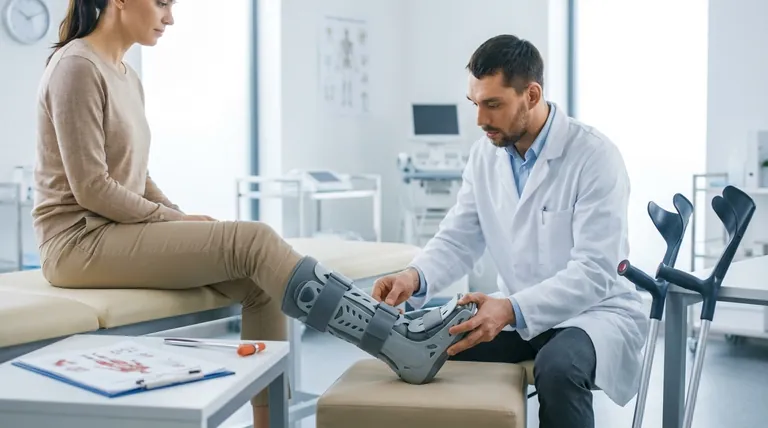
Why Your Doctor's Prescription is Highly Specific
A common mistake is to view a walking boot as a one-size-fits-all solution. In reality, the instructions provided by your physician transform a generic device into a personalized treatment tool. Each element of their recommendation is a calculated decision.
Matching the Boot to the Injury
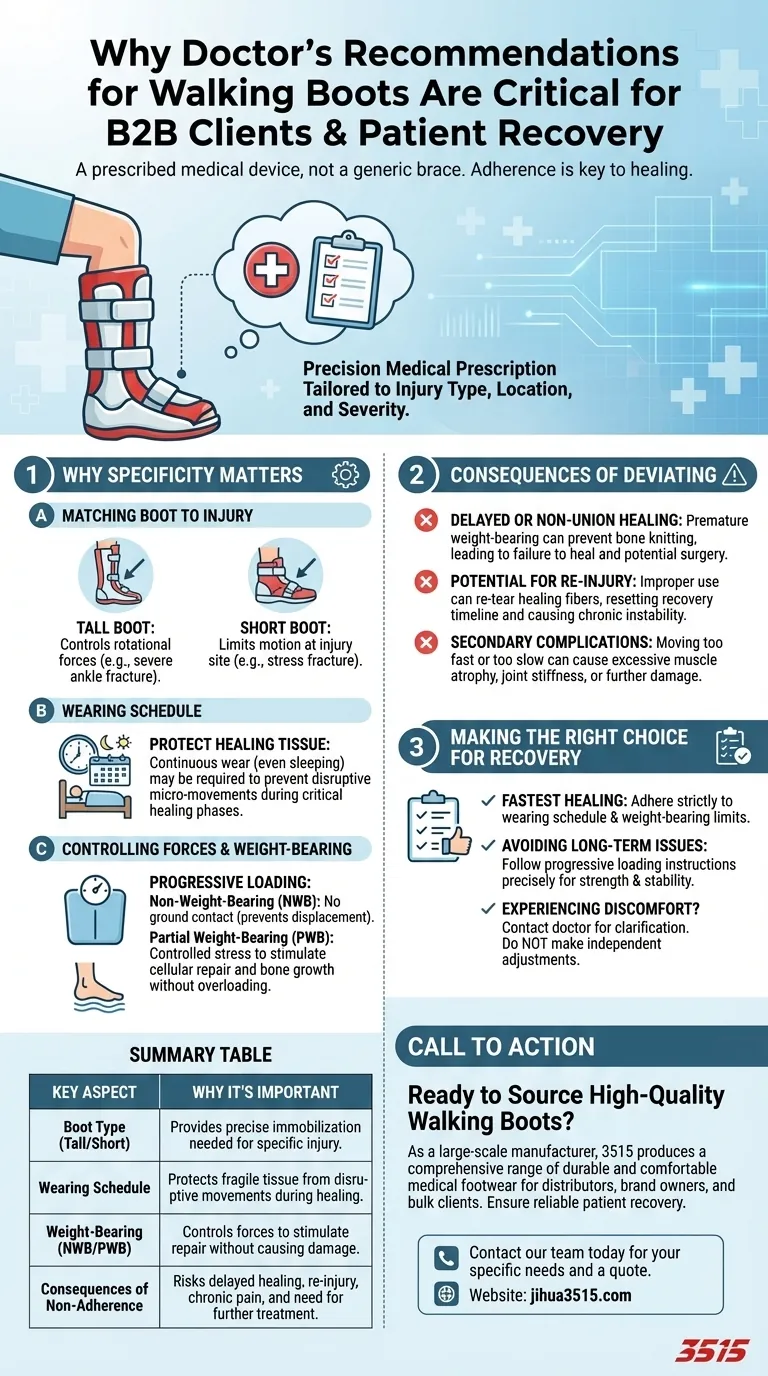
The specific type of boot—whether it's tall or short, with or without an air pump—is chosen to provide a precise level of immobilization.
A severe ankle fracture requires a tall boot to control the rotational forces from the lower leg. In contrast, a stress fracture in the foot might only need a short boot to limit motion at the immediate injury site.
The Critical Role of the Wearing Schedule
The instruction for how long and when to wear the boot is designed to protect the healing tissue from disruptive micro-movements.
For a new fracture or a tendon repair, you will likely be told to wear it continuously, even while sleeping. This constant stabilization prevents shifting that can interrupt the fragile new bone or tissue fibers from forming, which is a critical phase of healing.
Controlling Forces with Weight-Bearing Instructions
Perhaps the most crucial instruction is how much weight you can put on your foot. This is known as progressive loading, and it is essential for stimulating proper healing without causing damage.
Your instructions will be specific:
- Non-weight-bearing (NWB): This means your foot cannot touch the ground at all. It is reserved for severe injuries where any pressure could cause displacement.
- Partial weight-bearing (PWB): You may be told "toe-touch" or a specific percentage of your body weight. This introduces just enough stress to encourage cellular repair and bone growth without overloading the site.
Ignoring these directives is equivalent to disrupting the fundamental biology of the healing process.
The Consequences of Deviating From the Plan
While the boot can be cumbersome, making independent adjustments to your doctor's plan can have serious consequences. The short-term convenience is not worth the long-term risk.
Risk of Delayed or Non-Union Healing
For fractures, putting too much weight on the limb too soon can prevent the bone ends from knitting together. This can lead to a delayed union (slow healing) or a non-union (failure to heal), which may require surgery to correct.
Potential for Re-Injury
For soft tissue injuries like severe sprains or tendon ruptures, improper use can easily re-tear the delicate, healing fibers. This resets your recovery timeline and can lead to chronic instability or weakness.
Creating Secondary Complications
Failing to follow the progressive weight-bearing plan can also cause problems. Moving too slowly can lead to excessive muscle atrophy and joint stiffness, while moving too quickly can cause the issues noted above. The doctor's plan is designed to find the optimal balance.
Making the Right Choice for Your Recovery
Your cooperation is an active and essential part of your treatment. The goal is not just to heal, but to restore function and prevent future problems.
- If your primary focus is the fastest possible healing: Adhere strictly to the prescribed wearing schedule and weight-bearing limits without exception.
- If your primary focus is avoiding long-term complications: Follow the progressive loading instructions precisely, as this is key to rebuilding strength and preventing re-injury.
- If you are experiencing significant pain, discomfort, or confusion: Contact your doctor for clarification immediately instead of making your own adjustments.
Treat your doctor's instructions as the blueprint for your recovery, because that is exactly what they are.
Summary Table:
| Key Aspect | Why It's Important |
|---|---|
| Boot Type (Tall/Short) | Provides the precise level of immobilization needed for your specific injury. |
| Wearing Schedule | Protects fragile new tissue from disruptive movements that can interrupt healing. |
| Weight-Bearing (NWB/PWB) | Controls forces on the injury to stimulate repair without causing damage. |
| Consequences of Non-Adherence | Risks delayed healing, re-injury, chronic pain, and the need for further treatment. |
Ready to source high-quality walking boots for your patients or customers?
As a large-scale manufacturer, 3515 produces a comprehensive range of durable and comfortable medical footwear for distributors, brand owners, and bulk clients. Our production capabilities ensure you receive reliable products that support proper patient recovery.
Contact our team today to discuss your specific needs and receive a quote.
Visual Guide
Related Products
- Durable Goodyear Welt Leather Work Boots for Wholesale & Private Label
- Durable Rubber Sole Outdoor Shoes Wholesale & Custom Manufacturing
- Wholesale Durable Camouflage Canvas Shoes with High-Traction Cleated Rubber Sole
- Wholesale Safety Boots Manufacturer for Custom & Private Label Orders
- Heavy-Duty Waterproof Nubuck Safety Boots Safety Shoes for Bulk Supply
People Also Ask
- What is the difference between full-grain and top-grain leather? Premium Material Guide for Boot Manufacturers
- What are the advantages of leather as an upper material for work boots? Unmatched Durability & Custom Comfort
- Why is it important to waterproof leather work boots? Protect Your Investment and Performance
- How should new leather work boots be broken in? A Guide to Comfort and Durability
- What are the advantages of leather uppers in work boots? Unmatched Durability & Protection

















