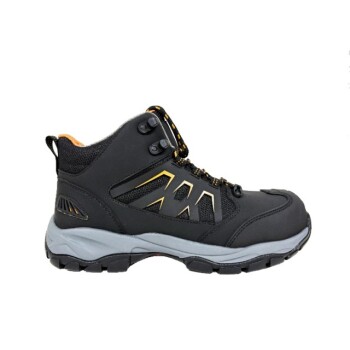
High-load mechanical testing equipment is strictly necessary to replicate the extreme kinetic energy and crushing pressures found in hazardous industrial environments. Standard testing apparatus cannot generate the force required to perform limit-strength testing on steel or composite protective toe caps, which is the only way to scientifically verify they will not collapse under the weight of heavy machinery or falling debris.
High-load testing serves as the critical bridge between theoretical design and life-saving reality. By simulating the "worst-case" stress conditions of heavy industry, this equipment validates that safety footwear meets rigorous industry standards for impact and compression resistance.
Simulating Real-World Extremes
Replicating Industrial Hazards
Safety footwear is designed for environments where the risk of injury is severe, such as construction sites or heavy manufacturing plants. High-load equipment is required to simulate the specific magnitude of forces encountered when heavy objects fall or roll onto a worker's foot.
Limit-Strength Testing
To ensure safety, testing must go beyond normal wear and tear; it must push materials to their breaking point. This equipment performs limit-strength testing, applying massive loads to determine exactly how much force a protective toe cap can withstand before structural failure occurs.
Validating Toe Cap Integrity
Whether the protective cap is made of steel or advanced composites, its structural integrity is non-negotiable. High-load machines apply precise, destructive force to verify that the cap maintains enough clearance to protect the toes during an impact event.
The Mechanics of Verification
Precision Under Pressure
While the forces are high, the application must be precise. Laboratory-grade hydraulic and pressure testing equipment is used to control compression parameters and pressure-holding times down to the millisecond.
Analyzing Resistance Limits
Technical personnel use these machines to analyze the absolute resistance limits of both the toe caps and the soles. This includes testing against compression (crushing) and puncture (penetration) to ensure the foot bones and muscles remain isolated from external mechanical stress.
Objective Quality Control
This testing provides objective, quantifiable data rather than subjective observations. By generating accurate force curves and stress data, manufacturers can certify that every production batch meets the specific safety ratings required by law.
Understanding the Trade-offs
The Cost of Destructive Testing
High-load compression and impact testing is inherently destructive. To verify a batch of footwear, a certain percentage of the product must be sacrificed and destroyed to prove it meets safety standards, representing a necessary operational cost.
Equipment Complexity
Simulating these forces requires complex, heavy-duty hydraulic systems that differ significantly from lighter diagnostic tools. While low-load motors (like BLDC systems) are excellent for testing shoe flexibility and comfort, they lack the torque and power necessary for safety impact certification.
Making the Right Choice for Your Goal
When evaluating safety footwear testing requirements, align your testing protocols with your specific safety objectives.
- If your primary focus is Regulatory Compliance: Prioritize equipment capable of performing standard-defined impact and compression tests on steel and composite toe caps.
- If your primary focus is Product Development: Use high-precision hydraulic systems to determine the exact breaking points of new materials, allowing you to optimize weight versus protection.
- If your primary focus is Quality Assurance: Implement a routine schedule of limit-strength testing to ensure manufacturing consistency across large production volumes.
Reliable safety footwear is not just about design; it is about proven performance under the crushing loads that only high-capacity mechanical testing can certify.
Summary Table:
| Test Type | Equipment Requirement | Objective | Industrial Outcome |
|---|---|---|---|
| Compression Testing | High-Capacity Hydraulic Press | Measures resistance to crushing under heavy machinery. | Prevents toe-crush injuries from rolling loads. |
| Impact Testing | Weighted Drop Tower | Simulates kinetic energy from falling debris. | Validates toe cap structural integrity. |
| Limit-Strength | Destructive Load Sensors | Pushes materials to their absolute breaking point. | Determines safety margins for composite and steel. |
| Puncture Resistance | High-Torque Penetration Probe | Measures force required for a nail to pierce the sole. | Protects the foot from sharp objects on-site. |
Partner with a Manufacturer That Prioritizes Safety Standards
At 3515, we understand that in heavy industry, equipment reliability is the difference between safety and catastrophe. As a large-scale manufacturer serving global distributors and brand owners, we utilize rigorous high-load mechanical testing to ensure every pair of shoes exceeds international safety benchmarks.
Our flagship Safety Shoes series is engineered for maximum protection, complemented by our extensive production capabilities across work and tactical boots, outdoor shoes, training shoes, sneakers, and Dress & Formal footwear.
Ready to elevate your product line with certified safety performance? Contact our expert team today to discuss your bulk requirements and discover how our manufacturing excellence can add value to your brand.
References
- Md Ferdous Alam, Faez Ahmed. From Automation to Augmentation: Redefining Engineering Design and Manufacturing in the Age of NextGen-AI. DOI: 10.21428/e4baedd9.e39b392d
This article is also based on technical information from 3515 Knowledge Base .
Related Products
- Safety Footwear Wholesale Manufacturer for Custom OEM/ODM Production
- Premium Suede Sport Safety Shoes for Wholesale & Bulk Orders
- Wholesale Safety Footwear Manufacturer for Bulk & Custom OEM Orders
- Premium Safety Shoes with Rotating Buckle Safety Sneakers
- Wholesale Anti-Smash & Puncture-Proof Safety Shoes Custom Manufacturing for Brands
People Also Ask
- What are the key OSHA regulations for safety footwear? Ensure Compliance & Protect Your Workforce
- What does a red rectangle with a white C letter on safety footwear mean? Essential Guide to Conductive Footwear
- What is the difference between oil resistance and slip resistance in footwear? Protect Your Boots and Your Safety
- What are the basic requirements of the ASTM F2413-05 standard? Mandatory Impact & Compression Protection
- What are the CSA Group standards for safety footwear in Canada? A Guide to Compliance and Protection