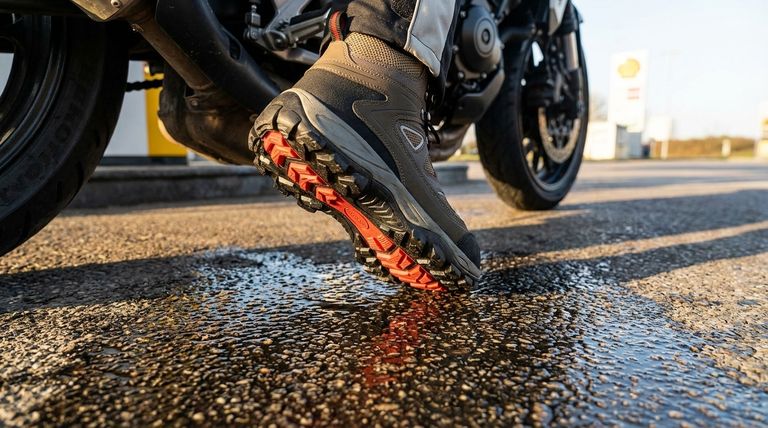
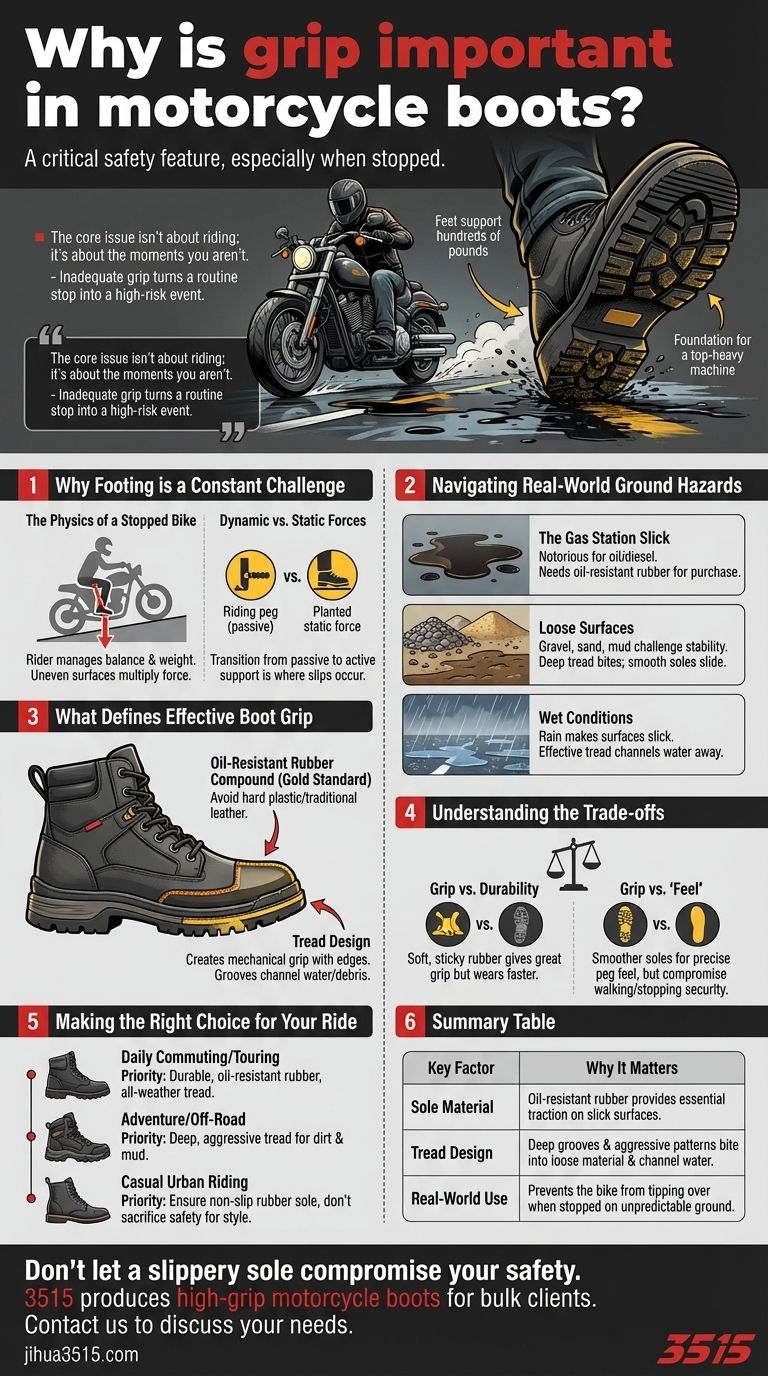
Grip is a critical safety feature on motorcycle boots because your feet are responsible for supporting the entire weight of the motorcycle anytime you are stopped. On unpredictable surfaces like a greasy gas station patch or loose gravel, a slippery sole can easily slide out, causing you to lose your footing and potentially drop the bike.
The core issue isn't about riding; it's about the moments you aren't. When your feet are on the ground, they become the foundation for a top-heavy machine weighing hundreds of pounds, and inadequate grip turns a routine stop into a high-risk event.
Why Footing is a Constant Challenge
A motorcycle is inherently unstable at low speeds and at a standstill. Unlike a car, it relies entirely on the rider for balance, and that connection to the ground is through the soles of your boots.
The Physics of a Stopped Bike
Your feet and legs act as the bike's temporary kickstands at every stoplight and in every parking lot. A slight lean or an uneven surface multiplies the force you must manage. A boot with poor grip cannot provide the stable platform needed to control this weight.
Dynamic vs. Static Forces
While riding, your feet rest on the pegs and are mostly passive. The moment you stop and plant your feet, they must immediately handle the bike's static, downward force. This transition is where a slip is most likely to occur.
Navigating Real-World Ground Hazards
The controlled environment of a showroom floor is nothing like the street. Riders constantly encounter surfaces that are actively working to compromise their footing.
The Gas Station Slick
Gas stations are notorious for oil and diesel spills. These fluids create an incredibly low-friction surface where only a specifically designed, oil-resistant rubber sole can maintain a secure purchase.
Loose Surfaces
Gravel, sand, and mud present a major stability challenge. A boot with a deep, aggressive tread pattern can bite into these loose materials, whereas a smooth or worn-out sole will slide across the top like a ski.
Wet Conditions
Rain makes everything slicker, from asphalt to painted road markings. An effective tread pattern is designed with channels that push water away from the contact point, ensuring the sole material can grip the surface directly.
What Defines Effective Boot Grip
Not all boot soles are created equal. The materials and design are engineered specifically to counteract the hazards of the road.
The Critical Role of Sole Material
The gold standard for motorcycle boots is a high-quality, oil-resistant rubber compound. Hard plastic or traditional leather soles become dangerously slick when exposed to oil or water and should be avoided.
The Importance of Tread Design
A good tread provides mechanical grip by creating edges that can lock onto surface imperfections. Deeper grooves also provide a path for water, mud, and sand to escape, preventing a layer of debris from coming between your boot and the pavement.
Understanding the Trade-offs
Choosing a boot always involves balancing different characteristics. Understanding these compromises allows you to make an informed decision.
Grip vs. Durability
Extremely soft, sticky rubber compounds offer phenomenal grip but may wear down more quickly with frequent walking. Manufacturers work to find a balance that provides safe, reliable traction for a reasonable lifespan.
Grip vs. "Feel" on the Pegs
Some performance-oriented or track-day boots may have a slightly smoother sole. This is designed to allow for tiny, precise foot adjustments on the pegs, but it comes at the cost of walking and stopping security. For street riding, a more defined tread is almost always the safer choice.
Making the Right Choice for Your Ride
Your choice of boot should directly reflect your primary riding environment and goals.
- If your primary focus is daily commuting or touring: Your priority should be a boot with a durable, oil-resistant rubber sole and an all-weather tread pattern for maximum safety.
- If your primary focus is adventure or off-road riding: Look for a very deep and aggressive tread pattern designed to dig into unpredictable surfaces like dirt and mud.
- If your primary focus is casual urban riding: Do not mistake style for safety; ensure your fashion-conscious boots still feature a non-slip rubber sole designed for motorcycling.
Ultimately, proper motorcycle boots provide the stable foundation you need to confidently manage your machine in every situation.
Summary Table:
| Key Factor | Why It Matters |
|---|---|
| Sole Material | Oil-resistant rubber provides essential traction on slick surfaces like gas station spills. |
| Tread Design | Deep grooves and aggressive patterns bite into loose gravel and channel water away in the rain. |
| Real-World Use | Prevents the bike from tipping over when stopped on unpredictable or slippery ground. |
Don't let a slippery sole compromise your safety.
As a large-scale manufacturer, 3515 produces a comprehensive range of high-grip motorcycle boots for distributors, brand owners, and bulk clients. Our production capabilities ensure durable, oil-resistant soles and advanced tread patterns designed for maximum safety on any surface.
Contact us today to discuss your footwear needs and discover how our manufacturing expertise can provide the secure foundation your riders demand.
Visual Guide
Related Products
- Heavy-Duty Goodyear Welted Pull-On Safety Rigger Boot
- Premium Oil Wax Leather Safety Boots for Bulk Purchase
- Wholesale Waterproof Tactical Boots Custom Suede & High-Traction Soles
- Premium High-Cut Waterproof Safety Boots Manufacturing & Wholesale Solutions
- High Performance Fire-Retardant Waterproof Safety Boots
People Also Ask
- What are the key elements of quality boot construction? Ensure Longevity & Performance
- Are Goodyear welted boots worth it? The Ultimate Guide to Lifelong Footwear
- What is a Goodyear welt on a boot? The Secret to Durable, Repairable Footwear
- What makes Goodyear Welt boots suitable for harsh environments? Unmatched Durability & Repairability
- What additional high-quality materials are used in Goodyear Welt boots? A Guide to Advanced Components