
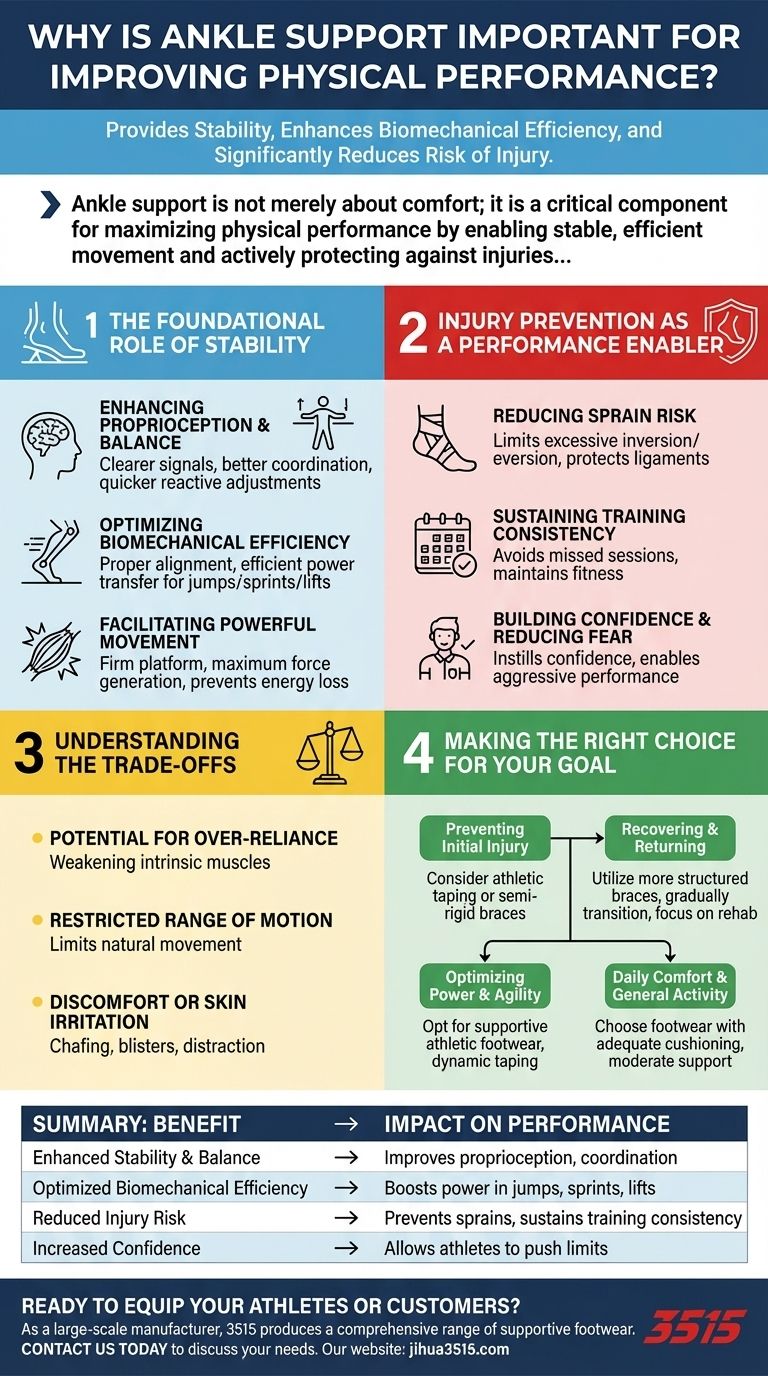
Ankle support is fundamentally important for improving physical performance because it provides crucial stability, enhances biomechanical efficiency, and significantly reduces the risk of injury. By ensuring the foot and ankle complex operates optimally, athletes and active individuals can execute movements with greater power, precision, and confidence, leading to superior outcomes and consistent training. This support allows for sustained participation without the limitations imposed by discomfort or potential injury.
Ankle support is not merely about comfort; it is a critical component for maximizing physical performance by enabling stable, efficient movement and actively protecting against injuries that could otherwise derail progress. It forms the foundation for dynamic activities by optimizing the body's kinetic chain.
The Foundational Role of Ankle Stability in Performance
Optimal physical performance hinges on a stable base. The ankle joint, a complex structure of bones, ligaments, and tendons, is the first point of contact and force transfer for many movements.
Enhancing Proprioception and Balance
Proper ankle support improves the body's proprioception, which is the sense of self-movement, force, and body position. When the ankle is well-supported, the brain receives clearer signals about its position and movement. This leads to better balance and coordination, essential for complex athletic tasks. Increased proprioception allows for quicker reactive adjustments, reducing the likelihood of missteps during dynamic activities.
Optimizing Biomechanical Efficiency
The ankle acts as a critical link in the kinetic chain, transferring forces from the ground up through the body. Effective ankle support ensures proper alignment of the foot and ankle during movement. This alignment allows for more efficient transfer of power, impacting jumping height, running speed, and lifting capacity. Misalignment due to an unstable ankle can dissipate force, leading to reduced performance and increased strain on other joints.
Facilitating Powerful Movement
For activities requiring explosive power, such as jumping, sprinting, or rapid changes in direction, ankle stability is paramount. A stable ankle provides a firm platform for pushing off, allowing muscles in the legs and glutes to generate maximum force. Without adequate support, the ankle can pronate or supinate excessively, absorbing energy that should be directed into the movement.
Injury Prevention as a Performance Enabler
One of the most significant contributions of ankle support to performance improvement is its role in injury prevention. Ankle injuries, particularly sprains, are among the most common in sports and physical activity.
Reducing Sprain Risk
Ankle support, through taping, bracing, or supportive footwear, helps to limit excessive inversion or eversion movements of the ankle. These movements are primary causes of ankle sprains. By restricting these motions, the ligaments are protected from overstretching or tearing.
Sustaining Training Consistency
Avoiding injuries is crucial for continuous performance improvement. Frequent ankle injuries lead to missed training sessions, reduced intensity, and a decline in overall fitness. Consistent, uninterrupted training is a cornerstone of performance enhancement, and ankle support helps maintain this consistency.
Building Confidence and Reducing Fear
Athletes who have experienced ankle injuries often develop a fear of re-injury, which can unconsciously limit their performance. Knowing that the ankle is well-supported can instill confidence, allowing individuals to push their limits without hesitation. This psychological benefit directly translates to more aggressive and effective performance.
Understanding the Trade-offs
While beneficial, it's important to acknowledge that excessive or inappropriate ankle support can have drawbacks.
Potential for Over-Reliance
Constant, rigid ankle support can sometimes lead to a weakening of intrinsic ankle muscles over time. These muscles are vital for natural stability. Therefore, support should be balanced with strengthening exercises.
Restricted Range of Motion
Some forms of rigid support might limit the natural range of motion required for specific movements. This could potentially hinder certain aspects of performance or alter gait mechanics if not chosen carefully.
Discomfort or Skin Irritation
Ill-fitting or poorly chosen ankle support can cause chafing, blisters, or discomfort. This can be a distraction and negatively impact focus and performance during activity.
Making the Right Choice for Your Goal
Selecting the appropriate level of ankle support depends heavily on your specific activity, injury history, and performance objectives.
- If your primary focus is preventing initial ankle injuries in high-risk sports: Consider athletic taping or semi-rigid braces for dynamic stability during training and competition.
- If your primary focus is recovering from a previous ankle injury and returning to activity: Utilize more structured braces initially, gradually transitioning to lighter support and focusing on rehabilitation exercises to rebuild intrinsic strength.
- If your primary focus is optimizing power and agility for competitive performance: Opt for supportive athletic footwear with good ankle collar design, possibly complemented by dynamic taping, ensuring support without excessive restriction.
- If your primary focus is daily comfort and general activity without specific injury concerns: Choose footwear with adequate cushioning and moderate ankle support to maintain overall foot health and prevent fatigue.
Ultimately, proper ankle support is a strategic investment in your body's capabilities, allowing you to train harder, perform better, and stay in the game longer.
Summary Table:
| Benefit | Impact on Performance |
|---|---|
| Enhanced Stability & Balance | Improves proprioception for better coordination and reactive movements. |
| Optimized Biomechanical Efficiency | Ensures proper force transfer, boosting power in jumps, sprints, and lifts. |
| Reduced Injury Risk | Limits excessive ankle motion to prevent sprains and sustain training consistency. |
| Increased Confidence | Allows athletes to push limits without fear of re-injury. |
Ready to equip your athletes or customers with performance-enhancing footwear?
As a large-scale manufacturer, 3515 produces a comprehensive range of supportive footwear for distributors, brand owners, and bulk clients. Our production capabilities encompass all types of high-performance shoes and boots designed with optimal ankle support, stability, and durability in mind.
Contact us today to discuss your specific needs and learn how we can help you deliver superior products that boost performance and prevent injuries.
Visual Guide
Related Products
- Wholesale Leather Ankle Boots with Lug Soles for Custom Brand Manufacturing
- Durable High-Ankle Tactical Boots for Wholesale & Custom Manufacturing
- Durable High-Ankle Tactical Boots Wholesale Manufacturer for Custom & Bulk Orders
- Durable Leather High-Ankle Tactical Boots for Wholesale & Custom Manufacturing
- Wholesale Classic Leather Lace-Up Ankle Boots for Brand Manufacturing
People Also Ask
- What is the difference between full-grain and top-grain leather? Premium Material Guide for Boot Manufacturers
- What are the key qualities of leather for work boots? Superior Durability, Breathability & Custom Fit
- What is the complete process for deep cleaning leather work boots? A Step-by-Step Guide to Preserve Your Investment
- What are the advantages of leather uppers in work boots? Unmatched Durability & Protection
- How should new leather work boots be broken in? A Guide to Comfort and Durability







