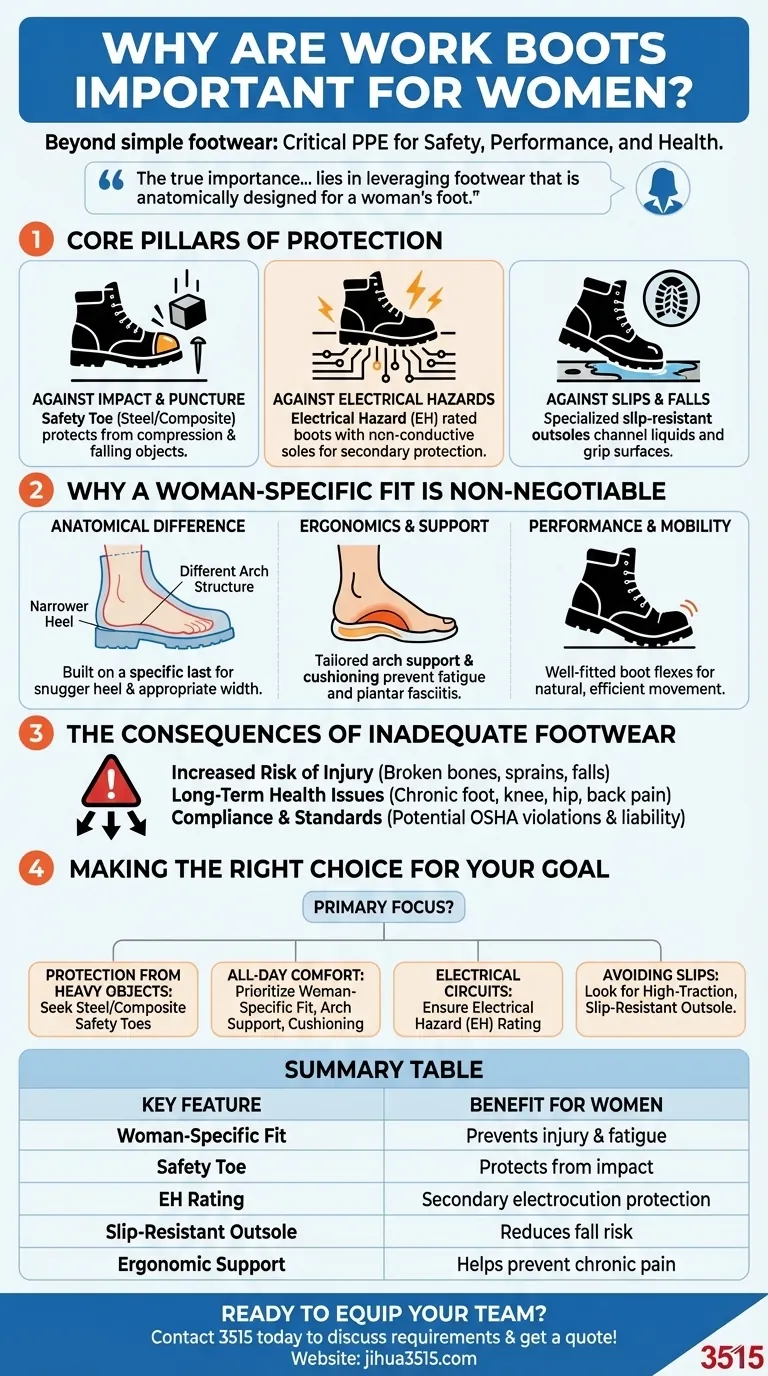
Beyond being simple footwear, women's work boots are a critical piece of personal protective equipment (PPE) specifically engineered for safety, performance, and health. They provide essential protection from workplace hazards like falling objects and electrical currents while offering a superior fit tailored to the anatomical structure of a woman's foot, which prevents injury and ensures all-day comfort.
The true importance of women's work boots lies not just in meeting safety regulations, but in leveraging footwear that is anatomically designed for a woman's foot. This specific engineering is what maximizes safety, prevents chronic injury, and enhances on-the-job performance.
The Core Pillars of Protection
Work boots serve as the first line of defense against a wide range of common workplace hazards. Their protective features are not optional add-ons; they are fundamental to preventing serious injury.
Against Impact and Puncture
The most recognized feature of a work boot is the safety toe. These are typically made of steel or lighter composite materials.
This reinforced toe cap is designed to protect the foot from compression and impact caused by falling objects, a common risk in construction, manufacturing, and warehouse environments.
Against Electrical Hazards
For electricians, maintenance workers, and others working near live circuits, Electrical Hazard (EH) rated boots are essential.
These boots are constructed with non-conductive materials in the sole and heel to provide a secondary source of protection against accidental electrocution.
Against Slips and Falls
Slips, trips, and falls are among the most frequent causes of workplace injuries.
Work boots feature specialized slip-resistant outsoles with tread patterns designed to channel away liquids and grip securely on wet, oily, or uneven surfaces.
Why a Woman-Specific Fit is Non-Negotiable
Simply wearing a smaller size of a man's boot is insufficient and can be dangerous. Women's feet have distinct anatomical differences, and proper footwear accounts for these to ensure both safety and comfort.
The Anatomical Difference
Compared to men's feet, women's feet are typically narrower, particularly in the heel, and have a different arch structure.
Boots designed for women are built on a different last (the mold used to shape the boot), providing a snugger heel fit to prevent slippage and a more appropriate width to avoid internal foot movement.
The Role of Ergonomics and Support
A proper fit directly translates to better ergonomic support. Features like dedicated arch support and cushioning are tailored to a woman's typical gait and pressure points.
This support is crucial for preventing fatigue and chronic conditions like plantar fasciitis, especially for those who spend long hours on their feet.
Impact on Performance and Mobility
Poorly fitting boots can significantly hinder job performance. Boots that are too loose can cause blisters and instability, while boots that are too tight can restrict circulation and movement.
A well-fitted boot flexes properly at the ball of the foot, allowing for natural, efficient movement and reducing the energy needed to perform daily tasks.
The Consequences of Inadequate Footwear
Choosing the wrong footwear, or ignoring the need for it, introduces significant and unnecessary risks that extend beyond simple discomfort.
Increased Risk of Injury
Without the correct protective features, feet are vulnerable to a host of injuries, including broken bones, deep cuts, burns, and punctures.
An improper fit also dramatically increases the risk of ankle sprains and falls, as the foot is not properly secured within the boot.
Long-Term Health Issues
Wearing ill-fitting boots day after day can lead to chronic pain in the feet, knees, hips, and back. The body is an interconnected system, and improper foot support can misalign your entire posture.
Compliance and Workplace Standards
Many industries have regulations mandated by bodies like the Occupational Safety and Health Administration (OSHA) that require specific types of foot protection.
Failure to wear compliant footwear can not only endanger the worker but also create liability for the employer.
Making the Right Choice for Your Goal
To select the best boot, align its primary features with the most significant risks and demands of your specific work environment.
- If your primary focus is protection from heavy objects: Seek out boots with certified steel or composite safety toes that meet impact resistance standards.
- If your primary focus is all-day comfort and preventing fatigue: Prioritize a true woman-specific fit with excellent arch support and cushioning.
- If your primary focus is working around live circuits: Ensure the boots are explicitly marked with an Electrical Hazard (EH) rating.
- If your primary focus is avoiding falls on slippery floors: Look for boots with a certified, high-traction, slip-resistant outsole.
Investing in the right work boots is a direct investment in your personal safety, daily comfort, and professional capability.
Summary Table:
| Key Feature | Benefit for Women |
|---|---|
| Woman-Specific Fit | Snug heel, proper width, and arch support prevent injury and fatigue. |
| Safety Toe (Steel/Composite) | Protects feet from impact and compression from falling objects. |
| Electrical Hazard (EH) Rating | Provides secondary protection against electrocution. |
| Slip-Resistant Outsole | Reduces risk of slips and falls on wet or oily surfaces. |
| Ergonomic Support | Tailored cushioning helps prevent chronic pain in feet, knees, and back. |
Ready to equip your team with high-performance, safety-compliant footwear?
As a large-scale manufacturer, 3515 produces a comprehensive range of work boots for distributors, brand owners, and bulk clients. Our production capabilities encompass all types of safety footwear, including women's boots engineered for superior protection and an anatomical fit.
We can help you source or customize the perfect boots to meet your specific safety standards and comfort needs.
Contact 3515 today to discuss your requirements and get a quote!
Visual Guide
Related Products
- Wholesale Leather Work Boots with Customizable Wedge Sole for Brands
- Durable Leather Work Boots for Wholesale & Custom Manufacturing
- Durable Leather Moc Toe Work Boots for Wholesale & Custom Manufacturing
- Durable Leather Work Boots for Wholesale & Custom OEM Manufacturing
- Durable Moc Toe Wedge Sole Work Boots for Wholesale and Private Label
People Also Ask
- What is the difference between full-grain and top-grain leather? Premium Material Guide for Boot Manufacturers
- What are the advantages of leather as an upper material for work boots? Unmatched Durability & Custom Comfort
- How can leather work boots be protected from environmental elements? A 3-Step Guide to Lasting Durability
- What is the complete process for deep cleaning leather work boots? A Step-by-Step Guide to Preserve Your Investment
- What are the key qualities of leather for work boots? Superior Durability, Breathability & Custom Fit